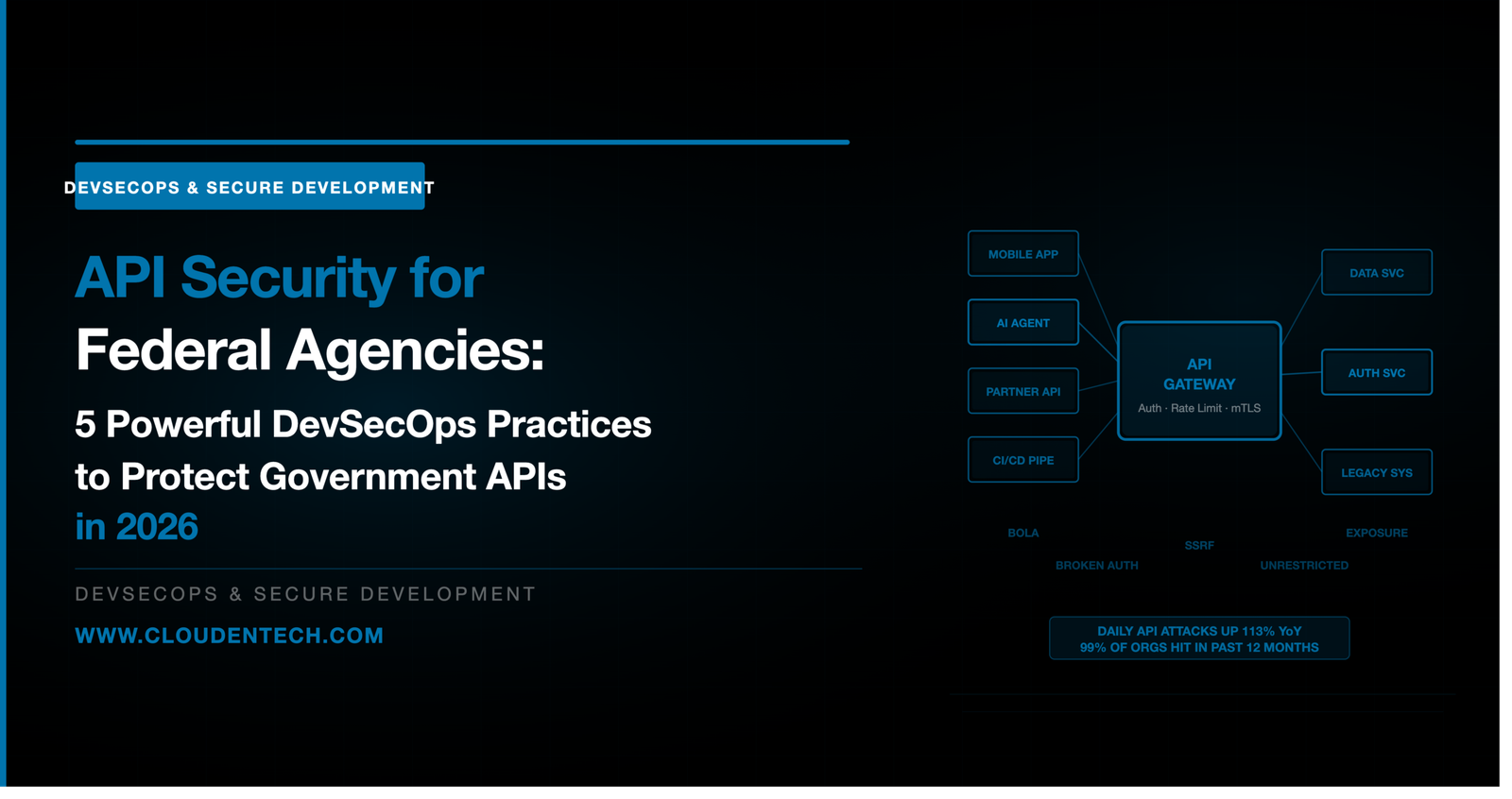
API security for federal agencies has become the most rapidly deteriorating attack surface in government IT. The statistics from 2025 and 2026 are unambiguous: APIs are the preferred attack vector for adversaries targeting government systems, and the pace of attack is accelerating faster than most federal security programs have recognized.
Average daily API attacks per organization rose 113 percent year-over-year, from 121 to 258 attacks per day. Ninety-nine percent of organizations encountered API security problems in the past 12 months. Behavior-based attacks — unauthorized workflows exploiting legitimate API functions — accounted for 61 percent of API attacks in 2025, up from 30 percent in 2024. In 2025, APIs accounted for 17 percent of all published security bulletins, making them one of the largest single vulnerability surfaces in modern software. AppSec SantaAppSec Santa
For federal agencies, these numbers are not abstract industry statistics. They describe the threat environment that every agency API — every REST endpoint serving a citizen-facing application, every data exchange between agency systems, every AI agent calling a government data service, every partner integration with a federal platform — operates in every day.
APIs are the connective tissue of modern federal IT. They enable cross-agency data sharing under the EVIDENCE Act, they power the mobile and web applications through which citizens interact with government services, they provide the programmatic interfaces through which AI capabilities consume agency data, and they interconnect the microservices architectures that DevSecOps programs build to replace legacy monolith applications. Every one of those functions depends on APIs that are correctly designed, properly authenticated, continuously monitored, and tested against the attack patterns that adversaries are actively using right now.
This post covers the specific API security requirements that federal agencies must address, what the OWASP API Security Top 10 means for government application developers and security teams, and the five DevSecOps practices that transform API security from a periodic assessment activity into a continuous, integrated discipline.
Why API Security Is a Distinct and Critical Federal Security Domain
API security is not a subset of application security or network security. It is its own discipline with its own attack taxonomy, its own testing methodology, and its own governance requirements. APIs have become the preferred attack surface. Most API vulnerabilities are trivial to exploit, and attackers know it. AppSec Santa
The reason APIs are uniquely vulnerable is structural. Traditional web application security focused on protecting the user interface layer — the web pages that humans interact with. APIs expose the same underlying business logic and data that web applications use, but through machine-readable interfaces that are designed for programmatic access. That programmatic access is what makes APIs valuable and what makes them dangerous.
An attacker targeting a government web application must understand the user interface, navigate its controls, and work around browser-enforced protections. An attacker targeting a government API can enumerate endpoints, test authentication boundaries, probe authorization logic, and craft malicious payloads programmatically, at machine speed, with automated tools. The attack surface is more accessible, the exploitation is more automatable, and the potential for harvesting sensitive data at scale is significantly higher than through traditional web application attack vectors.
Behavior-based attacks accounted for 61 percent of API attacks in 2025, up from 30 percent in 2024. This shift is significant. Traditional API attacks exploited technical vulnerabilities — SQL injection through API parameters, authentication bypass through token manipulation. Behavior-based attacks exploit legitimate API functionality in unauthorized ways — using a data retrieval endpoint as designed, but calling it repeatedly with different identifiers to enumerate records that the calling party should not be able to access. These attacks do not trigger traditional vulnerability scanners because they use correctly formed, technically valid API calls. They can only be detected through behavioral analysis that identifies unauthorized access patterns. AppSec Santa
For federal agencies, the behavior-based attack shift has a specific implication. Only 27.3 percent of organizations deploy Content-Security-Policy, and CORS misconfigurations remain common. Federal agencies that have invested in perimeter defenses and vulnerability scanning but have not implemented API behavioral monitoring are defending the wrong surface with the wrong tools. AppSec Santa
The OWASP API Security Top 10: What Federal Developers Must Know
The OWASP API Security Top 10 is the authoritative consensus list of the most critical API security risks. The current authoritative list as of mid-2026 remains the OWASP API Security Top 10 2023. For federal application developers and security architects, this list defines the vulnerability classes that must be addressed in every government API — not as a compliance checklist but as a practical threat model derived from analysis of real-world API breaches. Axway
According to Wallarm’s analysis of 60 API breaches in 2025, broken authentication caused 52 percent of incidents. OWASP’s API Security Top 10 lists Broken Object Level Authorization (BOLA) as the number one risk, followed by Broken Authentication. AppSec Santa
Broken Object Level Authorization is the most pervasive and most consequential API vulnerability in government environments. BOLA tops the list because it is easy to exploit (just swap an ID), hard to detect (stateful — scanners without auth context miss it), and bypasses traditional defenses (WAFs cannot know your ownership model). In a federal application, BOLA means that an authenticated API caller can access data objects belonging to other users or organizations by manipulating object identifiers in the request. A benefits applicant who can access another applicant’s case file by incrementing a case number in an API call is exploiting a BOLA vulnerability. A contractor who can retrieve another organization’s contract details by changing a contract ID parameter is exploiting BOLA. Chs
Broken Authentication allows attackers to access APIs without valid credentials or with credentials that should not grant access. For federal APIs, this includes inadequate token validation, weak API key implementations, missing authentication on endpoints that are assumed to be internal-only, and authentication bypass techniques that work against poorly implemented OAuth or SAML flows.
Broken Object Property Level Authorization allows attackers to read or modify object properties that they should not have access to. A federal API that returns a complete user record including sensitive administrative fields to any authenticated caller, when only administrators should see those fields, has a property-level authorization failure even if the object-level authorization is correct.
Unrestricted Resource Consumption — previously Lack of Resources and Rate Limiting in the earlier OWASP list — allows attackers to exhaust API capacity through high-volume requests, causing denial of service for legitimate users. For federal agencies serving mission-critical services through APIs, denial of service through resource exhaustion is as consequential as data exfiltration.
Server-Side Request Forgery through API parameters allows attackers to cause the server to make requests to internal resources on their behalf. In a federal cloud environment, SSRF through API endpoints can expose internal metadata services, internal network services, and cloud provider management endpoints that are not directly accessible to external attackers.
OWASP released a dedicated Top 10 for Agentic Applications in March 2026 covering goal hijacking and insecure inter-agent communication. AI agents introduce a new attack surface — MCP vulnerabilities grew 270 percent between Q2 and Q3 2025, and AI-specific API CVEs jumped from 19 to 34 in a single quarter. As federal agencies deploy AI copilots and autonomous workflow agents that call government APIs, the specific vulnerabilities that affect agentic API consumers must be addressed in API security architecture from the design stage. Chs
The Federal API Security Compliance Landscape
Federal API security requirements emerge from multiple overlapping policy frameworks that must be addressed simultaneously rather than sequentially.
OMB Memorandum M-23-22, “Delivering a Digital-First Public Experience,” establishes requirements for how federal agencies expose digital services to the public, including API design standards and security requirements for citizen-facing digital services. The Federal API Strategy and the Digital Experience Council’s API standards reference security requirements that align to NIST guidelines and FedRAMP requirements for any API hosted on cloud infrastructure.
NIST SP 800-53 Rev 5 includes specific controls applicable to API security within the Access Control, System and Communications Protection, and Identification and Authentication control families. AC-3 (Access Enforcement) directly addresses the authorization logic that prevents BOLA vulnerabilities. IA-3 (Device Identification and Authentication) applies to machine-to-machine API authentication. SC-5 (Denial of Service Protection) applies to rate limiting and resource consumption controls. These controls are not optional additions to a federal ATO — they are mandatory requirements that the system security plan must document and that the ATO assessment must verify are implemented.
FedRAMP requirements for cloud-hosted APIs add specific continuous monitoring obligations. API security events — authentication failures, authorization violations, rate limit breaches, anomalous request patterns — must be captured in the agency’s security information and event management infrastructure and reviewed as part of the continuous monitoring program. APIs that are not producing security telemetry are not being monitored and therefore cannot satisfy FedRAMP continuous monitoring requirements.
The NIST Secure Software Development Framework under EO 14028 and EO 14306 requires that API security be addressed throughout the development lifecycle, not only through post-deployment testing. This means threat modeling for API attack surfaces at the design phase, SAST scanning for API authentication and authorization patterns at the code review phase, and DAST testing that specifically validates OWASP API Security Top 10 vulnerability classes at the pre-production phase.
5 Powerful DevSecOps Practices to Protect Federal Government APIs
Practice 1: Build API Inventory and Discovery Before Any Security Program Can Be Effective
The prerequisite for every other API security practice is knowing what APIs exist. Federal agencies that have grown their API portfolio through years of application development, third-party integrations, and cloud migration often have significant undocumented API surface area — endpoints that were created for specific integrations and never formally inventoried, internal APIs that were assumed to be safe because they were not externally accessible, and legacy APIs that continued operating after the applications they originally served were decommissioned.
Shadow APIs — undocumented, unmonitored, and unprotected endpoints — are among the most dangerous elements of a federal API portfolio. They cannot be tested because they are not in the test plan. They cannot be monitored because they are not in the monitoring configuration. And they often run older, less secure code versions because they are not in the patch management program.
Building a complete API inventory requires a combination of active discovery — scanning network traffic and cloud environments for API endpoints that are accepting requests — and documentation review against actual deployed configurations. The inventory must capture every endpoint, its authentication mechanism, its authorization model, the data it exposes or accepts, its compliance classification, and its owner. This inventory is the asset register for API security programs, and it must be maintained as a continuously updated, living document rather than a point-in-time assessment artifact.
For federal agencies operating under FedRAMP, the API inventory is also an authorization boundary documentation requirement. Every API that processes federal data must be within an authorized system boundary, and the security controls documented in the system security plan must accurately describe how that API authenticates callers, authorizes access, and protects the data it handles.
Practice 2: Implement Zero Trust Authentication and Authorization at Every API Endpoint
According to NIST Special Publication 800-207, architecture must verify communication between every single component with the same rigor applied to a human user. No entity — human or machine — gets a free pass based on where it is sitting on the network. Applied to API security, this principle means that every API endpoint must authenticate every caller and authorize every request, regardless of where that request originates. Nhimg
The common failure pattern in federal API security is the trusted internal caller assumption. An API that requires strong authentication from external callers but allows unauthenticated or weakly authenticated access from internal network addresses is not implementing zero trust — it is implementing the perimeter security model that zero trust explicitly replaces. Any service running inside the network perimeter that is compromised can then call internal APIs without authentication, with the full access that the internal caller assumption provides.
OAuth 2.1 is the current recommended standard for API authentication in federal environments, superseding OAuth 2.0 and eliminating several insecure grant types that created vulnerabilities in earlier implementations. For machine-to-machine API authentication — the service-to-service calls that constitute the majority of API traffic in modern federal architectures — Client Credentials Flow with short-lived tokens and mutual TLS provides the authentication assurance that zero trust requires.
Authorization at the object level — the control that prevents BOLA vulnerabilities — must be implemented by verifying that the authenticated caller has specific permission to access the specific object being requested, not just that they have general permission to call the endpoint. An API that authenticates a caller successfully and then returns any object they request based on an ID parameter without verifying that the caller owns or has been explicitly granted access to that specific object has correct authentication and broken authorization. Fixing BOLA requires implementing row-level or object-level access control checks in every endpoint that returns or modifies individual data records.
For AI agent API consumers, OAuth 2.1 with Proof Key for Code Exchange and fine-grained, resource-specific, least-privilege access scopes is the recommended authentication and authorization model. The Model Context Protocol Authorization Specification, finalized in June 2025, defines how AI agents should authenticate to APIs and request access to specific resources with appropriate scope limitations. Federal APIs that will be consumed by AI agents must implement MCP-compatible authentication and authorization to prevent the goal hijacking and unauthorized workflow attacks that the OWASP Agentic Applications Top 10 addresses.
Practice 3: Deploy API-Specific Security Testing in the Development Pipeline
Standard SAST and DAST tools that are not specifically configured for API security testing produce incomplete coverage of the OWASP API Security Top 10 vulnerability classes. Static application security testing tools can analyze source code to detect vulnerabilities early in API development, while dynamic application security testing tools test an API at runtime by attempting to exploit vulnerabilities from an attacker’s perspective. But both tools must be configured with API-specific rules and test cases to be effective against the vulnerability classes that are most prevalent in API environments. CyCognito
API-specific SAST rules should check for authentication bypass patterns in API handler code, missing object-level authorization checks in data retrieval endpoints, exposed sensitive data fields in API response schemas, SQL injection and injection vulnerabilities in API parameter handling, and insecure direct object reference patterns where user-supplied identifiers are used to retrieve records without ownership validation.
API-specific DAST testing — also called API fuzzing or API security testing — tests running API endpoints by generating and sending requests designed to trigger vulnerability classes. Effective API DAST for federal applications must include authentication context so that authorization vulnerabilities are tested from the perspective of an authenticated caller, not just an unauthenticated attacker. BOLA testing requires authenticated requests with manipulated object identifiers. Broken authentication testing requires attempts to bypass token validation, extend expired tokens, and use tokens in contexts they were not issued for.
Fifty-five percent of organizations slowed the rollout of a new application due to API security concerns. For federal agencies where ATO reviews can delay deployment by months, integrating API security testing into the development pipeline — producing findings continuously during development rather than as a pre-ATO assessment gate — dramatically reduces the security-related delays that slow mission capability delivery. API security findings caught in sprint review take hours to fix. The same findings caught in ATO assessment take weeks of documentation, remediation, and re-assessment. AppSec Santa
Practice 4: Implement API Gateway Enforcement and Rate Limiting
An API gateway positioned between API consumers and backend services provides a centralized enforcement point for security policies that would otherwise need to be implemented redundantly in every API service. For federal agencies operating multiple APIs across a complex microservices architecture, the API gateway is the most efficient mechanism for enforcing authentication requirements, rate limiting, request validation, and audit logging as organization-wide policies rather than service-specific implementations.
At minimum, a federal API gateway should enforce authentication requirements by rejecting requests that do not present valid credentials before forwarding to backend services, validate request format and schema to reject malformed requests that exploit injection vulnerabilities, implement rate limiting that prevents resource exhaustion attacks from high-volume request flooding, add security headers to API responses that prevent browser-based attacks, and produce centralized audit logs of all API requests with authentication context, response status, and timing data.
Rate limiting in federal API environments must be calibrated to mission requirements. A too-restrictive rate limit that blocks legitimate high-volume use cases — batch data processing, authorized monitoring tools, licensed data feed consumers — creates mission disruption. A too-permissive rate limit that allows attackers to enumerate data records through BOLA attacks at thousands of requests per minute provides no protection. Rate limiting must be designed with knowledge of the expected usage patterns for each API, with the ability to apply different limits to different caller types — human users, service accounts, partner integrations, and AI agents all have different legitimate usage patterns that require different rate limit configurations.
For AI agent API consumers specifically, rate limiting must account for the autonomous, high-volume nature of agent workflows. An AI agent processing a batch of documents may legitimately generate more API requests per minute than a human user ever would. Rate limiting that treats all API callers identically will either block legitimate AI workloads or provide no meaningful protection against automated attacks. Fine-grained rate limiting that identifies and separately governs AI agent callers is the governance model that federal APIs serving AI workloads require.
Practice 5: Implement Continuous API Behavioral Monitoring and Anomaly Detection
Behavior-based attacks accounted for 61 percent of API attacks in 2025, up from 30 percent in 2024. This means that the majority of API attacks against federal systems in 2026 cannot be detected through signature-based security tools or vulnerability scanning. They can only be detected through behavioral analysis that identifies unauthorized access patterns in technically valid API traffic. AppSec Santa
Continuous API behavioral monitoring establishes baseline usage patterns for every endpoint and every authenticated caller, and detects deviations from those baselines that indicate attack activity. A caller that has been making 10 to 20 API requests per hour suddenly making 500 requests per minute is exhibiting an anomalous usage pattern that warrants investigation, regardless of whether the individual requests are technically valid. A caller that has historically accessed only their own organization’s data records and suddenly begins requesting records belonging to other organizations is exhibiting a BOLA attack pattern, even if each individual request is correctly authenticated.
What has changed is execution speed and scale. Agentic workflows turn small authorization gaps, logic flaws, and inventory blind spots into continuous, automated attack paths. API security in 2026 is not about finding more vulnerabilities. It is about preventing classes of failure that machines can exploit relentlessly. Aptori
For federal agencies, API behavioral monitoring must produce alerting that is integrated with the agency’s security operations center rather than operating as a standalone API security tool. API security events must be correlated with identity events, network security events, and application security events to provide the complete incident picture that security analysts need to respond effectively. An API authorization anomaly that is investigated independently from the identity events that preceded it may miss the credential compromise that enabled the API attack in the first place.
API behavioral monitoring is also the mechanism through which federal agencies can detect AI agent behavior that has been compromised or misbehaved. An AI agent that begins accessing data outside its designated scope, calling API endpoints it was not configured to use, or producing unusually large data transfer volumes is exhibiting behavioral anomalies that behavioral monitoring can detect even when each individual API call is technically authenticated and authorized.
The AI Agent API Security Challenge Federal Agencies Must Address Now
AI agents introduce a new attack surface. The Wallarm 2026 API ThreatStats Report found MCP vulnerabilities grew 270 percent between Q2 and Q3 2025, and AI-specific API CVEs jumped from 19 to 34 in a single quarter. Chs
Federal agencies deploying AI agents that call government APIs face a security challenge that the OWASP API Security Top 10 — written before agentic AI was a significant federal deployment reality — does not fully address. The OWASP Top 10 for Agentic Applications, released in March 2026, covers the specific vulnerability classes that affect AI agent API consumers: goal hijacking, where adversarial inputs cause an agent to pursue unauthorized objectives; insecure inter-agent communication, where trust relationships between agents can be exploited; and privilege escalation through delegation chains, where agents acting on behalf of users accumulate permissions that exceed what either the agent or the user should individually have.
For federal agencies building AI-enabled applications that call government APIs, these vulnerability classes must be addressed in the API security architecture from the design stage. Each AI agent must have a unique, auditable identity with specific, documented API access permissions. Agent delegation chains — where an AI agent acts on behalf of a human user — must implement proper scope limitation so that the agent cannot access resources that the human user themselves could not directly access. And agent behavior must be continuously monitored against expected task boundaries, with automated alerting when agent API usage deviates from its defined scope.
How ClouDen Technologies Supports Federal API Security
At ClouDen Technologies, our application development practice designs federal APIs with security built into the architecture from the first endpoint specification — implementing OWASP API Security Top 10 mitigations, zero trust authentication and authorization, and the audit logging infrastructure that FedRAMP continuous monitoring requires as standard elements of every API we build for government environments.
Our DevSecOps services integrate API-specific security testing into federal development pipelines — including API SAST rule sets tuned for BOLA and authentication bypass patterns, API DAST testing configured with authentication context that tests authorization logic rather than just perimeter controls, and the automated compliance artifact generation that produces the API security evidence that ATO packages require.
Our cybersecurity services provide the API security architecture review, threat modeling, and continuous monitoring integration that connect API security controls to the broader security posture that agencies must maintain across their full IT environment. Our cloud solutions practice implements the FedRAMP-authorized API gateway and WAF infrastructure that provides centralized authentication enforcement, rate limiting, and behavioral monitoring for federal API portfolios.
As an SBA-certified 8(a) small business operating under ISO 27001:2022, ISO 9001:2015, and ISO/IEC 20000-1:2018, we bring the security governance and development discipline that federal API security demands at every level — from the individual endpoint authorization logic to the enterprise-wide API behavioral monitoring program.
If your agency is assessing its API security posture, implementing zero trust API authentication, building API security testing into your development pipeline, or addressing the specific security requirements of AI agent API consumers, contact ClouDen Technologies today.
Key Takeaways
API security for federal agencies addresses the fastest-growing attack surface in government IT. Daily API attacks rose 113 percent year-over-year in 2026, behavior-based attacks now account for 61 percent of all API incidents, and 99 percent of organizations report API security problems in the past 12 months.
The OWASP API Security Top 10 (2023 edition, current as of mid-2026) defines the most critical vulnerability classes: Broken Object Level Authorization, Broken Authentication, Broken Object Property Level Authorization, Unrestricted Resource Consumption, and Server-Side Request Forgery are the highest-priority risks for federal application teams.
BOLA is the number one federal API risk. It is easy to exploit (swap an ID in the request), hard to detect (scanners without authentication context miss it), and bypasses traditional defenses (WAFs cannot know an application’s ownership model). Fixing BOLA requires object-level authorization checks — verifying that the authenticated caller owns or has been granted access to the specific object being requested, not just that they have permission to call the endpoint.
Behavior-based attacks that exploit legitimate API functions in unauthorized ways cannot be detected through vulnerability scanning. They require continuous behavioral monitoring that establishes usage baselines and alerts on deviations, integrated with the agency’s security operations center.
The five practices are: build a complete API inventory including shadow API discovery, implement zero trust authentication and authorization at every endpoint, deploy API-specific SAST and DAST testing in the development pipeline, implement API gateway enforcement and rate limiting, and deploy continuous API behavioral monitoring and anomaly detection.
AI agent API consumers represent a new and rapidly growing vulnerability class. MCP vulnerabilities grew 270 percent between Q2 and Q3 2025. Federal agencies deploying AI agents that call government APIs must address the OWASP Top 10 for Agentic Applications alongside the standard API Security Top 10.
About ClouDen Technologies
ClouDen Technologies is an SBA-certified 8(a) small business delivering cloud, cybersecurity, DevSecOps, enterprise architecture, application development, and management services to U.S. federal agencies, educational institutions, and commercial organizations. ClouDen operates under ISO 9001:2015, ISO/IEC 20000-1:2018, and ISO/IEC 27001:2022.