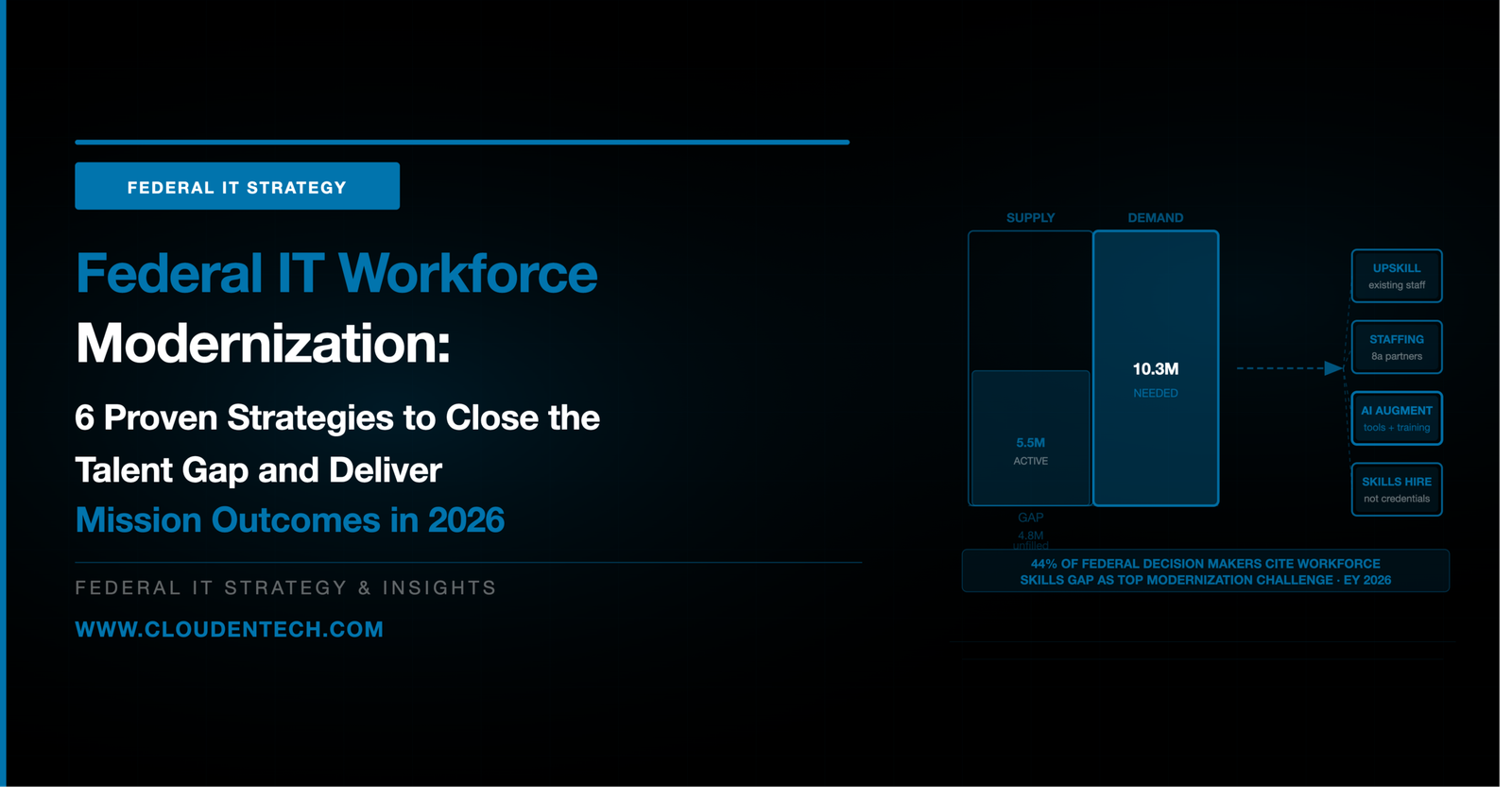
Federal IT workforce modernization is the most consequential and least technology-dependent challenge in government IT in 2026. The 2026 EY Federal Trends Report, based on a survey of 131 federal decision makers, states it directly: one of the most critical bottlenecks to federal goals for modernization, efficiency, and scaling AI is not a technological gap but a human capital gap. Forty-four percent of federal decision makers surveyed by EY cite workforce skill gaps as the top challenge to modernizing federal IT infrastructure.
The numbers behind that finding are specific. The global cybersecurity workforce gap has grown to 4.8 million unfilled roles globally, with the United States accounting for a disproportionate share of the shortage. Seventy-eight percent of government respondents and 76 percent of military respondents in an ISC2 survey noted they face cybersecurity staffing shortages — tied for first and second by industry across all sectors. The global IT skills shortage is predicted to impact 90 percent of organizations by 2026.
In a September 2026 Federal News Network commentary, federal IT leaders put the challenge in operational terms: the government’s tech gap is about capacity, not just budget. The GAO continues to identify cybersecurity workforce shortages as a government-wide challenge. In a January 2025 report, GAO found that while agencies recognize recruiting and retaining cyber talent as a critical issue, many have implemented fewer than half of the key workforce planning practices needed to address those shortages, recommending 23 improvements to strengthen workforce planning and evaluation.
The talent gap is now a critical operational risk. Some contractors are winning federal projects they cannot staff due to a severe shortage of specialized expertise. There is a particularly acute need for professionals who have both high-level AI skills and the necessary top-secret security clearances for federal work. As federal programs move from AI experimentation to AI deployment, from zero trust planning to zero trust enforcement, and from cloud migration to cloud optimization, the workforce required to execute those programs at the speed federal mandates demand simply does not exist at the scale agencies need.
This post covers the specific dimensions of the federal IT workforce challenge in 2026, why hiring alone cannot solve it, and the six proven strategies that federal agencies and their management services partners are using to close the gap and deliver mission outcomes.
The Scale of the Federal IT Workforce Crisis
Understanding the federal IT workforce challenge requires separating it from the general statement that there is a cybersecurity talent shortage. The shortage is real and global, but federal agencies face additional constraints that make their version of the problem structurally harder than the challenge commercial employers face.
Federal IT compensation consistently lags private sector salaries for equivalent technical roles. A federal cybersecurity analyst with five years of experience and relevant certifications earns significantly less than a counterpart in financial services, defense contracting, or technology. This compensation gap has widened as private sector AI and cloud roles have escalated in salary, while federal pay scales have moved more slowly. The result is that federal agencies compete for the same talent pool with a structural compensation disadvantage that cannot be quickly resolved through normal budget processes.
Federal hiring timelines are a second structural constraint. The civil service hiring process — position classification, job posting, application review, interviews, background investigation, and onboarding — can take six to eighteen months for technical positions. For positions requiring security clearances, that timeline extends further. A federal agency that identifies a cybersecurity skills gap today cannot fill it through the normal hiring process before the end of FY2027.
The clearance requirement itself is a third constraint. AI roles at national security agencies require both specialized technical skills and active Top Secret or TS/SCI clearances. That intersection of requirements reduces the eligible candidate pool dramatically. Some agencies are finding that the cleared AI talent market is effectively exhausted at current compensation levels.
The combination of rising cyber threats, ambitious federal modernization roadmaps, and a persistent talent gap has turned staffing into both a strategic enabler and a key risk factor for program success. Budget cuts and hiring freezes have slowed workforce growth, making it harder to attract and retain talent. Senior security leaders describe environments where burnout is common and turnover is a major concern, particularly among those who feel disconnected from mission impact or see limited opportunities for advancement.
At the same time, AI-related capabilities — including prompt engineering, model governance, and AI-driven security analytics — are becoming embedded in many federal contracts, forcing agencies and their vendors to either upskill current staff or bring in niche expertise. Cybersecurity roles are evolving quickly, and the skills required for federal IT positions in 2026 are materially different from those required in 2023. Static workforce planning approaches that do not account for skill evolution will fall further behind as technology mandates continue to advance.
Why Hiring Alone Cannot Solve the Federal IT Talent Gap
The instinct when facing a talent shortage is to hire. For federal agencies in 2026, hiring alone cannot close the gap, and leading federal IT practitioners have recognized this.
To bridge the workforce gap, agencies are shifting focus from external hiring to aggressive internal upskilling by training veteran analysts specifically in AI defense and cloud-native architecture. This shift is driven by mathematics. The total number of qualified cybersecurity professionals available in the market does not meet total demand at any price point. Even agencies with the budget and the flexibility to offer competitive compensation will find themselves competing for a pool of candidates that is smaller than the aggregate demand from all employers seeking the same skills.
Eighty-five percent of employers would rather upskill existing staff than hire for new technical roles. Sixty-nine percent of hiring managers favor candidates who have recently upskilled or gained certifications. These preferences reflect a practical recognition that existing federal employees already hold the clearances, know the agency’s systems and mission context, and have demonstrated the reliability and commitment that government work requires. An experienced federal analyst with five years of institutional knowledge who completes a cloud security certification is a more valuable asset than a new hire who brings cloud credentials but needs a year to understand the agency’s environment.
The federal cybersecurity workforce is under pressure not just from workload but from the emotional toll of constant alertness and regulatory scrutiny. Addressing the talent gap is therefore not just a recruitment and training problem. It is an employee experience and retention problem. Agencies that invest in their workforce through meaningful upskilling, clear career progression paths, and tools that reduce manual burden will retain the people they have while simultaneously building the skills they need. Those that do not will continue the attrition cycle that perpetuates the gap.
6 Proven Strategies for Federal IT Workforce Modernization
Strategy 1: Build an IT Workforce Plan Aligned to the Agency’s Technology Roadmap
The GAO recommended 23 improvements to strengthen federal cybersecurity workforce planning and evaluation. The most fundamental of these is building a workforce plan that is explicitly aligned to the agency’s IT modernization roadmap — identifying the skills the agency will need to execute each phase of the roadmap, mapping those requirements against the current workforce, and defining a multi-year plan to close the gaps through a combination of upskilling, hiring, and managed services.
A workforce plan that is not connected to the technology roadmap is an HR exercise with limited operational value. The question is not how many people the agency can hire into generic IT positions. It is how many people with specific capabilities — FedRAMP authorization management, zero trust architecture design, AI model governance, DevSecOps pipeline engineering, container security operations, cloud FinOps management — the agency needs, when it needs them, and how to develop or acquire those capabilities on the timeline the program requires.
Sustainable federal IT staffing frameworks will be the deciding factor in whether agencies can deliver secure, agile, and mission-ready technology outcomes. Building that framework starts with the workforce plan as a governed, regularly updated program management artifact — not a document produced once and reviewed annually.
Strategy 2: Invest in Aggressive Internal Upskilling With Defined Skill Targets
Targeted upskilling in cloud security and AI defense reduced time to fill cybersecurity roles by 40 percent and increased team retention by 30 percent within one year at organizations that implemented structured programs. A 70 percent fall in security-related risks follows cybersecurity awareness training for existing staff. The evidence for upskilling as a primary workforce strategy is consistent and compelling.
For federal agencies, upskilling programs must address specific skill targets — not generic IT training — that align to the capabilities the technology roadmap requires. An agency pursuing zero trust implementation needs staff who understand NIST SP 800-207 architecture, CISA Zero Trust Maturity Model assessment, identity governance for non-human entities, and network micro-segmentation design. An agency deploying AI capabilities needs staff who understand AI model governance, prompt security, output validation, and the data quality requirements that AI reliability demands.
Sixty-five percent of cybersecurity roles now demand ongoing certification updates. Federal upskilling programs must therefore be designed as continuous learning investments rather than one-time training events. The skills required for federal IT roles in 2026 will continue to evolve as zero trust enforcement advances, post-quantum cryptography migration accelerates, and AI deployment expands. Agencies that establish recurring training cadences and certification pathways — and protect time for training within operational schedules — will build the learning culture that keeps workforce capability current over time.
The Department of Commerce’s Project Management Certificate Program was eliminated, reducing access to formal training for public-sector employees. This loss underscores the importance of partnering with external training providers, professional associations, and contractor partners who can deliver the skill-specific training that federal agencies need when in-house programs are reduced or eliminated.
Strategy 3: Shift to Skills-Based Hiring to Expand the Eligible Candidate Pool
Federal hiring practices have historically emphasized credentials — specific degree requirements, years of experience in specific roles, position classification criteria that map to traditional career paths. Skills-based hiring shifts the focus from credentials to demonstrated capabilities, evaluating candidates based on what they can do rather than the specific path they took to develop those abilities.
The federal government has actively promoted skills-based hiring through OPM guidance and the Executive Order on reforming federal civilian hiring. Skills-based hiring expands the eligible candidate pool by including professionals who have developed relevant capabilities through non-traditional paths — bootcamps, apprenticeships, self-study, and experience in adjacent fields — who would be screened out by traditional credential requirements. For technical roles in cybersecurity, cloud, and AI where the skill set evolves faster than formal education can track, the candidate who completed a rigorous cloud security practicum last year may be more qualified for a 2026 federal role than someone with a computer science degree from 2018.
Skills-based hiring must be paired with practical assessment. Hands-on technical evaluations, realistic work simulations, and performance-based hiring processes that test actual capability rather than paper credentials are the tools that allow agencies to identify skilled candidates who might not meet traditional credential requirements. The investment in building practical assessment processes pays returns in a higher-quality candidate pool and better hiring outcomes.
Strategy 4: Use Managed Services and Contract Staffing Strategically for Surge Capacity
Contract staffing enables government agencies to access specialized IT professionals quickly, without the lengthy civil service hiring timelines. It provides budget flexibility, reduces long-term headcount risk, and allows agencies to bring in project-specific expertise for digital transformation and cybersecurity initiatives. When managed through a strong staffing partnership, contract placements also serve as effective trial periods for candidates who may eventually move into permanent roles.
The strategic use of managed services and contract staffing addresses the specific workforce challenge that federal hiring timelines create: the gap between when a skill is needed and when a permanent hire can be onboarded. A cloud migration program that needs a FedRAMP authorization expert in the next 90 days cannot wait 18 months for a permanent hire to clear the civil service process. A contract staffing arrangement through an experienced federal IT management services partner provides that capability on the timeline the program requires.
Managed services — where the vendor provides an ongoing capability rather than individual staff augmentation — go further. A managed services arrangement that provides continuous monitoring, vulnerability management, or cloud FinOps governance delivers a complete capability, not just individual contributors. For federal agencies facing workforce gaps in operational disciplines that must run 24/7 — security operations, system monitoring, cloud cost management — managed services can fill the gap more effectively and at lower total cost than trying to hire sufficient permanent staff at competitive salaries.
The key to strategic workforce engagement is treating managed services as a component of the workforce plan rather than an emergency measure. Agencies that plan their workforce strategy to include a defined scope of managed services from the beginning of the fiscal year, rather than reaching for contract staffing when internal capacity fails, get better outcomes at lower cost and with greater continuity.
Strategy 5: Deploy AI Tools to Augment Workforce Capacity Rather Than Replace Workers
AI, automation, and other cutting-edge tools can create a more dynamic and innovative work environment for federal employees. These advancements can help reduce menial tasks and simplify complex projects, freeing up employees time to enhance their skills and reduce the risks of oversight due to staffing challenges and burnout. In turn, providing this necessary support will help retain top talent and allow professionals to grow in the long term.
For federal cybersecurity teams specifically, AI-powered tools that automate alert triage, generate preliminary incident reports, prioritize vulnerability remediation queues, and correlate threat intelligence across data sources allow teams of 10 to do work that previously required 15 or 20. That productivity multiplier does not replace experienced security professionals — it concentrates their attention on the judgment-intensive decisions that machines cannot make rather than distributing it across routine processing that machines handle well.
AI is already helping relieve the federal IT skills gap in specific ways. Generative AI tools assist with documentation, reporting, and compliance artifact generation — reducing the administrative burden that consumes a disproportionate share of technical staff time in federal environments. AI-assisted code review supports junior developers by flagging security issues that would otherwise require senior review. AI-driven monitoring systems extend the reach of small security operations teams by processing event volumes that would be impossible to review manually.
The workforce planning implication is that agencies should model their AI tool deployments explicitly for their workforce capacity impact. What manual processes will AI eliminate? What skilled capacity will that release for higher-value work? What new AI-specific skills do existing staff need to be effective AI collaborators rather than passive recipients of AI outputs? These questions connect the AI deployment strategy to the workforce modernization strategy in a way that produces both better AI outcomes and better workforce outcomes.
Strategy 6: Build Mission-Centered Career Pathways That Retain Technical Talent
The most effective retention strategy for federal technical talent is mission alignment. Federal IT professionals who understand how their work directly enables the agency’s mission — who can draw a clear line from their daily technical work to citizen services, national security, public health, financial integrity, or whatever the agency’s purpose is — demonstrate significantly higher retention than those who experience their work as generic IT maintenance.
Building mission-centered career pathways means creating clear progression routes from entry-level IT positions through senior technical leadership, with defined skill requirements, training investments, and compensation progression at each level. It means designing technical roles so that experienced staff have opportunities to work on the most challenging and consequential problems the agency faces, rather than being assigned to maintenance work while contractors handle modernization programs. And it means recognizing technical expertise as a distinct career track with senior-level positions that do not require moving into management — so that the agency does not lose its best engineers to private sector offers because the only advancement path available is into program management.
In several agencies, repeated budget and staffing constraints have eroded morale and trust in leadership, making it harder to attract and retain mid-level and senior technical talent. Rebuilding that trust requires consistent investment in the workforce — visible, sustained commitment to training, tools, and career development that demonstrates leadership’s understanding that people are the most critical technology resource the agency has.
For federal agencies competing against private sector employers who offer remote work, equity compensation, and better title advancement, mission purpose is the differentiator that government can offer and no commercial employer can match. Agencies that make their mission compelling, visible, and directly connected to the daily work of every IT professional they employ will consistently outperform those that treat workforce engagement as an HR function separate from technical leadership.
The Role of Management Services Partners in Federal IT Workforce Modernization
Federal agencies do not need to solve the workforce gap alone. Management services partners who specialize in federal IT bring two things that internal workforce development alone cannot provide on the timelines that modernization programs demand: immediate access to specialized capabilities that would take years to build internally, and institutional knowledge of how to operate in the federal IT environment that external recruits from the private sector must spend months acquiring.
The most effective management services partnerships are those designed to transfer capability rather than create dependency. A managed services arrangement that embeds skilled practitioners alongside agency staff, documents processes and knowledge, and includes structured knowledge transfer is an investment in both immediate capability and long-term workforce development. The agency receives the benefit of the partner’s expertise immediately while building internal capacity over the engagement period.
IT-related capabilities such as prompt engineering, model governance, and AI-driven security analytics are becoming embedded in many federal contracts. The right partner brings these capabilities as a current operational practice, not a planned future investment, and can deploy them to federal programs on the timescale that program requirements demand.
How ClouDen Technologies Supports Federal IT Workforce Modernization
At ClouDen Technologies, our management services practice provides the IT program management, staffing, consulting, and operational delivery support that federal agencies need to close workforce gaps and execute their modernization programs on time.
We bring credentialed federal IT practitioners with direct experience in the compliance frameworks, authorization processes, and mission environments that federal programs require. Our staff are not recruited from commercial IT and learning the federal context on the agency’s time. They are experienced in FISMA, FedRAMP, NIST, zero trust, and the specific governance disciplines that federal IT work demands.
Our management services practice supports agencies across the full workforce modernization spectrum. For immediate capability gaps — programs that need specific skills faster than civil service hiring can provide — we provide experienced practitioners on the timeline the program requires. For ongoing operational functions — continuous monitoring, cloud FinOps management, security operations support — we provide managed capability that scales with program need rather than headcount authorization. For long-term workforce development — building internal agency capability in cloud, cybersecurity, DevSecOps, and AI governance — we structure engagements that transfer knowledge alongside delivering outcomes.
Our full service portfolio means that workforce support is never disconnected from technical delivery. Our management services practitioners work alongside our cloud solutions, cybersecurity, enterprise architecture, DevSecOps, and application development capabilities — so the skills gap in one domain can be addressed by the same partner that is delivering the technical program the gap is blocking.
As an SBA-certified 8(a) small business operating under ISO 9001:2015 quality management, ISO/IEC 20000-1:2018 IT service management, and ISO/IEC 27001:2022 information security certification, we bring both the human capital and the governance discipline that federal IT workforce modernization demands. We have delivered management and technology services for the U.S. Department of the Interior, the Federal Reserve Board, and the Defense Finance Agency.
If your agency is developing a workforce plan aligned to your FY2027 technology roadmap, filling critical capability gaps through contract staffing or managed services, or building the internal upskilling program that your modernization initiatives require, contact ClouDen Technologies today.
Key Takeaways
Federal IT workforce modernization is the defining operational challenge for federal IT in FY2027. The 2026 EY Federal Trends Report identifies workforce skills gaps as the top modernization barrier for 44 percent of federal decision makers. The global cybersecurity workforce gap has reached 4.8 million unfilled roles globally, with government agencies facing structural constraints — compensation gaps, hiring timelines, clearance requirements — that make their version of the problem harder than the commercial talent market.
Hiring alone cannot close the gap. The eligible candidate pool at competitive compensation levels does not meet aggregate demand. The agencies building the most resilient workforces in 2026 are shifting from external hiring to aggressive internal upskilling, deploying AI tools to multiply existing workforce capacity, and using managed services strategically for surge capability and ongoing operational functions.
The six proven strategies are: build an IT workforce plan aligned to the technology roadmap, invest in aggressive internal upskilling with defined skill targets, shift to skills-based hiring to expand the eligible candidate pool, use managed services and contract staffing strategically for surge capacity, deploy AI tools to augment workforce capacity, and build mission-centered career pathways that retain technical talent.
Eighty-five percent of employers prefer to upskill existing staff over hiring for new technical roles. A 70 percent fall in security-related risks follows cybersecurity awareness training for existing staff. Targeted upskilling in cloud security and AI defense reduces time to fill cybersecurity roles by 40 percent and increases team retention by 30 percent within one year.
The most effective retention strategy for federal technical talent is mission alignment — helping every IT professional understand how their daily work connects to the agency’s mission. Mission purpose is the competitive advantage government employers have that no private sector employer can replicate.
Management services partners who transfer capability alongside delivering outcomes — rather than creating long-term dependency — provide the most sustainable path to federal IT workforce modernization for agencies facing immediate gaps on programs that cannot wait for the civil service hiring timeline.
About ClouDen Technologies
ClouDen Technologies is an SBA-certified 8(a) small business delivering cloud, cybersecurity, DevSecOps, enterprise architecture, application development, and management services to U.S. federal agencies, educational institutions, and commercial organizations. ClouDen operates under ISO 9001:2015, ISO/IEC 20000-1:2018, and ISO/IEC 27001:2022.