Cloud FinOps for federal agencies is no longer a financial management improvement project. As the federal government enters FY2027, it is the discipline that determines whether the $100 billion-plus invested annually in federal cloud infrastructure actually delivers the mission outcomes agencies were funded to achieve — or disappears into the same operational overhead that consumed 80 percent of federal IT budgets before the cloud migration began.
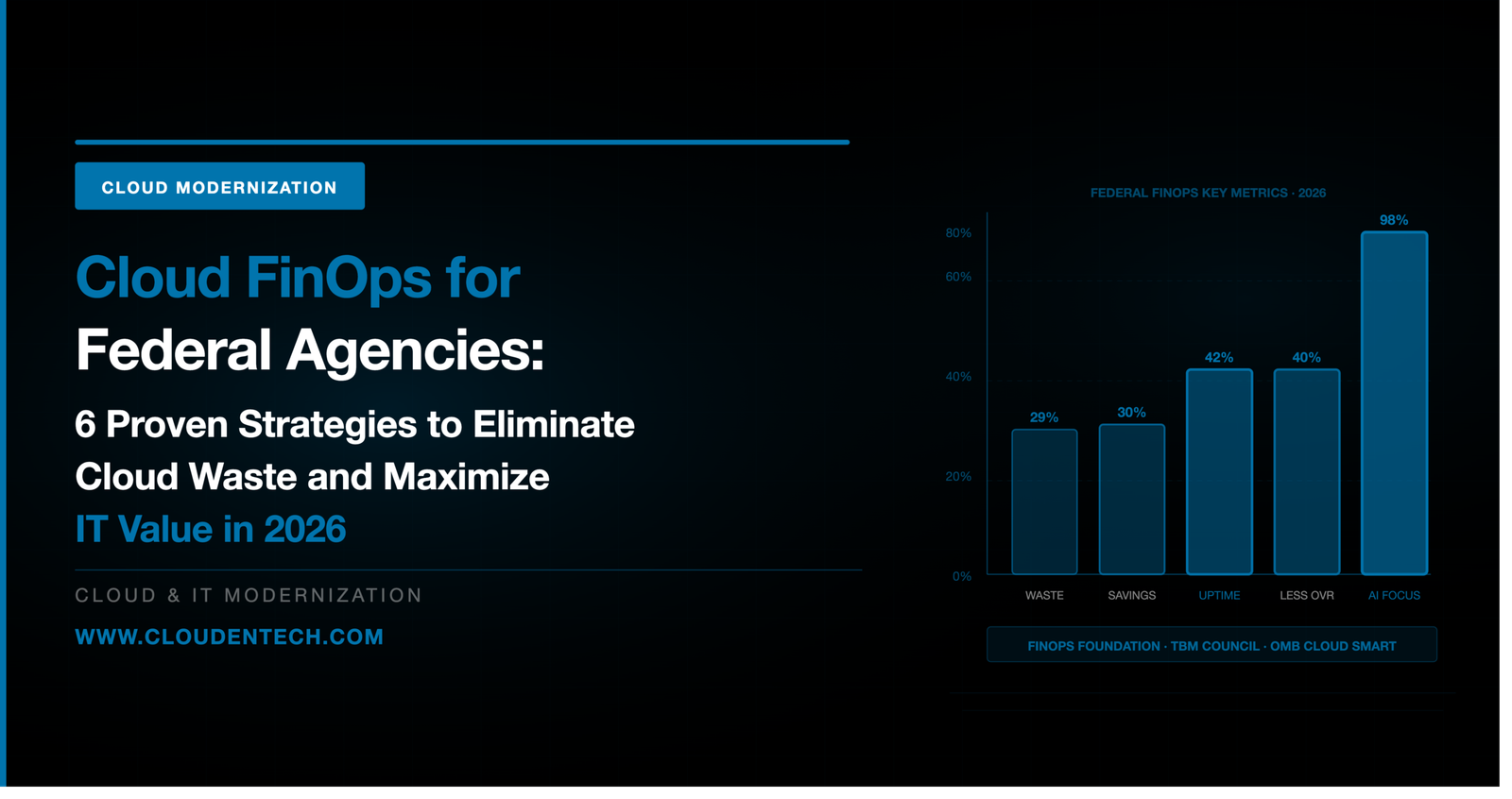
The math is stark. Cloud waste across IaaS and PaaS environments is estimated at 29 percent of spend in 2026 — up from 27 percent in 2025 — making it a five-year high driven by AI workloads that make cost forecasting structurally harder than before. Government cloud markets are projected to grow 17 percent annually through 2026, with 53 percent of organizations now operating hybrid or multi-cloud architectures. That growth compounds the waste problem: more cloud spend means more opportunity for ungoverned spending to accumulate.
In a commercial enterprise, 29 percent waste is a performance problem. In a federal agency operating under fixed congressional appropriations, 29 percent waste is a mission impact crisis. Cloud dollars that are wasted on idle resources, oversized instances, orphaned storage, and ungoverned SaaS subscriptions are dollars that cannot be used for AI deployment, zero trust implementation, application modernization, or any of the other mission-critical programs on the FY2027 agenda.
The good news is equally specific. Enterprises that implement structured cost optimization programs report an average 25 to 30 percent reduction in monthly cloud spend. Government agencies adopting modern FinOps practices report a 42 percent improvement in digital service uptime when implementing cloud transformation strategies with strong cost governance at the core. Predictive cost modeling and anomaly detection reduce cloud overspend by 40 percent in mature FinOps organizations.
This post covers what FinOps means in the specific context of federal cloud operations, why FY2027 makes this the right moment to implement it, and the six proven strategies that translate cloud financial management from a planning aspiration into an operational discipline that delivers measurable results.
What FinOps Means in a Federal Cloud Environment
FinOps — cloud financial management — is the discipline of making cloud spending predictable, traceable, and aligned to mission priorities. It shifts cloud from an uncontrollable operational expense into a managed strategic capability that enables informed decisions that align with broader business goals.
In commercial environments, FinOps primarily serves the engineering and finance alignment problem: engineering teams provision cloud resources for velocity and performance; finance teams need those spending decisions to be traceable, justified, and within budget. FinOps creates the shared language, visibility tooling, and governance processes that let both functions operate effectively.
In federal environments, the problem has additional dimensions. Federal appropriations create hard budget constraints that commercial enterprises do not face. A commercial organization that overspends its cloud budget can address the issue in the next quarter. A federal agency that overspends its appropriation faces Antideficiency Act violations — a legal prohibition on spending funds in excess of appropriated amounts that carries personal consequences for senior officials.
The accountability framework is also different. Federal cloud spending must be defensible to Congress, to the agency Inspector General, to the Government Accountability Office, and to OMB. Every significant cloud expenditure must be traceable to an authorized program, a specific appropriation, and a documented mission requirement. Cloud sprawl — ungoverned, undocumented cloud resources that accumulate as development teams provision infrastructure outside the IT governance process — is not just a cost problem in federal environments. It is a compliance problem, an audit finding, and a potential Antideficiency Act issue simultaneously.
The industry’s own self-estimate puts cloud waste at 29 percent of spend, and in the public sector that percentage is not a margin — it is taxpayer money. Government IT officials must have visibility into their resources and knowledge of their capabilities. That visibility and accountability is what FinOps provides.
The FinOps Foundation updated its mission in February 2026 to formally expand beyond pure cloud cost management. Ninety percent of practitioners now manage SaaS spend, 64 percent manage licensing, 57 percent manage private cloud, and 48 percent manage data center. For federal agencies managing hybrid cloud environments with FedRAMP-authorized services, on-premise infrastructure, and growing AI compute costs, this expanded FinOps scope directly matches the financial governance challenge they face.
Why FY2027 Makes This the Right Time to Implement Federal FinOps
September 2026 is the final month of FY2026. Agencies are closing out current year obligations, finalizing program performance reports, and beginning the FY2027 budget execution cycle. This transition point is the optimal moment to implement cloud financial governance disciplines that will produce measurable savings and improved visibility from the first day of the new fiscal year.
Several specific FY2027 dynamics make FinOps implementation particularly valuable right now.
AI compute costs are entering agency budgets at scale for the first time. Federal AI spending is projected to reach $3.1 billion in FY2028, up from $2.7 billion in FY2026. AI workloads — model training, inference serving, fine-tuning, embedding generation — are among the most variable and least predictable cloud cost drivers that federal agencies have encountered. GPU compute, in particular, is expensive and easy to over-provision. AI cost management went from niche to universal in 24 months: in 2024, 31 percent of FinOps practitioners managed AI spend. By 2026, that share is 98 percent. Federal agencies deploying AI capabilities without FinOps governance for AI compute will discover cost overruns in their FY2027 execution that their appropriations cannot absorb.
Multi-cloud complexity is increasing. Federal agencies that have completed their initial cloud migration are now managing workloads across multiple FedRAMP-authorized cloud platforms — typically including at least two of the major providers, plus federal-specific platforms and mission-specific SaaS services. Managing cost governance across a single cloud provider is tractable. Managing it across three or more providers without a unified FinOps practice produces exactly the visibility gaps that drive waste to 29 percent of spend.
Budget efficiency mandates are intensifying. Federal agencies are under sustained pressure to demonstrate IT cost efficiency as a prerequisite for continued IT investment. FinOps provides the data — unit cost metrics, resource utilization rates, waste elimination records, and mission-value attribution — that agency leadership and oversight bodies need to justify cloud investment and demonstrate responsible stewardship of appropriated funds.
6 Proven Strategies to Eliminate Cloud Waste and Maximize Federal IT Value
Strategy 1: Establish a FinOps Operating Model With Clear Roles and Governance
Federal agencies don’t need to solve everything at once. But by improving visibility, establishing accountability, and taking a disciplined approach to optimization, they can bring cloud costs under control without slowing innovation. That is the balance FinOps makes possible.
The foundation of any effective FinOps program is a clear operating model that defines who is responsible for what, at what cadence, with what authority. The three foundational FinOps roles are the central cloud team — responsible for establishing tagging standards, cost allocation frameworks, tooling, and governance processes; the finance team — responsible for integrating cloud spend into budget planning, forecasting, and financial reporting; and the engineering and program office teams — responsible for acting on FinOps recommendations within their domains.
FinOps teams with VP or C-suite engagement are 53 percent likely to influence cloud service selection, versus 12 percent for those limited to director-level engagement. In federal agencies, this means that the CIO or Deputy CIO must be directly engaged in the FinOps operating model, not just briefed on results quarterly. Cloud cost governance decisions that require cross-agency coordination, budget reprogramming, or contract modifications require executive engagement to execute at the necessary speed.
The combination of small teams and specialized skill requirements means that the federated model has become dominant: central teams cannot scale through headcount alone, so they scale through enablement, automation, and embedded champions. For federal agencies, this translates into a small central FinOps team establishing standards and tooling, with cost champions embedded in each major program office who apply those standards to their specific cloud environments.
Workload optimization and waste reduction remain the single top current priority for FinOps teams. Year-over-year, the need to apply FinOps to more technology categories climbs significantly. Federal agencies establishing FinOps programs in FY2027 should plan for this scope expansion from the start, designing governance frameworks that can cover cloud IaaS and PaaS, SaaS subscriptions, AI compute, on-premise infrastructure, and data platform costs within a single unified financial management discipline.
Strategy 2: Implement Comprehensive Cloud Resource Tagging as the Foundation of All Attribution
Cloud resource tagging — the practice of applying consistent metadata labels to every cloud resource at provisioning — is the technical foundation on which every other FinOps capability depends. Without accurate, consistent tagging, cloud costs cannot be attributed to specific programs, missions, projects, or teams. Without attribution, accountability cannot be established. Without accountability, optimization recommendations cannot be enforced.
Federal cloud resource tagging must align to the Technology Business Management framework, which OMB has directed federal agencies to implement as the standard for technology cost transparency reporting. TBM provides a taxonomy for categorizing IT costs by tower, service, and cost pool that maps cloud resource costs to the program-level budget structures that federal agencies use for appropriations management and OMB reporting.
A federal cloud tagging standard should, at minimum, capture the agency and bureau, the program office or mission area, the appropriation that funds the resource, the environment (development, test, staging, production), the data classification of workloads the resource supports, the resource owner and technical contact, the project or initiative the resource serves, and a lifecycle status indicating whether the resource is active, experimental, or scheduled for decommissioning. Resources that cannot be attributed to a funding appropriation and mission requirement represent the highest-risk category for Antideficiency Act exposure and should be the first targets for cost attribution remediation.
Tagging compliance must be enforced through policy, not requested through communication. Cloud infrastructure as code templates should enforce required tags at provisioning. Admission control mechanisms should reject resource creation requests that do not include required tags. Automated remediation should flag untagged resources for immediate review and either apply correct tags based on available context or schedule them for decommissioning.
Strategy 3: Rightsize Workloads and Eliminate Idle Resources Through Continuous Optimization
The cloud gives agencies the flexibility to scale dynamically — but only if they take advantage of it. Rightsizing workloads and deleting unnecessary data are among the fastest ways to reduce costs. Rightsizing means matching each workload to the cloud resource configuration that provides the performance and availability it requires without provisioning excess capacity that sits idle.
In federal environments, over-provisioning is systematic and predictable. Development teams provision for peak load without confidence intervals, because they have no visibility into historical utilization patterns. Program managers approve resource requests with conservative buffers because their career risk from performance incidents exceeds their career risk from cost overruns. Procurement timelines that make resource scaling difficult incentivize provisioning excess capacity upfront. The result is cloud environments where average CPU utilization runs at 15 to 20 percent of provisioned capacity — meaning agencies are paying for four to five times more compute than their workloads actually consume.
Rightsizing requires utilization monitoring at the resource level, with dashboards that surface specific instances, databases, and storage volumes whose utilization patterns indicate over-provisioning. It requires the authority and the process to act on rightsizing recommendations — modifying instance sizes, storage tiers, and database configurations in production environments through a change management process that is fast enough to capture the savings before the next budget cycle. And it requires that the engineers and program managers who make provisioning decisions receive utilization feedback in the tools they actually use — not in a separate FinOps reporting portal they check quarterly.
Idle resource elimination is the highest-return, lowest-risk optimization available to federal agencies. Idle resources — instances that are running but receiving no traffic, storage volumes attached to decommissioned systems, development environments left running after projects complete, test databases that outlived their test programs — generate cost without generating mission value. Automated idle resource detection and decommissioning workflows can identify and eliminate idle resources continuously without requiring manual review of every resource in the environment.
Strategy 4: Implement AI Cost Management as a Dedicated FinOps Practice
AI cost management has become the defining FinOps challenge of 2026. AI workloads make cost forecasting structurally harder than traditional cloud workloads because GPU compute costs are significantly higher than CPU compute, AI inference request volume is less predictable than traditional application traffic, and the cost per business outcome — the cost of each AI response, each document processed, each fraud detection decision — is not a metric that traditional cloud cost management frameworks capture.
Federal agencies deploying AI capabilities in FY2027 need a dedicated AI cost management practice within their FinOps operating model. This practice must address four specific cost dimensions: training costs, which are typically large, one-time, and easy to attribute; inference costs, which are ongoing, variable, and tied to usage patterns that may not be predictable at budget time; fine-tuning costs, which recur as models are updated with new agency data; and embedding and data processing costs, which scale with the volume of documents and data records that AI pipelines process.
For federal AI programs, AI compute costs must also be mapped to appropriations. An AI capability that serves multiple agency programs must have its compute costs allocated to the programs it serves in a manner that can be documented in financial reporting. This allocation problem is not technically complex — it requires query volume attribution and cost-per-query calculations — but it requires explicit design and governance decisions before the AI capability goes to production, not after the first quarterly cost report.
The emergence of AI-driven services heightens the need for strong financial oversight, as compute-intensive workloads place more pressure on budgets and resource planning. FinOps allows agencies to make cloud spending predictable, traceable, and aligned to mission priorities — and for AI workloads specifically, that traceability is the difference between AI being a strategic capability with documented mission value and AI being an unexplained line item that grows faster than anyone predicted.
Strategy 5: Leverage Reserved Capacity and Committed Use Discounts Within Appropriation Constraints
Reserved instances, committed use discounts, and savings plans offered by FedRAMP-authorized cloud providers provide substantial cost reductions — typically 30 to 60 percent compared to on-demand pricing — in exchange for committing to a defined level of cloud resource usage over one to three years. For federal agencies, these savings are significant and the procurement constraints around committing to multi-year cloud spend are real.
Multi-year cloud commitments must be treated as contract vehicles that are subject to federal acquisition regulations. This means that the FinOps team, the contracting officer, and the program office must work together to structure reserved capacity commitments in ways that are consistent with the appropriation accounting principles that govern multi-year spending. Reserved instances paid upfront in a single fiscal year must be obligated against that year’s appropriation and accounted for as prepaid assets. Reserved instances billed monthly over a commitment period can be treated as operating expenditures within each fiscal year.
Working within federal appropriation constraints is the FinOps skill that differentiates a commercial FinOps practitioner from a federal FinOps practitioner. The optimization strategies are technically identical. The execution requires understanding how federal appropriations law governs multi-year commitments, how funds expiration rules affect long-term cloud contracts, and how reserved capacity commitments interact with continuing resolution periods when annual appropriations are not enacted on time.
Rightsizing workloads to identify stable baseline utilization before making reserved capacity commitments is the critical prerequisite. Committing to a one-year or three-year reserved instance for a workload that is then rightsized or migrated wastes the commitment discount and creates a cost that cannot be recovered. The sequence must be: rightsize first, establish stable utilization baseline second, then make committed use purchases at the rightsized level.
Strategy 6: Build FinOps Into the Cloud Procurement and Architecture Review Process
The lowest-cost cloud environment is one that was never over-provisioned in the first place. Shifting FinOps left — integrating cost analysis into the design and procurement decisions that determine what gets provisioned before any resources are deployed — is the most efficient approach to long-term cloud financial management in federal environments.
FinOps automation will become standard practice for 75 percent of enterprises by 2026. Continuous cost optimization and dynamic resource allocation will save organizations up to $100 billion globally per year. The organizations achieving those savings have embedded cost awareness into the decisions that create cloud costs — architecture reviews, infrastructure as code templates, procurement evaluations, and capacity planning processes.
Developers can see the estimated financial impact of a code change or infrastructure-as-code deployment before it goes live, effectively preventing waste before it is provisioned. For federal agencies, this shift-left model means that infrastructure as code templates include cost estimates at authoring time, architecture review boards evaluate cloud cost implications alongside security and compliance implications, and procurement decisions for cloud services include total cost of ownership analysis that accounts for operational costs over the anticipated service lifetime.
The Technology Business Management framework provides the structure for this integration. TBM maps cloud resource costs to the service, application, and business unit that consumes them — creating the cost transparency that allows architecture and procurement decisions to be made with full financial context rather than treating cloud costs as something to be accounted for after the fact.
The Connection Between FinOps and Mission Delivery
FinOps is not a cost-cutting program. It is a mission delivery optimization program that happens to reduce costs as a byproduct of improving resource allocation discipline.
Federal agencies that implement FinOps do not reduce their cloud capabilities. They reallocate the dollars currently consumed by idle resources, over-provisioned instances, and ungoverned SaaS subscriptions to the mission-critical programs that need them. The 29 percent of federal cloud spend that goes to waste is not needed waste — it is capacity that could be funding AI pilots, zero trust implementation, post-quantum cryptography migration, or application modernization if it were governed effectively.
Government agencies adopting modern FinOps practices report a 42 percent improvement in digital service uptime when implementing cloud transformation strategies with strong cost governance at the core. The uptime improvement is not a coincidence. Agencies that have comprehensive visibility into their cloud environments — who knows what resources exist, what they are supposed to do, and who owns them — respond to incidents faster, identify degraded resources before they fail, and make better capacity decisions because they understand their baseline.
In the broader federal IT context of September 2026, with CMMC Phase 2 enforcement six weeks away, FedRAMP CR26 enforcement in January, and the DoD zero trust deadline approaching in FY2027, every dollar of federal cloud investment must deliver mission value. FinOps is the discipline that ensures it does.
How ClouDen Technologies Supports Cloud FinOps for Federal Agencies
At ClouDen Technologies, our cloud solutions practice delivers cloud advisory, architecture, migration, and cloud security services that include FinOps governance as a core element of every cloud engagement. We do not complete cloud migrations and leave agencies to figure out cost governance independently. We design cloud environments with tagging standards, cost attribution frameworks, rightsizing baselines, and reserved capacity recommendations built in from the architecture stage.
Our management services practice provides the ongoing cloud financial management support that federal agencies need to sustain FinOps discipline after initial implementation — including cost review cadences, utilization reporting, optimization recommendations, and the program management governance that ensures FinOps findings translate into actionable cloud resource adjustments rather than periodic reports that sit unimplemented.
Our enterprise architecture practice aligns cloud cost management with the Technology Business Management framework, connecting cloud resource costs to the program-level budget structures that OMB reporting and agency financial management require. Our DevSecOps practice implements the shift-left cost awareness that embeds cloud cost analysis into infrastructure as code templates, CI/CD pipeline outputs, and architecture review processes — preventing over-provisioning at the point of decision rather than remediating it after the fact.
As an SBA-certified 8(a) small business operating under ISO 9001:2015, ISO/IEC 20000-1:2018, and ISO/IEC 27001:2022, we bring the quality management and service governance discipline that federal cloud financial management programs require. We have supported cloud modernization and management programs for the U.S. Department of the Interior, the Federal Reserve Board, and the Defense Finance Agency — environments where cloud cost governance is as consequential as cloud technical performance.
If your agency is implementing a FinOps program, building cloud cost attribution infrastructure for FY2027, or addressing AI compute cost governance as new AI capabilities enter production, contact ClouDen Technologies today.
Key Takeaways
Cloud FinOps for federal agencies addresses a specific and measurable problem: 29 percent of federal cloud IaaS and PaaS spend is wasted, a five-year high driven by AI workloads that make cost forecasting structurally harder than before. That waste represents billions in federal appropriations that cannot be directed to mission-critical programs.
Structured cloud cost optimization programs produce an average 25 to 30 percent reduction in monthly cloud spend. Government agencies implementing FinOps with strong cost governance report a 42 percent improvement in digital service uptime. Predictive cost modeling reduces cloud overspend by 40 percent in mature programs.
The FinOps Foundation expanded its mission in February 2026 to cover SaaS, licensing, private cloud, and data center in addition to public cloud. Federal agencies establishing FinOps programs should design governance frameworks that cover this full technology cost scope from the start.
AI cost management is now the defining FinOps priority. AI cost management went from 31 percent to 98 percent practitioner adoption in two years. Federal agencies deploying AI capabilities in FY2027 without dedicated AI compute cost governance will encounter appropriations management problems that their budget structures are not prepared to handle.
The six strategies are: establish a FinOps operating model with clear roles and governance, implement comprehensive cloud resource tagging aligned to TBM, rightsize workloads and eliminate idle resources continuously, implement AI cost management as a dedicated FinOps practice, leverage reserved capacity within appropriation constraints, and build FinOps into cloud procurement and architecture review processes.
In a federal environment, cloud waste is not a performance metric — it is a potential Antideficiency Act issue. Every cloud dollar without attribution to an appropriation and mission requirement represents audit risk, oversight risk, and mission resource loss simultaneously.
About ClouDen Technologies
ClouDen Technologies is an SBA-certified 8(a) small business delivering cloud, cybersecurity, DevSecOps, enterprise architecture, application development, and management services to U.S. federal agencies, educational institutions, and commercial organizations. ClouDen operates under ISO 9001:2015, ISO/IEC 20000-1:2018, and ISO/IEC 27001:2022.