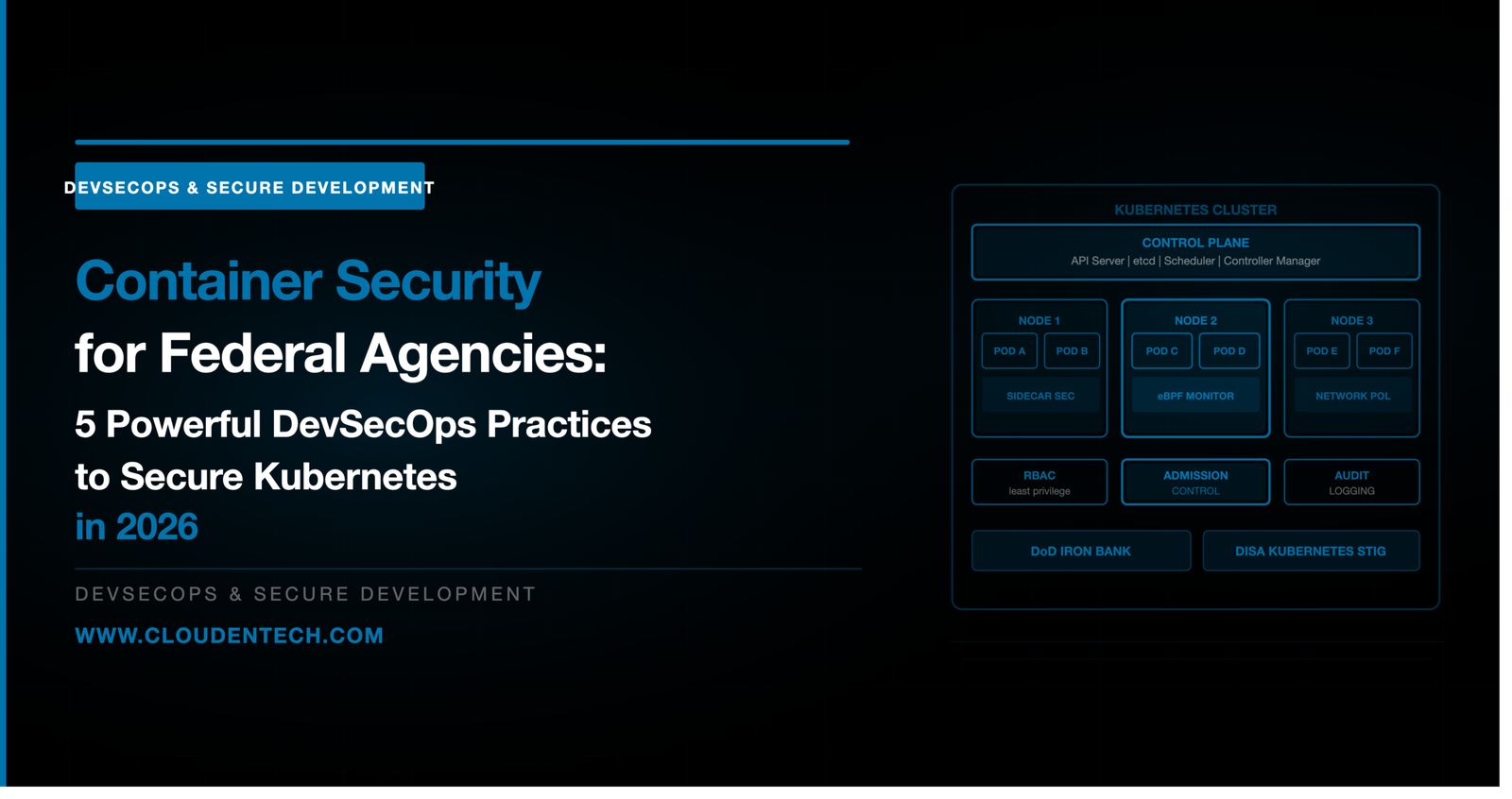
Container security for federal agencies has become one of the most urgent and least mature security disciplines in government IT in 2026. The adoption of containerization and Kubernetes orchestration across federal development programs has accelerated dramatically — but the security practices required to operate containers safely in government environments have not kept pace with the deployment velocity.
Over 85 percent of container images in production contain high or critical vulnerabilities. Outdated libraries and unpatched base images are common culprits. Container breaches rarely stay contained — one escape or a misconfigured Kubernetes control plane can cascade into full-cluster compromise, data theft, or supply-chain attacks. Medium
Ninety percent of organizations experienced at least one Kubernetes security incident in the past year. Sixty-seven percent delayed or slowed down application deployment specifically due to Kubernetes security concerns. Misconfigurations account for 45 percent of security incidents, making them the most common source of Kubernetes security failures. Kubezilla
For federal agencies and defense contractors operating Kubernetes workloads, the consequences of these failures are not just technical. A container escape in a DoD environment can expose Controlled Unclassified Information, compromise mission-critical application infrastructure, and potentially violate the FISMA, FedRAMP, and CMMC compliance obligations that govern every system those containers support.
Recent threat activity observed in late 2025 and early 2026 shows increasingly automated credential harvesting against Kubernetes environments. Modern malware frameworks now perform environment harvesting at execution time to specifically hunt for Kubernetes cluster identities. The TeamPCP worm uses scripts to detect whether they are running within a Kubernetes cluster — if so, branching into a separate execution path to harvest cluster credentials and discover resources via the API. Palo Alto Networks
This post covers what makes federal Kubernetes environments uniquely complex, the specific compliance requirements that govern containers in DoD and civilian agency environments, and the five DevSecOps practices that transform container security from a checkbox activity into a genuine defense capability.
Why Federal Kubernetes Security Is More Complex Than Commercial Environments
The security requirements that apply to federal Kubernetes deployments go significantly beyond what commercial container security frameworks address. Federal agencies operating Kubernetes workloads must satisfy multiple overlapping compliance frameworks simultaneously, each of which has specific implications for how the cluster is configured, how images are sourced and validated, and how runtime behavior is monitored and controlled.
FISMA requires that every federal information system maintain a current Authority to Operate based on a documented security plan, continuous monitoring of security controls, and a defined incident response capability. For Kubernetes deployments, this means that the cluster itself — the control plane, the worker nodes, the network policies, the RBAC configuration, the audit logging — must all be documented in the system security plan and continuously monitored against the authorized baseline.
FedRAMP adds cloud-specific requirements for any Kubernetes workload deployed on FedRAMP-authorized cloud infrastructure. Container images that run on FedRAMP-authorized platforms must be assessed as part of the overall authorization boundary, and the continuous monitoring obligations that FedRAMP imposes require that container security be addressed in the ongoing monitoring program, not just at initial authorization.
For DoD agencies and defense contractors, Security Technical Implementation Guides developed by DISA define mandatory configuration standards for Kubernetes deployments. The Kubernetes STIG and Container Platform STIG define over 100 security controls covering API server hardening, RBAC, network policies, audit logging, and more. STIG compliance is mandatory for ATO on DoD Kubernetes workloads. For a greenfield deployment, full STIG compliance typically takes six to eight weeks. For existing clusters, assessment and remediation typically runs eight to twelve weeks. THNKBIG
Iron Bank is the DoD’s hardened container image repository, maintained by Platform One, the U.S. Air Force’s DevSecOps enterprise services team. It serves as a centralized, vetted repository of container images that have undergone rigorous security testing and accreditation. These images have been approved to run in DoD environments. The Iron Bank registry is accessible to all, including third-party software vendors who can have their products published as approved for DoD use. Alpha Bravo
Iron Bank is the DoD’s source for hardened containers. A hardened container allows the application or container to run on an ATO’d Kubernetes cluster that meets the DevSecOps Reference Design. Hardened containers do not have a Certificate to Field or an Authority to Operate by themselves — they must go through the normal ATO process in the downstream environment. Iron Bank processes assist by producing a secure-by-design baseline and compliance and vulnerability findings that programs can leverage, resolving many compliance findings through the hardening process itself. Dso
Understanding these layered requirements is the prerequisite for designing a container security architecture that satisfies all of them simultaneously rather than treating FISMA, FedRAMP, DISA STIG, and Iron Bank as separate compliance tracks.
The Specific Threats That Federal Kubernetes Environments Face
Container security vulnerabilities span five layers: image, runtime, Kubernetes, supply chain, and the emerging AI and agent layer. A green CI/CD pipeline is not proof of safety — exit-code-zero gates and monitor-only tools create false confidence without real enforcement. Image hygiene shrinks the attack surface but never stops runtime exploitation. Runtime is the real battleground. AI EdgeLabs
The 2025 runc CVEs demonstrate the runtime exploitation problem precisely. CVE-2025-31133, CVE-2025-52565, and CVE-2025-52881 abuse symlinks and bind mounts to write to the host and break out of the container, with no kernel bug required. eBPF kernel-level monitoring catches what scanners miss — it sees the runc chain touch host /proc even when no scan flagged the image. AI EdgeLabs
When overly permissive tokens, exposed APIs, or insufficient workload and namespace isolation are combined, even small misconfigurations could enable threat actors to gain full cluster administrator privileges by leveraging a single compromised pod. Unit 42 researchers have witnessed the increased use of Kubernetes clusters as operational infrastructure for credential theft, lateral movement, and cloud-level compromise. Palo Alto Networks
The supply chain attack surface is equally consequential. The SolarWinds campaign demonstrated how a compromised build pipeline can distribute malicious code through signed, trusted artifacts. For federal Kubernetes environments that pull container images from external registries — including public Docker Hub repositories, commercial software vendor registries, and community-maintained image repositories — supply chain integrity is a direct mission security concern. An unverified image from an untrusted source is an uncontrolled code execution risk running inside the federal network perimeter.
AI and machine learning workloads running in containers introduce an additional threat surface that traditional container security tools do not address. LLM agents are a new insider risk — you can patch a bug but you cannot patch a brain. AI workloads running in containers must be contained at runtime because their behavior is inherently less predictable than traditional application workloads. For federal agencies deploying AI capabilities in containerized environments, the runtime monitoring and behavioral detection capabilities that address conventional container threats must be extended to account for the specific behavioral characteristics of AI inference workloads. AI EdgeLabs
5 Powerful DevSecOps Practices to Secure Federal Kubernetes Environments
Practice 1: Source All Container Images From Approved, Hardened Registries
The foundational container security practice for federal environments is establishing and enforcing a policy that only images from approved, hardened registries can run in the cluster. For DoD agencies and defense contractors, this means Iron Bank as the primary source for base images and approved software components. For civilian federal agencies without DoD authorization requirements, FedRAMP-compatible images from verified vendor registries with documented vulnerability management programs serve the equivalent function.
Iron Bank is Platform One’s centralized repository of hardened, DISA-STIG-compliant container base images. Images in Iron Bank are continuously scanned for CVEs, maintained with timely patches, and authorized for use in DoD environments. Using Iron Bank images as the foundation for federal application containers provides several specific compliance advantages. Many STIG controls are satisfied by the hardening process that Iron Bank images have already undergone, reducing the control implementation burden for the programs that use them. CVE tracking is centralized — when a vulnerability is discovered in a component used by Iron Bank images, the hardening team patches and republishes, and programs consuming those images can update through their normal pipeline rather than through emergency remediation. Rutagon
Container images must be reproducible and validated through secure build pipelines before they can be reviewed for Iron Bank inclusion. To ensure supply chain integrity, submitted container images are rebuilt from their Dockerfiles within Iron Bank’s controlled build pipelines. This reproducibility requirement means that the image running in production can be traced back to the exact source code, configuration, and build process that produced it — providing the provenance and lineage information that supply chain security requires. Oteemo
Admission control is the enforcement mechanism that gives the approved-registry policy operational teeth. A Kubernetes admission controller configured to reject pod creation for images that do not come from approved registries, do not carry verified signatures, or have not passed image scanning, means that registry policy is not just documented — it is automatically enforced at every deployment attempt.
Practice 2: Implement Runtime Security Monitoring With eBPF-Based Detection
Static image scanning, however thorough, cannot detect threats that emerge at runtime. Build-time scanning checks a static image at one moment. Runtime detection watches live syscall behavior as code executes. A CVE is not an exploit — not every CVE is exploitable, but every exploit started as a CVE. The runc container escape vulnerabilities of 2025 are precisely the class of threat that image scanning cannot detect: they are exploited through runtime behavior, not through vulnerable code that scanning tools can identify before deployment. AI EdgeLabs
eBPF — Extended Berkeley Packet Filter — is the kernel-level technology that enables deep runtime visibility into container behavior without requiring privileged access to the containerized workloads themselves. eBPF-based monitoring intercepts system calls at the kernel level, providing visibility into file system operations, network connections, process execution, and inter-process communication that user-space monitoring tools cannot observe with the same fidelity and overhead efficiency.
For federal Kubernetes environments, eBPF-based runtime monitoring provides the behavioral baseline and anomaly detection capability that both zero trust principles and continuous monitoring requirements demand. When a container that has been running normally suddenly begins executing unusual system calls, accessing file paths it has never previously touched, or establishing network connections to unexpected destinations, eBPF monitoring detects these behavioral anomalies in real time — enabling response before the adversary achieves their objective rather than after the incident report is written.
The DoD Enterprise DevSecOps Reference Design includes the Sidecar Container Security Stack, which enforces behavior detection and zero trust in runtime. Without a CNCF-compliant Kubernetes platform and the MVP Reference Design capabilities, a standalone container is not accredited and its certificate to field does not apply. For DoD programs, the sidecar security model — deploying a security monitoring container alongside each application container in a pod — is the architectural pattern that satisfies the runtime security requirements of the DevSecOps Reference Design. DoD Cyber Exchange
Practice 3: Enforce Least-Privilege RBAC and Minimize the Blast Radius of Compromise
Most security failures in Kubernetes stem from misconfigured environments and overly permileged identities. To secure Kubernetes against attacks, defenders must implement validated settings, deep runtime visibility, and strictly limited permissions. Palo Alto Networks
Role-Based Access Control is Kubernetes’ primary mechanism for governing who can do what within the cluster. RBAC policies that follow least-privilege principles grant each service account, each developer, and each CI/CD pipeline identity only the specific permissions required for its defined function — and nothing more. A CI/CD pipeline identity that can only create pods in a specific namespace, read secrets from a specific set of secret objects, and push images to a specific registry has a defined blast radius: if it is compromised, the attacker operates within those constraints.
The most dangerous RBAC configurations in federal Kubernetes environments are those that grant cluster-admin or broad namespace permissions to service accounts used by automation tools — CI/CD pipelines, monitoring agents, or certificate management tools. These accounts are attractive targets because they are always authenticated, rarely monitored, and frequently over-privileged. The TeamPCP worm specifically targets these service account identities for cluster credential harvesting.
RBAC hardening for federal Kubernetes requires auditing all existing service account permissions against least-privilege principles, revoking permissions that exceed what each account’s documented function requires, implementing just-in-time access patterns for privileged operations rather than maintaining persistent privileged service accounts, and regularly reviewing RBAC configurations after cluster upgrades — Kubernetes version upgrades frequently introduce new API groups and default RBAC bindings that require review.
For DoD programs, the DISA Kubernetes STIG includes specific RBAC controls that define the required baseline configuration. STIG controls V-242395 through V-242415 address RBAC, service account management, and privilege limitation in detail. Automated STIG compliance scanning — integrated into the pipeline and run on a continuous basis against the production cluster — produces the evidence that ATO documentation and continuous monitoring programs require.
Practice 4: Implement Network Policies and Mutual TLS for Zero Trust Pod Communication
The default networking model in a Kubernetes cluster allows every pod to communicate freely with every other pod in the cluster. This flat networking model is operationally convenient and a security disaster. A compromised pod in a flat network has direct network access to every other pod in the cluster — exactly the lateral movement capability that adversaries need to progress from initial container compromise to full cluster compromise.
Kubernetes Network Policies are the mechanism for implementing micro-segmentation within the cluster. A properly configured network policy framework allows each pod to communicate only with the specific pods, services, and external endpoints that its application function requires. A web frontend pod communicates with the application backend and the load balancer. It does not communicate with the database, the certificate management service, the monitoring agent, or any other cluster workload that its documented function does not require.
Zero trust architecture requires that communications between services, not just access from external sources, be authenticated and encrypted. Mutual TLS — where both the client and the server authenticate their identities before establishing a connection — implements this requirement at the service-to-service communication layer within the Kubernetes cluster. Service mesh implementations including Istio and Linkerd provide mTLS for all pod-to-pod communications as a cluster-wide policy, ensuring that even internal lateral movement attempts face cryptographic authentication requirements.
For federal Kubernetes environments, network policy implementation must address both east-west traffic within the cluster and north-south traffic between the cluster and external systems. Federal applications frequently integrate with external data sources, agency APIs, identity providers, and cloud platform services. Each of these connections must be explicitly authorized in network policy, encrypted in transit with TLS 1.3 or equivalent, and monitored for anomalous traffic patterns.
Practice 5: Automate Compliance Evidence Generation Aligned to STIG and FedRAMP Requirements
The fifth practice distinguishes a mature federal container security program from an immature one. Federal Kubernetes programs that operate secure clusters but cannot produce the compliance evidence that FISMA, FedRAMP continuous monitoring, and DISA STIG assessment require are not compliant — they are secure without documentation, which in federal terms is a compliance gap.
In a mature software factory, the STIG compliance score for production workloads is tracked over time. Automated STIG scanning produces a compliance report that documents the configuration state of the cluster against each STIG control. When this scanning is automated and run continuously — producing reports on a daily or weekly basis rather than on an assessment-driven schedule — the evidence output satisfies both the continuous monitoring requirement and provides the documentation that ATO reviews need to verify current compliance status. Rutagon
The compliance automation architecture for federal Kubernetes must address several specific evidence streams. Vulnerability scan results from image scanning tools must be retained with build metadata, showing which images were scanned, when, against which vulnerability database version, and what findings were produced. STIG compliance scan results must be retained with cluster version and configuration snapshot information. Audit logs from the Kubernetes API server must be captured, centralized in a tamper-evident log management system, and retained for the period required by the system’s ATO conditions. Network policy configuration must be version-controlled and documented alongside the security plan.
To get an ATO, a container must go through the normal process in the downstream environment as set up in that program. Iron Bank and the container hardening process assist by producing a secure-by-design baseline and compliance and vulnerability findings that can be leveraged, resolving many compliance findings through the Iron Bank hardening process itself. Programs that use Iron Bank images as their base inherit the evidence artifacts that the Iron Bank hardening process produces, reducing the compliance documentation burden for the program-specific security plan. But the program-level controls — the RBAC configuration, the network policies, the runtime monitoring, the continuous vulnerability management — still require program-specific documentation and continuous evidence generation. DoD Cyber Exchange
The shift to OSCAL-formatted compliance documentation, which FedRAMP is advancing under CR26 with enforcement beginning January 2027, creates an additional incentive for automated evidence generation. Kubernetes security tooling that produces OSCAL-compatible output — mapping cluster security findings directly to NIST SP 800-53 control identifiers in machine-readable format — will be significantly more efficient under the new FedRAMP requirements than tooling that produces human-readable reports requiring manual conversion to OSCAL format.
The DoD DevSecOps Reference Design: The Architecture Framework Every Federal Kubernetes Program Should Know
The DoD Enterprise DevSecOps Reference Design specifies the MVP requirements for a compliant federal DevSecOps platform, including the Sidecar Container Security Stack, which enforces behavior detection and zero trust in runtime. Without a CNCF-compliant Kubernetes platform and the MVP Reference Design capabilities, a standalone container is not accredited. DoD Cyber Exchange
The reference design is built around three components that work together to satisfy the security requirements of federal Kubernetes deployments. Platform One provides the hardened, continuously maintained Kubernetes platform running on Red Hat OpenShift or equivalent CNCF-compliant distributions. Iron Bank provides the hardened, DISA-STIG-compliant container images that serve as the building blocks for application containers. Repo One provides the centralized GitLab source code repository where application code and container configuration are version-controlled and subject to automated security scanning through the pipeline.
Platform One will ultimately make hundreds of approved, hardened containers available through the Iron Bank Artifact Registry. The DoD DevSecOps Reference Design specifies three main categories of container images that will be hardened: centralized container source code repository components, container hardening team validated images, and third-party software vendor images that have been approved for DoD use. Carahsoft
For civilian federal agencies that do not operate under DoD authorization requirements, the reference design provides a model — not a mandate. The architectural patterns it embodies — hardened base images, centralized image registry with continuous scanning, sidecar security monitoring, automated STIG compliance scanning, and audit log centralization — are the right patterns for any federal Kubernetes environment, regardless of whether the specific DoD implementation is used.
How ClouDen Technologies Supports Federal Container Security
At ClouDen Technologies, our DevSecOps services include the container security architecture, pipeline integration, and compliance evidence generation capabilities that federal Kubernetes deployments require. We design container security programs aligned to NIST SSDF, DISA STIG requirements, FedRAMP continuous monitoring obligations, and the DoD DevSecOps Reference Design — producing Kubernetes environments that are both operationally effective and compliance-ready from the first deployment.
We implement the five practices described in this post as an integrated container security architecture rather than as independent point solutions. Approved-registry policy enforcement, eBPF-based runtime monitoring, least-privilege RBAC, network policy micro-segmentation, and automated compliance evidence generation work together in a unified security program that produces the continuous visibility and documented evidence that federal authorization processes require.
Our application development practice builds the containerized applications that operate within this security architecture — secure by design from the first container image, with supply chain integrity, code signing, and SBOM generation built into the development pipeline. Our cybersecurity services provide the security architecture design, risk management, and continuous monitoring integration that connect container security to the broader security posture that FISMA and FedRAMP require.
Our cloud solutions practice designs the FedRAMP-authorized cloud environments where federal Kubernetes clusters operate, ensuring that the platform security controls complement rather than conflict with the cluster-level security architecture. Our enterprise architecture practice addresses the cross-system integration decisions that determine how containerized applications interact with the agency’s broader IT portfolio — including the API security, identity federation, and network integration requirements that connect containerized workloads to legacy systems and shared agency services.
As an SBA-certified 8(a) small business operating under ISO 27001:2022, ISO 9001:2015, and ISO/IEC 20000-1:2018, we bring the governance discipline that federal container security programs require. We have delivered secure application development and DevSecOps programs for the U.S. Department of the Interior, the Federal Reserve Board, and the Defense Finance Agency — environments where application security and operational reliability are equally non-negotiable.
If your agency is building or hardening a Kubernetes deployment, pursuing Iron Bank inclusion for your container images, addressing DISA STIG compliance for a DoD Kubernetes workload, or building the automated compliance evidence generation program that FedRAMP CR26 requires, contact ClouDen Technologies today.
Key Takeaways
Container security for federal agencies is one of the most critical and least mature security disciplines in government IT. Over 85 percent of production container images contain high or critical vulnerabilities, and 90 percent of organizations experienced at least one Kubernetes security incident in the past year.
The threat landscape is active and specific. Late 2025 and early 2026 threat activity shows automated credential harvesting against Kubernetes service accounts, container escape attacks exploiting 2025 runc CVEs that bypass image scanning entirely, and AI workloads presenting new behavioral monitoring challenges that traditional container security tools are not designed to address.
Federal Kubernetes deployments must satisfy FISMA continuous monitoring requirements, FedRAMP authorization controls, and for DoD programs the DISA Kubernetes STIG — over 100 mandatory security controls covering API server hardening, RBAC, network policies, audit logging, and more.
Iron Bank is the DoD’s centralized hardened container image repository. Using Iron Bank images as base images satisfies many STIG controls through the hardening process itself and provides programs with continuously maintained, CVE-tracked images that reduce emergency patching overhead.
The five practices are: source all container images from approved hardened registries with admission control enforcement, implement eBPF-based runtime security monitoring that detects behavioral anomalies that image scanning cannot see, enforce least-privilege RBAC and minimize blast radius, implement network policies and mutual TLS for zero trust pod-to-pod communication, and automate compliance evidence generation aligned to STIG and FedRAMP continuous monitoring requirements.
OSCAL-format compliance documentation is becoming the expected standard under FedRAMP CR26 with enforcement beginning January 2027. Container security tooling that produces OSCAL-compatible output mapping findings to NIST SP 800-53 control identifiers will be significantly more efficient in the new compliance environment than tooling requiring manual document conversion.
About ClouDen Technologies
ClouDen Technologies is an SBA-certified 8(a) small business delivering cloud, cybersecurity, DevSecOps, enterprise architecture, application development, and management services to U.S. federal agencies, educational institutions, and commercial organizations. ClouDen operates under ISO 9001:2015, ISO/IEC 20000-1:2018, and ISO/IEC 27001:2022.