IT program management for federal agencies is the discipline that determines whether IT investment becomes mission impact — or becomes another line item on the GAO High Risk list. The difference between a federal IT program that delivers on time, on budget, and within scope and one that becomes a cautionary tale is almost never a technology failure. It is a program management and governance failure.
Federal IT investments too frequently fail or incur cost overruns and schedule slippages while contributing little to mission-related outcomes. These investments have often suffered from a lack of disciplined and effective management, such as project planning, requirements definition, and program oversight and governance. The federal government’s management of IT acquisitions and operations has been on GAO’s High Risk list since 2015.
Only 31 percent of IT projects meet the classic definition of success: delivered on time, on budget, and within scope. Around 50 percent are considered challenged, while 19 percent fail outright. Organizations with mature program management practices waste 21 times less money than those without. Large IT projects run on average 45 percent over budget and 7 percent over time.
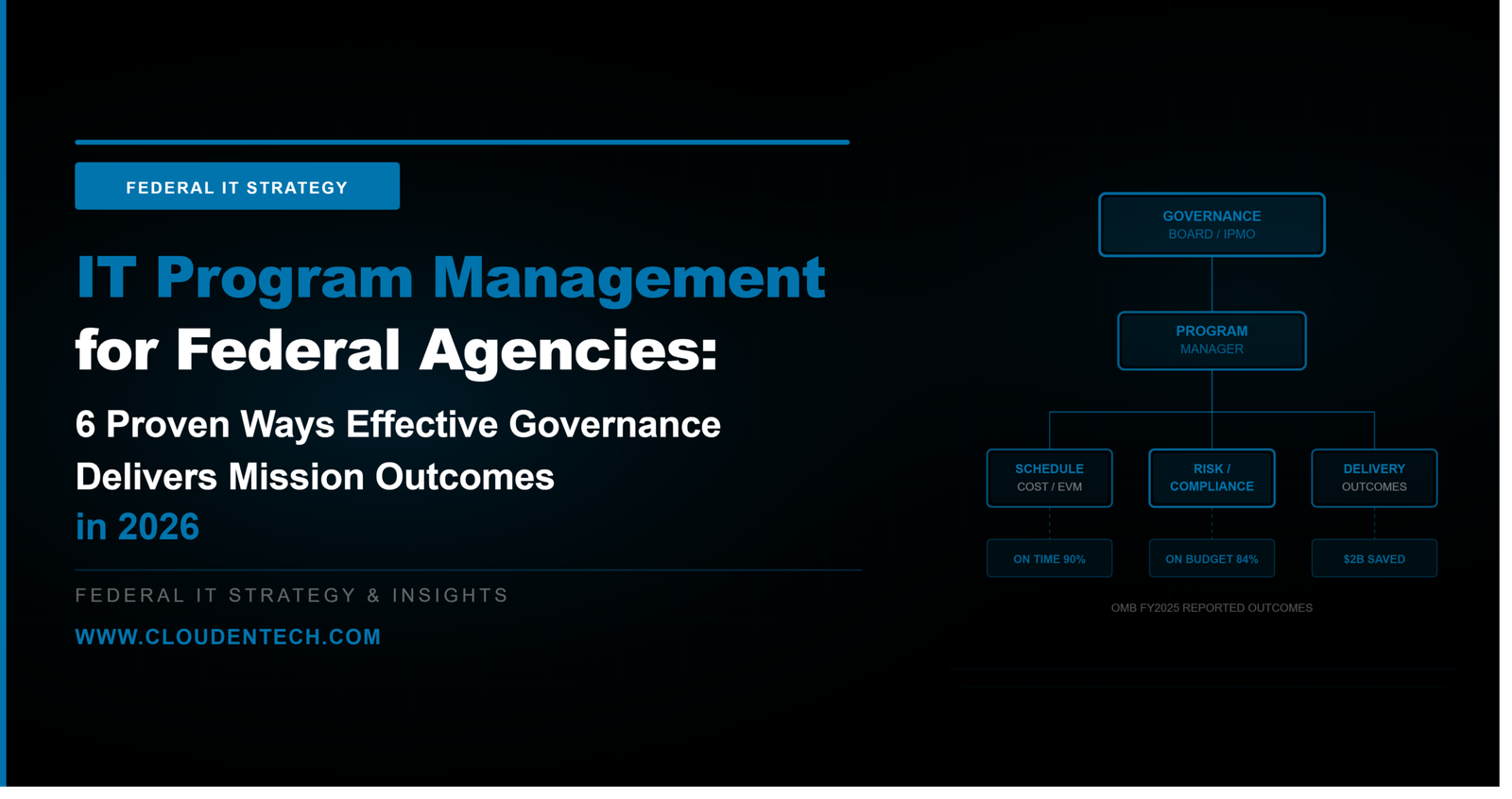
Against that backdrop, the most recent federal IT management data shows meaningful improvement when governance structures are applied rigorously. As of March 2026, 90 percent of federal IT projects are on time and 84 percent are on budget, with OMB reporting approximately $2 billion in cost savings in FY2025. Those numbers represent real progress from the persistent failures of prior years — and they directly reflect the governance and program management disciplines that produce them.
This post explains what IT program management in federal agencies actually involves, why the discipline matters more in 2026 than at any point in the last decade, and the six proven ways that effective program governance translates IT investment into measurable mission outcomes.
What IT Program Management Means in a Federal Context
Federal IT program management is not the same as commercial IT project management. The compliance requirements, stakeholder ecosystems, procurement constraints, and accountability frameworks that govern federal IT programs add layers of complexity that commercial project management frameworks do not fully address.
Government project management is high-stakes work — you deliver programs under strict rules, public scrutiny, shifting priorities, and complex stakeholder ecosystems. It is harder than most private-sector delivery, but also more meaningful, because outcomes impact citizens, infrastructure, and essential services.
The distinction between a project and a program is particularly important in the federal context. A project is a temporary, bounded effort with a defined start and end date. A program is a collection of related projects managed in a coordinated way to produce benefits that could not be achieved by managing the projects independently. Most significant federal IT modernization efforts are programs — multi-year, multi-component initiatives that include infrastructure migration, application modernization, workforce training, security implementation, and change management components that must be coordinated to deliver the intended mission outcome.
The success of most government initiatives often hinges on effective project and program management. Lack of knowledge and implementation of program management best practices costs federal agencies millions of dollars annually. The specific framework governing federal IT program management is the Federal Acquisition Certification for Program and Project Managers (FAC-P/PM), which establishes competency requirements for federal civilian employees managing IT programs. FAC-P/PM certification at three progressive levels — Entry, Mid, and Senior/Expert — defines the expected program management competency for federal program officials and their contractor counterparts.
The AI for Public Sector Digital Transformation market is projected to reach $98.1 billion by 2033. Agencies that build structured program management practices now will be positioned to scale these capabilities as they mature. By 2026, 80 percent of PMOs are expected to use AI to support decision-making — handling reporting, forecasting, and risk tracking faster than manual processes allow.
Why Program Management Governance Is More Critical in 2026 Than Ever
Several converging factors in 2026 make disciplined IT program management more consequential than at any previous point in the federal IT modernization era.
First, the scale of concurrent modernization programs across the federal government is unprecedented. Agencies are simultaneously executing cloud migrations, zero trust implementation programs, AI deployment initiatives, post-quantum cryptography migration planning, legacy system modernizations, and CMMC compliance programs. Each of these is a multi-year, multi-component effort. The agencies managing all of them concurrently without strong program governance are not managing risk — they are accumulating it.
Federal systems integrators in 2026 face a familiar mandate — deliver faster mission outcomes with tighter constraints — plus a new reality: agencies are moving from AI experimentation to operational scale, and procurement pathways are shifting to favor ready-now solutions. That combination rewards partners that can bring AI-ready data foundations, secure cloud capacity, continuous cyber controls, and ecosystem partnerships to the table — without turning every program into a science project.
Second, workforce constraints are compounding program management risk. Many federal training programs that prepare project leaders have been defunded. The Department of Commerce’s Project Management Certificate Program was eliminated, reducing access to formal training for public-sector employees. Agencies that have lost experienced program managers through retirement, attrition, or workforce reductions are managing complex modernization programs with reduced internal program management capacity.
Third, the accountability framework for federal IT investment has been tightened. OMB is reimagining how the Federal IT Dashboard works, sunsetting the existing platform and building a new, modern version designed to provide a credible, accessible window into IT spending, performance, and decision-making. Federal CIO Greg Barbaccia explicitly stated that the current dashboard does not fully deliver on its promise and must do better. The new dashboard is designed to provide more meaningful, real-time visibility into program performance — which means that program management failures will be more visible to OMB, agency leadership, and Congress than they have been under the compliance-oriented reporting model that the old dashboard incentivized.
6 Proven Ways Effective IT Program Governance Delivers Mission Outcomes
Way 1: Define Mission Outcomes Before Defining Technology Requirements
Lack of clear objectives is the number one reason projects fail. According to Wellingtone’s State of PM, 37 percent of projects fail because stakeholders never agreed on what success looked like. You cannot hit a target no one has defined.
In federal IT programs, this failure mode manifests as programs that deliver the system they were funded to build but do not achieve the mission outcome they were intended to support. An agency that funds a new case management system and defines success as system deployment has defined a technology output, not a mission outcome. If the system is deployed but case processing times do not improve, the program has not delivered value regardless of what the system deployment report says.
Effective federal IT program governance begins by defining mission outcomes in measurable terms before requirements are written or procurement decisions are made. How many cases should be processed per day after implementation? How long should the average processing time be? What fraud detection rate should the system achieve? What citizen satisfaction score is the target? These outcome metrics drive requirements definition, vendor evaluation, and ultimately program success measurement in ways that technology-output metrics cannot.
Performance management provides a government-wide framework that supports strategic planning, measures results, and improves the delivery of public programs and services. By aligning strategic plans with measurable outcomes, agencies can fulfill their missions, responsibly manage taxpayer resources, and continuously improve public service. The IT program management governance structure must connect every major program decision — scope, schedule, budget, vendor selection, technology architecture — back to the mission outcome metrics that the program was established to achieve.
Way 2: Establish an Integrated Program Management Office With Cross-Functional Authority
A federal IT program of any significant scale requires an Integrated Program Management Office — a governing body with representatives from IT, cybersecurity, contracting, finance, legal, and the mission program offices that the IT system supports. Without cross-functional representation and cross-functional authority, IT programs consistently encounter blockers that no single stakeholder has the authority to resolve.
The most common failure of federal PMO structures is insufficient authority. A PMO that can track program status but cannot make decisions or escalate effectively to the decision-makers who can resolve blockers is not a governance structure — it is a reporting structure. The distinction matters enormously in program execution. Issues that a properly governed PMO resolves in days become risks that stall programs for months when the PMO lacks the authority or the escalation pathway to drive resolution.
The biggest gains come not from automating old processes, but from redesigning the work itself. Simplifying rules, redesigning workflows around outcomes, and configuring teams and governance so that advanced technologies are scaled responsibly — agencies improve in weeks rather than years when these conditions are in place. A well-structured IPMO provides exactly this redesign function — it is the organizational mechanism through which program teams identify workflow bottlenecks, procurement obstacles, and governance gaps before they become program failures.
For large federal IT programs, the IPMO should also include a dedicated Risk and Issues owner whose sole function is tracking, escalating, and coordinating resolution of program risks and issues. Risk registers that are maintained by the same project managers responsible for executing the work they are tracking are systematically biased toward underreporting risk. An independent risk function provides the objective visibility that program governance requires.
Way 3: Implement Earned Value Management as the Financial Control Discipline
Earned Value Management is the federal government’s mandated performance management methodology for IT programs above defined cost thresholds. It integrates scope, schedule, and cost data into a unified performance picture that allows program managers and oversight officials to identify cost and schedule trends early — before they become overruns — and take corrective action while options remain.
OMB Circular A-11 and the Capital Programming Guide require EVM implementation for major IT investments. Despite this mandate, EVM is frequently implemented as a compliance reporting exercise rather than as a genuine program management tool. Program teams submit EVM data to OMB without using it to drive internal program decisions. The result is programs that appear to be on track in compliance reporting while actually accumulating schedule slippage and cost growth that will surface at completion.
Effective EVM implementation means using variance analysis — Schedule Performance Index and Cost Performance Index — to make real-time program management decisions. An SPI below 1.0 indicates that the program is delivering less work than planned for the elapsed schedule. A CPI below 1.0 indicates that the program is spending more than planned for the work delivered. Both conditions require immediate management attention and corrective action — not a note in the next monthly report.
Organizations with mature program management practices waste 21 times less money than those without. A 1 percent improvement in project performance can save organizations hundreds of millions annually. For federal agencies managing billion-dollar IT modernization programs, the financial return on rigorous EVM implementation is direct and quantifiable. Programs that use EVM as a genuine management tool rather than a compliance checkbox consistently outperform those that treat it as a reporting obligation.
Way 4: Structure Programs Into Manageable Increments With Defined Success Criteria
Large projects succeed less than 10 percent of the time, while small projects succeed roughly 90 percent of the time. As projects grow in complexity, coordination overhead and risk multiply. Breaking significant initiatives into smaller, trackable components reduces exposure dramatically.
For federal IT programs, this finding has a direct architectural implication. A five-year, $500 million legacy modernization program managed as a single program with a single completion milestone is a program with a 10 percent or lower success probability. The same scope managed as 12 increments of four to six months each, each with defined success criteria and independent funding authorization, produces a fundamentally different risk profile.
Modular contracting — the federal acquisition strategy that structures large IT programs into discrete, independently contractable components — is specifically designed to address this risk pattern. Each module has its own scope, schedule, cost, and success criteria. Modules that are failing can be terminated or restructured without jeopardizing the entire program. Modules that are succeeding can be expanded or accelerated. The program maintains its overall strategic direction while allowing individual component decisions to be made based on actual performance rather than sunk-cost commitments.
The success criteria for each program increment must be defined in terms of working software or operational capability, not in terms of documentation deliverables or phase completions. A program increment that produces a tested, deployed capability that users can operate is measurably successful. A program increment that produces a finalized requirements document, a completed architecture review, and a signed contract modification has produced deliverables that are prerequisites for value, not value itself.
Way 5: Build Stakeholder Engagement Into the Program Governance Structure, Not the Communications Plan
Poor communication is the primary contributor to project failure, with 30 percent of IT project failures directly attributable to poor communication and stakeholder management. In federal IT programs, stakeholder complexity is significantly higher than in commercial programs of equivalent technical scope. Federal IT programs typically involve agency leadership, multiple program offices, the CIO organization, the contracting office, oversight bodies including OMB and GAO, congressional appropriators, and often other agencies whose data or systems are affected by the program.
Managing this stakeholder ecosystem through a quarterly briefing cycle and a monthly status report is not stakeholder management — it is stakeholder notification. By the time a program reaches a quarterly briefing, stakeholder concerns that could have been addressed two months earlier have accumulated into positions that are much harder to change.
Effective federal IT program governance embeds stakeholder engagement in the program governance structure itself. Key stakeholders are represented in the IPMO. Decision gates require explicit stakeholder sign-off before the program can proceed to the next phase. Risk and issue reviews include stakeholder perspective on impact and priority. Change control processes require stakeholder approval for scope, schedule, or budget changes above defined thresholds.
A small business with strong program management, customer knowledge, and delivery discipline can compete more effectively when paired with partners who bring specialized skills, IP, or relevant past performance. Customer knowledge — understanding how the agency works, what its leadership priorities are, and how decisions get made — is the program management differentiator that technical capability alone cannot replicate.
Way 6: Integrate Compliance and Security Governance Into the Program Management Structure, Not the Security Review Process
Federal IT programs must satisfy FISMA requirements, FedRAMP authorization requirements for cloud components, Section 508 accessibility requirements, OMB data governance requirements, and increasingly the security requirements of CMMC, zero trust mandates, and post-quantum cryptography migration planning. The traditional approach — addressing these requirements through a security review at the end of the development phase — consistently produces programs that must choose between delaying delivery for remediation or accepting security and compliance gaps.
Integrating compliance and security governance into the program management structure means establishing the compliance requirements framework at program initiation, assigning compliance ownership to specific program roles with defined responsibilities, incorporating compliance checkpoints into the program’s standard decision gate process, and treating compliance findings as program risks that require management attention rather than security issues that security teams resolve independently.
For cloud components, this means beginning the FedRAMP authorization process in parallel with system development — not after it. Authorization boundaries must be defined before architecture decisions are finalized. Control baselines must be selected and documented before configuration decisions are made. The evidence generation practices that continuous monitoring requires must be built into the development pipeline from the first sprint.
IT Dashboard governance is evolving. OMB is sunsetting the existing platform and building a new version designed for real-time transparency into IT spending and performance. Programs that maintain current, accurate performance data will be significantly better positioned in the new reporting environment than those that have treated IT Dashboard compliance as a periodic update exercise. The new dashboard represents a shift from compliance-oriented reporting to performance-oriented accountability — exactly the management discipline that the six practices described in this post are designed to institutionalize.
The Role of IT Management Services in Supporting Federal Program Governance
Not every federal agency has the internal program management capacity to apply the six practices described above simultaneously across a portfolio of complex modernization programs. Building internal capacity takes time, requires sustained investment in training and certification, and cannot keep pace with the rate at which new program requirements are emerging in 2026.
IT management services — provided by experienced federal IT contractors who bring credentialed program managers, proven governance frameworks, and documented delivery methodology — fill this capacity gap. The right IT management services partner does not replace the federal program manager. They work alongside the federal PM, providing surge capacity, specialized expertise, and governance infrastructure that the internal team would take years to build independently.
Management services are most valuable in three specific federal program contexts. First, at program initiation — when governance structures, performance metrics, stakeholder engagement frameworks, and compliance integration must be established before the program gains momentum that makes changing them difficult. Second, during major program transitions — system go-live, contract transitions, organizational changes — when program management complexity spikes and experienced surge capacity prevents transitions from becoming crises. Third, during program recovery — when a program is identified as at-risk and needs the structured, experienced program management intervention that turns failing programs around.
How ClouDen Technologies Delivers IT Management Services for Federal Programs
At ClouDen Technologies, our management services practice provides the IT program management, staffing, consulting, and operational delivery support that federal agencies need to execute their modernization programs with the governance discipline that mission outcomes require.
We bring credentialed program and project managers with federal IT delivery experience, proven governance frameworks aligned to FAC-P/PM requirements and federal acquisition standards, and the cross-functional expertise that bridges IT program management, cybersecurity compliance, cloud migration, and application development. Our management services engagements are structured to build agency capacity — not to create dependency — by embedding governance practices and knowledge into the agency’s program teams throughout the engagement.
Our management services practice works in direct coordination with our technical delivery practices. When a federal program needs both program management governance and technical execution support, our cloud solutions, cybersecurity, enterprise architecture, DevSecOps, and application development capabilities are available from the same partner — eliminating the integration overhead that multi-vendor program management environments create.
As an SBA-certified 8(a) small business operating under ISO 9001:2015 quality management, ISO/IEC 20000-1:2018 IT service management, and ISO/IEC 27001:2022 information security certifications, we bring the documented governance discipline that federal program management requires at every level — from the daily standup to the OMB program review. We have delivered IT management and program support for the U.S. Department of the Interior, the Federal Reserve Board, and the Defense Finance Agency — environments where program management failure is not recoverable within a fiscal year and where mission continuity depends on disciplined program governance.
If your agency is initiating a major IT modernization program, experiencing program management challenges on an existing program, or building the governance infrastructure for a complex multi-year initiative, contact ClouDen Technologies today.
Key Takeaways
IT program management for federal agencies is the determining factor in whether IT investments deliver mission outcomes or contribute to the federal government’s persistent pattern of cost overruns, schedule slippage, and capability gaps. Only 31 percent of IT projects fully succeed. Organizations with mature program management practices waste 21 times less money than those without.
The most recent federal IT performance data shows meaningful improvement under structured governance: 90 percent of federal IT projects are on time, 84 percent are on budget, and OMB reported $2 billion in cost savings in FY2025. These outcomes are directly attributable to the governance disciplines that effective program management institutionalizes.
The six proven ways that effective governance delivers mission outcomes are: defining mission outcomes before technology requirements, establishing an IPMO with cross-functional authority, implementing EVM as a genuine financial control discipline, structuring programs into manageable increments with defined success criteria, building stakeholder engagement into the governance structure rather than the communications plan, and integrating compliance and security governance into the program management structure from initiation.
FAC-P/PM certification is the federal government’s established competency framework for IT program and project managers. Programs managed by FAC-P/PM-certified program officials with appropriate governance structures consistently outperform programs managed without these standards.
Management services provided by experienced federal IT partners can fill the program management capacity gaps that agencies face as they execute multiple concurrent modernization programs in a constrained workforce environment. The right management services partner builds agency capacity rather than creating dependency.
About ClouDen Technologies
ClouDen Technologies is an SBA-certified 8(a) small business delivering cloud, cybersecurity, DevSecOps, enterprise architecture, application development, and management services to U.S. federal agencies, educational institutions, and commercial organizations. ClouDen operates under ISO 9001:2015, ISO/IEC 20000-1:2018, and ISO/IEC 27001:2022.