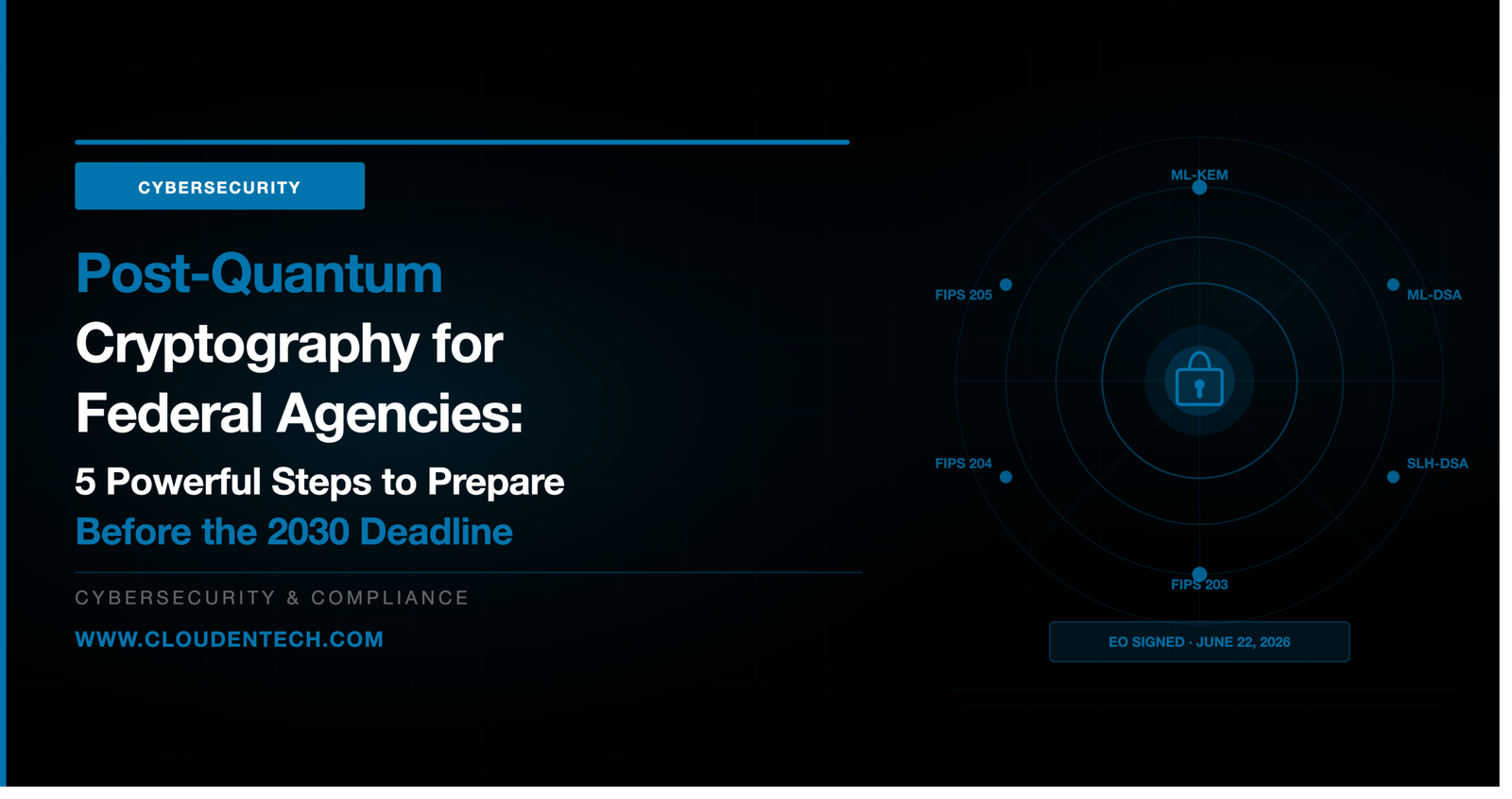
Post-quantum cryptography for federal agencies moved from a strategic planning priority to an enforceable executive mandate on June 22, 2026. On that date, President Trump signed two Executive Orders that officially launched the federal government’s next phase of post-quantum cryptography migration while accelerating U.S. quantum technology development. The orders set concrete deadlines, named responsible officials, and shifted the entire conversation from awareness to execution.
Under the new order, agencies must transition high-value assets and high-impact systems to post-quantum cryptography for key establishment by December 31, 2030, and for digital signatures by December 31, 2031. The order requires agencies to designate migration leads, review high-value assets and high-impact systems, and develop migration plans aligned with the accelerated deadlines. Centerforcybersecuritypolicy
Two offices are put in charge of coordination: the Director of OMB and the National Cyber Director are directed to lead the strategic coordination and oversight of the national PQC migration policy and strategy. NIST, NSA, and CISA are tasked with giving agencies ongoing technical guidance. This is no longer a recommendation from a standards body. It is a top-down program with named owners. QuSecure
The urgency behind these deadlines is not theoretical. Google warned in March 2026 that a cryptographically relevant quantum computer capable of breaking RSA-2048 encryption could arrive as early as 2029. Yet only 13 percent of organizations have moved post-quantum cryptography into production, 60 percent have not begun a meaningful migration, and large enterprises face a transition timeline spanning eight to fifteen years. Ciphers Security
That eight-to-fifteen year implementation timeline means the clock for federal agencies began before most security teams noticed it. This post covers what the June 2026 Executive Orders require, why the threat model demands immediate action regardless of when quantum computers arrive, what the NIST standards require, and the five concrete steps every federal agency must begin now.
The Threat That Does Not Wait for Quantum Computers
The most important thing to understand about post-quantum cryptography migration is that the threat it addresses is already active. Federal agencies and their security teams do not need to wait for a quantum computer to exist before acting. They needed to act years ago.
The first thing to understand about post-quantum cryptography is that the deadline is not the day quantum computers break RSA. The deadline already passed for any data that needed to stay confidential for a decade. Adversaries do not need a working cryptographically relevant quantum computer today to compromise your encrypted traffic — they need a hard drive and patience. Capture the ciphertext now, store it cheaply, decrypt it when the math becomes possible. The technical name is harvest now, decrypt later. iTechs Online
CISA, the NSA, the UK NCSC, ENISA, and the Australian Cyber Security Centre have all formally confirmed harvest-now-decrypt-later collection is actively occurring against government targets. Nation-state adversaries with the capability and patience to archive encrypted traffic are already doing so. They are targeting communications, diplomatic records, classified data, financial transactions, and intelligence that carries long-term sensitivity. When quantum computers become capable of breaking current encryption — whether in 2029 as Google’s assessment suggests or somewhat later — that harvested data becomes immediately readable. Ciphers Security
The memo identifies specific quantum-vulnerable algorithms requiring eventual replacement: RSA, ECDSA, ECDH, DSA, Diffie-Hellman, and MQV — essentially all widely deployed asymmetric cryptographic algorithms. Every federal system that uses any of these algorithms to encrypt data in transit, protect stored credentials, sign code or certificates, or authenticate users is currently vulnerable to harvest-now-decrypt-later attacks on its most sensitive communications. PostQuantum
A July 2024 White House report estimated the total government-wide PQC migration cost at approximately $7.1 billion in 2024 dollars between 2025 and 2035. A May 2026 estimate places the total global cost of post-quantum cryptography migration at approximately $15 billion — a figure that increases the longer organizations delay, as emergency remediation under deadline pressure is consistently more expensive than planned migration. Agencies that treat the 2030 deadline as a future planning item rather than an immediate operational program will face significantly higher costs and significantly higher risk of not meeting compliance requirements on time. PostQuantumCiphers Security
The NIST Standards: What Federal Agencies Must Migrate To
NIST finalized the first three post-quantum cryptography standards in August 2024 — FIPS 203, FIPS 204, and FIPS 205. These three standards form the foundation of every federal PQC migration program and replace the quantum-vulnerable algorithms that currently protect federal systems. iTechs Online
FIPS 203, formally the Module-Lattice-Based Key-Encapsulation Mechanism Standard, implements the ML-KEM algorithm and addresses the key establishment use case — the encryption of data in transit. This is the standard that must be deployed for federal high-value assets and high-impact systems by December 31, 2030, under the June 2026 Executive Orders. ML-KEM is based on lattice mathematics, a class of mathematical problems that quantum computers are not known to be able to solve efficiently.
FIPS 204, the Module-Lattice-Based Digital Signature Standard, implements ML-DSA and addresses digital signature use cases — code signing, certificate authentication, document signing, and identity verification. This standard must be deployed for digital signature applications by December 31, 2031 under the Executive Orders.
FIPS 205, the Stateless Hash-Based Digital Signature Standard, implements SLH-DSA as an alternative digital signature standard using hash-based cryptography. SLH-DSA provides a security assurance based on a different mathematical foundation than ML-DSA, offering cryptographic diversity that provides resilience if a vulnerability is discovered in one algorithm family.
NSA’s Commercial National Security Algorithm Suite 2.0, originally published in 2022 and most recently updated in May 2025, defines requirements for systems processing classified or sensitive government information. By 2027, new systems and acquisitions must support quantum-resistant cryptography. Software and firmware signing face exclusive-use requirements from January 1, 2027. For defense contractors and agencies operating national security systems, the CNSA 2.0 timeline is actually more aggressive than the civilian agency deadlines — new acquisitions must support quantum-resistant cryptography now. Axelspire
Executive Order 14144 maintains PQC urgency under the current administration, requires TLS 1.3 or successor adoption across all federal systems by January 2, 2030, and delegates oversight to NSA and OMB. CISA and NSA published a list of quantum-safe product categories, drawing a clear line between technologies where PQC is already widely available and those still in development. Safelogic
The Migration Timeline Every Federal Agency Must Understand
Realistic enterprise migration takes 42 to 54 months from start to compliance. For agencies targeting the December 31, 2030 deadline for key establishment, that means a migration program that begins no later than mid-2026 and maintains continuous progress through 2030. Agencies that have not yet begun their cryptographic inventory — the essential first step — are already behind the minimum timeline for a credible compliance program. Axelspire
The phased timeline across the federal civilian enterprise is as follows. Cryptographic inventories, required under OMB M-23-02, should have been underway since 2023. Agencies that have not completed their inventory are working with an unknown migration scope. By January 2027, all new NSS acquisitions must be CNSA 2.0 compliant and software and firmware signing must exclusively use quantum-resistant algorithms for national security systems. By January 2, 2030, all federal systems must adopt TLS 1.3 or successor. By December 31, 2030, all high-value assets and high-impact systems must complete post-quantum key establishment migration. By December 31, 2031, all high-value assets and high-impact systems must complete post-quantum digital signature migration. By 2035, all quantum-vulnerable algorithms — RSA at any key length, ECDH, ECDSA — are fully deprecated from NIST standards and FIPS guidelines.
NIST guidance indicates that quantum-vulnerable algorithms will be deprecated by 2030 and disallowed by 2035. The NSA requires national security systems to adopt quantum-resistant cryptography for new acquisitions starting in 2027. Industry analyses suggest migration efforts may need to begin several years in advance to meet these timelines. The Quantum Insider
5 Powerful Steps to Prepare for Post-Quantum Cryptography Migration
Step 1: Complete a Comprehensive Cryptographic Inventory
The credible enterprise migration takes 5 to 15 years and starts with a cryptographic inventory — not a vendor purchase. Every federal agency must know exactly where quantum-vulnerable cryptography is deployed before any migration planning can be meaningful. OMB M-23-02 required agencies to begin annual inventories of quantum-vulnerable IT systems in 2023. The quality and completeness of those inventories varies significantly across agencies. iTechs Online
A comprehensive cryptographic inventory for PQC migration purposes must document every system, application, and service that uses asymmetric cryptography for any purpose. This includes TLS certificates protecting web services and APIs, code signing certificates validating software integrity, PKI infrastructure issuing identity and device certificates, VPN tunnels and encrypted communication channels, database encryption for data at rest, email encryption and digital signing capabilities, authentication protocols including SAML, OAuth, and SSH, and IoT and operational technology devices that use cryptography for device authentication or firmware validation.
The inventory must also capture the specific algorithms in use, the key lengths, the certificate lifetimes, and the renewal cycles for each cryptographic deployment. This information determines migration sequencing — systems with short certificate lifetimes can be migrated at the next renewal cycle, while systems with long-lived certificates or deeply embedded cryptographic implementations require more complex migration planning.
Federal agencies can only migrate to PQC if the products they buy support PQC. To operationalize this, CISA released its product categories for technologies that use post-quantum cryptography standards, drawing a clear line between technologies where PQC is already widely available and those still in development. The cryptographic inventory should be cross-referenced against CISA’s product category list to identify which systems can be migrated using currently available quantum-safe products and which require vendor roadmap commitments for future PQC support. Cloudflare
Step 2: Designate a Migration Lead and Establish PQC Governance
The June 2026 Executive Orders require agencies to designate migration leads and develop migration plans aligned with the accelerated deadlines. PQC migration at the scale required by federal agencies cannot be managed as a secondary responsibility of the existing cybersecurity team. It requires dedicated ownership, cross-functional authority, and executive-level visibility. Centerforcybersecuritypolicy
The migration lead role needs authority to drive decisions across the agency’s technology portfolio, including authority over procurement decisions — requiring that new technology acquisitions support PQC or have credible vendor roadmaps for PQC support within the migration timeline. Without this procurement authority, agencies will continue acquiring systems that use quantum-vulnerable cryptography through 2028, dramatically complicating their 2030 migration program.
The PQC governance structure should include a technical working group with representatives from cybersecurity, infrastructure, application development, and the program offices operating high-value assets and high-impact systems. The working group should meet regularly — monthly at minimum — to track inventory completion, assess vendor PQC readiness, evaluate migration complexity for specific systems, and escalate decisions that require agency leadership involvement.
OMB and the National Cyber Director will lead the strategic coordination and oversight of national PQC migration policy. Agencies should engage with this coordination mechanism to ensure that their migration plans align with government-wide standards and to access technical assistance that OMB and CISA are directed to provide. QuSecure
Step 3: Prioritize High-Value Assets and High-Impact Systems for Immediate Action
The June 2026 Executive Orders create a clear prioritization framework: high-value assets and high-impact systems migrate first. These are the agency systems whose compromise would have the most significant consequences for mission continuity, national security, or public trust — and they are also the systems that adversaries are most likely targeting with harvest-now-decrypt-later attacks right now.
FISMA’s system categorization framework identifies high-impact systems as those where a security failure would have severe or catastrophic consequences for agency operations, assets, or individuals. For most agencies, these include systems supporting law enforcement operations, financial disbursement, benefits administration, healthcare records, national security intelligence, and critical infrastructure management. These systems should be the first targets for PQC migration — both because their data carries the longest-term sensitivity and because their compromise would be most consequential.
For PQC migration, high-value assets and high-impact systems should be assessed against a specific additional criterion: data longevity. Systems that process or store data that must remain confidential for 10 or more years face the most urgent migration requirement, because that data may already be subject to harvest-now-decrypt-later collection by adversaries counting on quantum computers arriving within that window. Diplomatic communications, long-term financial records, intelligence data, and personally identifiable information that will be relevant for decades all fall into this category.
The migration plan for priority systems should document the current cryptographic algorithms in use, the target NIST PQC standards to replace them, the vendor PQC readiness status for each system’s components, the estimated migration timeline including testing and validation, and the interim risk mitigation measures that will be applied while migration is underway. Hybrid cryptography — deploying both current and PQC algorithms simultaneously — is the recommended interim approach for systems where immediate full migration is not feasible.
Step 4: Implement Crypto-Agility as an Architectural Principle
Orchestrated crypto-agility lets organizations transition to NIST-approved PQC and update algorithms by policy without code changes or downtime, and allows users to download an up-to-date cryptographic bill of materials for when auditors and contracting officers start asking for proof of PQC readiness. QuSecure
Crypto-agility is the architectural capability that allows cryptographic algorithms to be updated without requiring changes to the applications and systems that use them. Without crypto-agility, every migration from a quantum-vulnerable algorithm to a PQC standard requires modifying the application code or system configuration that has hard-coded references to the old algorithm. For a federal agency with thousands of applications and systems, hard-coded cryptographic dependencies represent an enormous migration complexity multiplier.
Implementing crypto-agility means separating cryptographic policy from application code. Cryptographic decisions — which algorithm to use for what purpose, with what parameters — should be controlled through configuration and policy management rather than embedded in application logic. Modern cryptographic libraries and TLS implementations support this model, allowing algorithm selection to be updated by policy across entire application fleets simultaneously.
A Cryptographic Bill of Materials is the inventory artifact that documents the cryptographic algorithms, implementations, and dependencies in every component of an agency’s software portfolio. CISA, NSA, and NIST’s six-step quantum readiness playbook specifically includes CBOM generation as a foundational capability for PQC migration programs. As contracting officers start asking for proof of PQC readiness, agencies need a current CBOM to demonstrate their migration status and support procurement decisions about vendor PQC support requirements. Cloudflare
Step 5: Engage Vendors on PQC Roadmaps and Embed Requirements in Procurement
Federal agencies migrate to post-quantum cryptography through the products and services they procure. An agency cannot deploy ML-KEM or ML-DSA if the TLS implementations, certificate management systems, authentication platforms, VPN concentrators, and hardware security modules it operates do not support these algorithms. Vendor PQC readiness is therefore a critical dependency that agencies must actively manage rather than passively assume.
CISA and NSA published a list of quantum-safe product categories, drawing a clear line between technologies where PQC is already widely available and those still in development. For product categories where PQC is widely available — TLS 1.3 implementations, modern certificate management platforms, and major cloud provider key management services — agencies should require PQC support in current procurement decisions. For product categories where PQC support is still in development, agencies should require vendor commitments to specific delivery timelines for PQC support within the migration window. Safelogic
New technology acquisitions should include PQC requirements in the Statement of Work or System Requirements Specification. For systems expected to remain in operation through 2030, quantum-resistance must be a procurement requirement rather than a desired feature. For systems with shorter expected lifespans, vendor PQC roadmaps should be evaluated as part of the acquisition decision — a system whose vendor cannot commit to PQC support before its expected replacement is a system that will require manual cryptographic remediation.
The NSA’s CNSA 2.0 requirements for national security systems provide a clear template for DoD agencies and defense contractors: new acquisitions must support quantum-resistant cryptography now, and the specific algorithms are specified by the CNSA 2.0 suite. Civilian agencies can apply the same principle to their procurement processes, using NIST’s FIPS 203, 204, and 205 standards as the required algorithm suite rather than CNSA 2.0.
What Federal Contractors Must Understand About PQC Requirements
National Security Memorandum 10 has not been rescinded by the Trump administration. Trump’s June 2025 executive order explicitly references NSM-10 as the foundational document for PQC transition. M-23-02 remains technically binding. For defense contractors operating national security systems, the CNSA 2.0 timeline is already active — new acquisitions must support quantum-resistant cryptography, and software and firmware signing must exclusively use quantum-resistant algorithms from January 1, 2027. PostQuantum
DIB contractors handling classified data and operating national security systems face the most aggressive PQC timeline in the federal ecosystem. CMMC 2.0 compliance requirements, which are already enforcing cybersecurity standards for contractors handling CUI, will eventually incorporate PQC requirements as NIST standards are updated. Contractors who build PQC migration into their security architecture now — as an integrated element of their CMMC compliance program — will be significantly better positioned than those treating it as a separate future obligation.
For contractors developing software for federal agencies, SSDF attestation under EO 14028 and EO 14306 is already required. Software security attestations will increasingly need to address cryptographic security as the NIST SSDF is updated to reflect PQC requirements. Contractors that can demonstrate crypto-agility in their development pipelines and PQC-readiness in their software products will have a competitive advantage in federal procurement as agencies embed PQC requirements in their acquisition decisions.
How ClouDen Technologies Supports PQC Readiness
At ClouDen Technologies, our cybersecurity services provide the security architecture, risk management, and compliance support that federal PQC migration programs require. We help agencies understand their current cryptographic exposure, develop migration plans aligned with the June 2026 Executive Order requirements, and build the governance structures that make PQC migration manageable as a multi-year operational program rather than a crisis remediation effort.
Our enterprise architecture practice addresses the architectural decisions that determine whether a federal agency can achieve crypto-agility — the ability to update cryptographic algorithms across its technology portfolio without requiring changes to every application and system that uses cryptography. We design IT infrastructure frameworks where cryptographic policy is separated from application implementation, enabling the flexible, policy-driven migration approach that a credible 2030 compliance program requires.
Our cloud solutions practice ensures that the cloud environments where agency data is processed and stored support PQC-ready key management and encryption, including FedRAMP-authorized cloud services that have committed to FIPS 203 and FIPS 204 support within the migration timeline. Our application development practice builds new federal applications with crypto-agility as a design requirement, using cryptographic libraries and TLS implementations that support PQC algorithms and can be updated by policy as standards and requirements evolve.
As an SBA-certified 8(a) small business operating under ISO 27001:2022 — the international standard for information security management — we bring the governance discipline that PQC migration programs demand: systematic risk management, documented decision processes, and continuous monitoring of the cryptographic security posture that protects agency data. We have supported cybersecurity and IT modernization programs for the U.S. Department of the Interior, the Federal Reserve Board, and the Defense Finance Agency — environments where cryptographic security directly protects sensitive financial, legal, and mission-critical information.
If your agency is developing a PQC migration plan, conducting a cryptographic inventory, or building the procurement and governance framework for post-quantum readiness, contact ClouDen Technologies today.
Key Takeaways
Post-quantum cryptography for federal agencies became an enforceable executive mandate on June 22, 2026, when two Executive Orders set a December 31, 2030 deadline for key establishment migration and a December 31, 2031 deadline for digital signature migration for all high-value assets and high-impact systems.
The harvest-now-decrypt-later threat model means the risk is active today, not in a future when quantum computers arrive. Nation-state adversaries confirmed by CISA, NSA, NCSC, ENISA, and ACSC are actively archiving encrypted federal communications for future decryption. Any data that must remain confidential for a decade is already potentially compromised.
NIST finalized three post-quantum cryptography standards in August 2024: FIPS 203 (ML-KEM for key establishment), FIPS 204 (ML-DSA for digital signatures), and FIPS 205 (SLH-DSA as an alternative signature standard). These are the standards that federal systems must migrate to under the June 2026 Executive Orders.
Realistic enterprise PQC migration takes 42 to 54 months from start to compliance. Agencies that have not yet completed their cryptographic inventory are working with an unknown migration scope and face serious timeline risk for the 2030 deadline.
The five steps are: complete a comprehensive cryptographic inventory, designate a migration lead and establish PQC governance, prioritize high-value assets and high-impact systems for immediate action, implement crypto-agility as an architectural principle, and engage vendors on PQC roadmaps while embedding requirements in procurement decisions.
For NSS contractors, NSA’s CNSA 2.0 requirements are already active — new acquisitions must support quantum-resistant cryptography and software and firmware signing must exclusively use quantum-resistant algorithms from January 1, 2027.
About ClouDen Technologies
ClouDen Technologies is an SBA-certified 8(a) small business delivering cloud, cybersecurity, DevSecOps, enterprise architecture, application development, and management services to U.S. federal agencies, educational institutions, and commercial organizations. ClouDen operates under ISO 9001:2015, ISO/IEC 20000-1:2018, and ISO/IEC 27001:2022.