Federal data modernization is the single most consequential gap between what federal agencies want to do with artificial intelligence and what they can actually deliver. The ambition is real, the investment is growing, and the mandate is clear. But the data foundation that AI requires does not yet exist at the scale federal programs demand.
The Office of Management and Budget’s latest AI inventory identified roughly 3,600 AI use cases across federal agencies, reflecting a nearly 70 percent year-over-year increase. That growth underscores how quickly AI is moving from experimentation to execution across the government. But inventory growth is not the same as operational maturity. FedScoop
More than 80 percent of federal leaders say their data is not AI-ready. Thirty-five percent of those leaders cite poor data quality as the top barrier to scaling AI within their agencies. Only 38 percent of federal agencies have a comprehensive and unified AI governance strategy in place. The majority — 89 percent — of federal agency leaders admit their agency faces barriers to achieving efficiency, with 48 percent citing the difficulty of integrating with legacy IT systems as the top challenge. ICFEY
The data problem is not new. But its consequences are now immediate in a way they have never been before. Federal agencies must translate early AI experimentation into measurable outcomes that demonstrate sustainable operational impact — deploying models in citizen services, supply chains, and government programs where accuracy, trust, and accountability are critical. Without addressing the data gap, federal AI adoption risks stalling before delivering mission impact objectives. Federal News Network
This blog post is a practical guide for federal IT leaders and their technology partners who are ready to build the data foundation that mission outcomes require. It covers the regulatory framework governing federal data as a strategic asset, the specific barriers that prevent agencies from realizing data value, and the six proven strategies that move agencies from fragmented data environments to unified, AI-ready platforms.
The Federal Data Policy Framework: What Agencies Are Required to Do
Federal data modernization is not purely an operational initiative. It is governed by a body of law, policy, and executive direction that defines what agencies must do with the data they hold.
The Foundations for Evidence-Based Policymaking Act of 2018, commonly called the EVIDENCE Act, established the legal framework requiring agencies to treat data as a strategic asset. It mandated the designation of Chief Data Officers at all CFO Act agencies, required agency data governance boards, directed agencies to produce comprehensive data inventories, and established requirements for open data, data sharing across agencies, and data use for evidence-building in policy decisions.
The Federal Data Strategy, developed by OMB and the Federal Chief Data Officers Council, translates these statutory requirements into a 10-year action plan with annual action plans defining specific agency priorities. The CDO Council and the Chief Data Officers have a critical role in the policies and implementations of the Federal Data Strategy, supporting CDOs in learning about policy developments, sharing best practices, and collaboratively working on shared challenges — partnering with OMB and other CXO councils to identify cross-cutting opportunities. Cdo
OMB Memorandum M-25-05, issued in January 2025, updated the guidance on data governance and AI readiness, specifically addressing how agencies must structure their data environments to support responsible AI deployment. The memorandum reinforces that data governance is not a preparatory step for AI but an ongoing operational requirement that must be embedded in the agency’s IT and mission delivery processes.
The intersection of these policy requirements with the practical demands of AI deployment in 2026 creates a clear imperative: agencies that have not yet operationalized their data governance programs face both a compliance obligation and a competitive disadvantage in deploying AI for mission outcomes.
The Real Barriers Preventing Federal Data Modernization
Understanding why federal data modernization has been so difficult helps identify where intervention is most effective. The barriers are structural, not motivational. Federal agency leaders understand the importance of data modernization. What they face are systemic challenges that generic IT modernization approaches do not address.
Many federal data environments remain fragmented across legacy systems, siloed ownership structures, and disconnected platforms that were never designed to support interoperable AI workflows. Procurement decisions not aligned to data readiness and governance maturity risk creating fragmented AI deployments that are difficult to scale or sustain. FedScoop
Many statistical agencies have lost between 25 and 35 percent of their staff, leading to delayed or suspended production of key datasets. Together, these factors lead to inaccurate, inconsistent, and incomplete data — making it difficult to build the reliable data foundation that AI and modern analytics require. Federal News Network
Federal executives report a higher incidence of additional factors that impede their transition to modern platforms compared to commercial peers, including more complex regulatory requirements, more restrictive procurement processes, longer budget cycles, and greater organizational resistance to change due to mission criticality concerns. TCG
The talent dimension is particularly acute. Twenty percent of federal IT leaders say data quality, trust, and governance is their biggest challenge, while 11 percent say it is the top reason AI projects fail. Fifty-two percent say generative and agentic AI tools or platforms are their top investment area — but 41 percent say data platforms are their second most important investment, and 40 percent say data quality and observability are among their most important priorities. The agencies recognizing that data infrastructure investment must accompany AI tool investment are the ones moving from pilot to production. FedTech Magazine
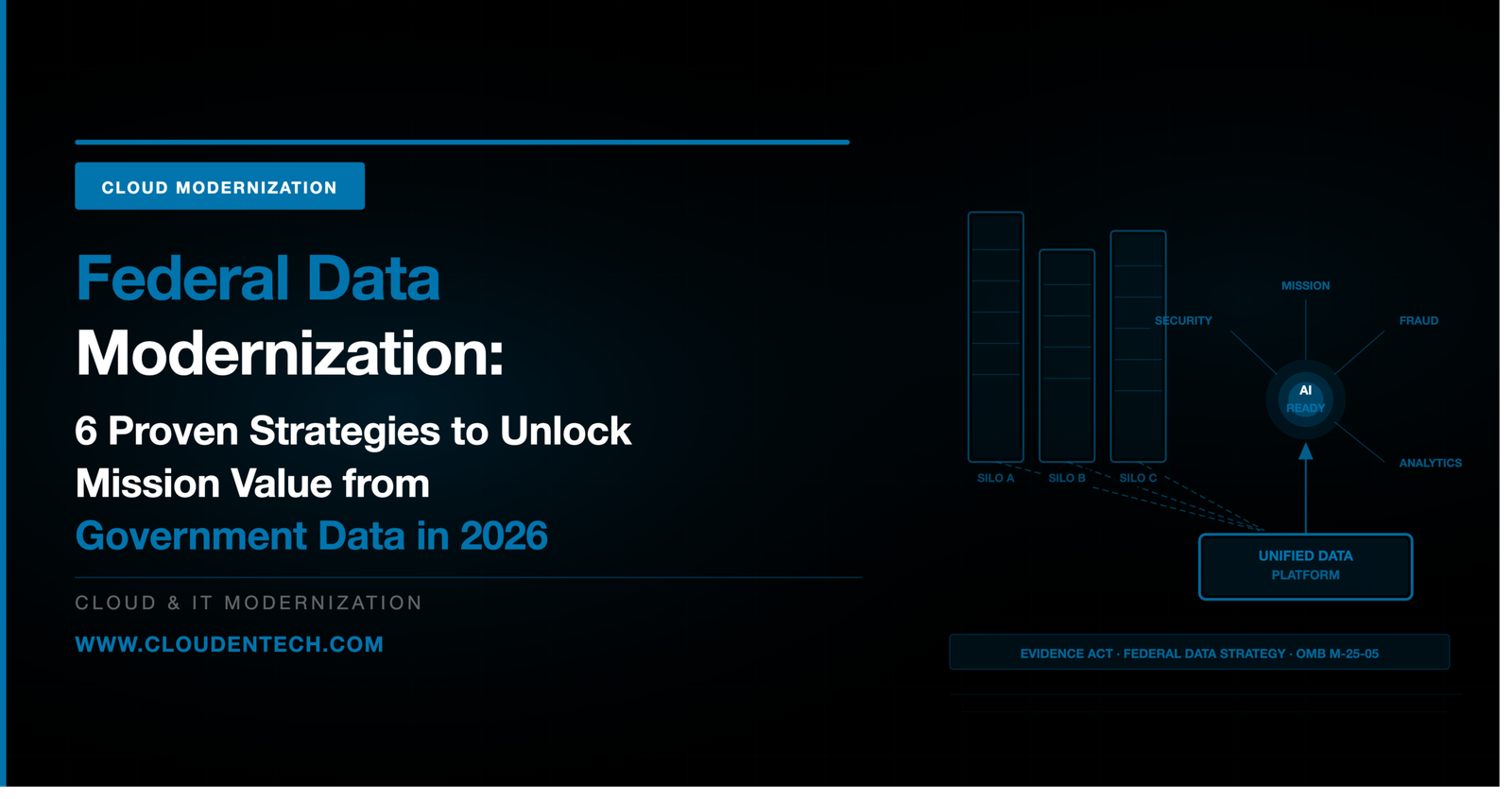
Data silos remain the most pervasive structural barrier. Federal agencies accumulate data across decades of system implementations, each creating its own storage format, access control model, and metadata standard. A mission analytics capability that requires data from three different agency systems faces three different authentication mechanisms, three different data models, and three different governance policies — even when all three systems serve the same mission function. This fragmentation is not the result of poor decisions. It is the accumulated product of 30 years of system-by-system procurement without an enterprise data architecture.
6 Proven Strategies for Federal Data Modernization
Strategy 1: Build a Comprehensive Data Inventory Before Any Platform Decision
The prerequisite for every other data modernization strategy is knowing what data the agency actually holds. This sounds obvious. In practice, building a strong data foundation requires agencies to understand where data resides, who owns it, how current it is, whether it can be securely accessed, and whether it is usable by AI systems for identified mission outcomes. Most agencies cannot answer all five of these questions for all of their data assets. FedScoop
The EVIDENCE Act requires agencies to produce and maintain comprehensive data inventories. But the statutory requirement and the operational reality often diverge. Inventory entries that were accurate when they were created become stale as systems are updated, datasets are moved, and ownership changes. A data inventory that is not actively maintained is not an asset — it is a false confidence generator that causes modernization efforts to fail when they encounter the gap between documented and actual data landscape.
Data inventory for modernization purposes must capture more than location and format. It must capture data quality indicators — completeness, accuracy, consistency, and timeliness — that determine whether a dataset is usable for the intended purpose. It must capture classification and handling requirements that determine where and how the data can be processed. And it must capture the provenance and lineage information that AI governance requires when models are trained on agency data.
The data inventory should drive the modernization roadmap. Datasets that are high-quality, mission-critical, and currently inaccessible due to silo architecture are the first targets for integration work. Datasets that are low-quality and non-critical may be better candidates for remediation or retirement than for integration. Missions vary widely, and so will data strategies. Not only is a clearly articulated strategy essential for guiding work and investments, it is also vital for gaining widespread alignment and the ability to measure return on investment. A good data strategy must address alignment with business strategy as its primary purpose — understanding the business and program mission of the organization to develop a data strategy that will support that mission. CGI Federal
Strategy 2: Implement Federated Data Governance With a Unified Policy Framework
Data governance is the most critical and most consistently underfunded element of federal data modernization. Only 38 percent of federal agencies have a comprehensive and unified AI governance strategy in place. This fragmentation prevents many organizations from moving AI from pilot to production. Governance gaps are the mechanism through which data quality problems perpetuate across generations of system replacement. EY
Federated data governance means establishing agency-level governance policies and standards that apply consistently across all data assets, while delegating operational responsibility for specific datasets to the program offices or mission units that own and understand that data. The Chief Data Officer provides the governance framework — standards, definitions, quality requirements, classification policies, and access control principles. Program offices operate within that framework while maintaining the subject matter expertise needed to actually manage their data.
When Taka Ariga was chief data and chief AI officer at the Office of Personnel Management, he introduced agile governance — a model that allows AI projects to move at the speed of innovation rather than being stymied by federal bureaucracy. He created a 10-person governance team representing every part of the organization to oversee data governance, data readiness, and AI initiatives. Instead of quarterly or monthly meetings where AI might get five minutes of discussion, the small team met every two weeks to guide decisions on data quality and reliability for AI projects. The agile governance model demonstrates that effective federal data governance does not require a massive bureaucratic structure. It requires the right people, meeting at the right cadence, with clear authority to make decisions. FedTech Magazine
A unified policy framework must address data classification and handling, standardized metadata schemas that enable cross-system data discovery, data quality standards and remediation thresholds, access control principles including least-privilege and zero trust alignment, retention and disposition requirements, and the privacy and security controls that govern how data can be shared within and between agencies.
Strategy 3: Migrate to a Unified Cloud Data Platform That Eliminates Silo Architecture
The technical solution to data fragmentation is a unified cloud data platform that consolidates access to agency data assets without requiring all data to be physically co-located. Modern cloud data platforms — data lakes, data lakehouses, and managed data platform services on FedRAMP-authorized cloud infrastructure — provide the technical foundation for breaking down silo architecture while respecting the data sovereignty, classification, and access control requirements that federal data governance demands.
For federal agencies, a modern data foundation can help turn fragmented legacy systems, cloud pilots, and edge environments into one governed environment. This foundation leverages a unified data plane to bring mission data together across on-premise, cloud, and edge — and an intelligent control plane to automate how that data is classified, secured, and delivered to AI. This type of data readiness ensures AI models are fed with clean, well-managed data to enable more accurate outcomes. Federal News Network
The unified cloud data platform does not mean a single monolithic data warehouse. It means a governed data architecture where multiple data sources — including legacy on-premise systems that cannot yet be migrated — are accessible through standardized interfaces, common authentication, and consistent access control policies. Data from a 30-year-old legacy system can be made available to modern analytics and AI tools through well-designed integration architecture without requiring the legacy system itself to be replaced first.
FedRAMP authorization is the non-negotiable starting point for the cloud data platform infrastructure. Any cloud service that processes, stores, or transmits federal data must be FedRAMP-authorized, and the data platform’s architecture must satisfy the security and continuous monitoring requirements of the relevant FedRAMP baseline. For agencies handling CUI, FedRAMP Moderate minimum requirements apply. For agencies with higher-sensitivity data environments, FedRAMP High or equivalent controls may apply.
Cloud data platform selection must also account for the zero trust access control requirements that OMB M-22-09 and the DoD Zero Trust Strategy impose on federal IT environments. A data platform that provides broad, role-based access to all data in a unified environment does not advance zero trust — it simply consolidates the silo problem into a single location. True data platform architecture applies attribute-based, context-aware access controls that limit each user and system to the specific data assets their mission function requires.
Strategy 4: Implement Automated Data Quality Management as a Continuous Discipline
Data quality is not a project. It is an operational discipline that requires continuous investment. A major shift is expected from reactive data cleansing to proactive, automated data quality monitoring. AI-based anomaly detection will become standard in data pipelines, ensuring the accuracy and reliability of data feeding AI systems and mission analytics. Federal News Network
The traditional federal approach to data quality — periodic manual data audits followed by remediation campaigns — cannot keep pace with the data volumes, data ingestion rates, and AI model refresh cycles that 2026 mission environments require. Manual audits produce point-in-time quality assessments that are stale before they are acted upon. Automated data quality monitoring produces continuous quality metrics that alert data owners to emerging problems before they propagate into downstream analytics and AI outputs.
Automated data quality management requires defining quality dimensions for each dataset — completeness, accuracy, consistency, timeliness, and validity — and establishing measurable thresholds for each dimension. Quality monitoring tools continuously evaluate incoming and stored data against these thresholds, producing quality scores and exception reports that data stewards can act on in near-real time rather than discovering problems months after they occurred.
For federal agencies deploying AI on agency data, automated data quality management is also a model governance requirement. AI models trained on data whose quality has not been monitored and validated will degrade as data quality drifts over time. The model governance requirements established by OMB M-25-21 for high-impact AI explicitly require that agencies monitor model performance — and model performance depends directly on the quality of the data feeding those models.
Strategy 5: Establish Cross-Agency Data Sharing Frameworks Under EVIDENCE Act Authority
Federal agencies hold data that is individually useful for each agency’s own mission but dramatically more valuable when shared across agency boundaries. Fraud detection, public health surveillance, economic analysis, national security intelligence, and emergency response all depend on the ability to connect data held by multiple agencies into a coherent analytical picture.
The EVIDENCE Act established the framework for this cross-agency data sharing through the Federal Statistical Research Data Centers, Interagency Data Linkage projects, and the requirement for agencies to develop data sharing agreements under standardized terms. The National Secure Data Service, established to facilitate cross-agency data linkage for evidence-building purposes, represents the institutional infrastructure for realizing the mission value that cross-agency data sharing enables.
In practice, cross-agency data sharing in federal environments faces persistent barriers that the statutory framework does not fully resolve. Different agencies apply different data classification policies to what is nominally the same data. Privacy Act restrictions on personally identifiable information require formal agreements before data sharing can occur. Different technical standards make automated data exchange between agency systems difficult. And the lack of standardized metadata means that even when data is technically accessible, the receiving agency often cannot determine what it represents or how to interpret it reliably.
Federal data modernization programs that address cross-agency sharing specifically — by establishing standardized data exchange formats, harmonized metadata schemas, formal data sharing agreement templates, and common privacy protection mechanisms for shared datasets — produce mission outcomes that no single agency’s internal data modernization effort can achieve independently.
Strategy 6: Build Data Readiness for AI as a Parallel Track to AI Deployment
The most common sequencing mistake in federal AI programs is treating data readiness as something that will be addressed once AI tools are in place. In reality, AI readiness is a prerequisite for AI deployment, not a consequence of it. Agencies that implement data readiness practices and modernize their infrastructure will be positioned to operationalize AI at scale. AI success will not simply be defined by who adopts the most advanced model, but by which agencies treat data readiness as a strategic priority and build for long-term mission impact. FedTech Magazine
While 77 percent of federal leaders believe their agencies can implement AI cost-effectively, only 65 percent believe they can do so quickly. The gap is not ambition — it is execution. Procurement delays, fragmented data, and workforce readiness challenges continue to slow delivery, widening the gap between AI investment and mission impact. ICF
Data readiness for AI has five specific requirements that differ from general data governance requirements. Training data must be labeled, formatted, and structured to the specifications of the models being trained. Feature engineering pipelines must transform raw agency data into the input formats that AI models consume. Data versioning must enable reproducibility — the ability to identify exactly which version of a dataset was used to train a specific model version, for audit and accountability purposes. Data lineage must be traceable from model input back through transformation pipelines to original source systems. And bias assessment must evaluate whether training data systematically over- or under-represents populations in ways that would cause model outputs to be unfair or inaccurate for specific user groups.
AI models are only as reliable as the data used to train them. Incomplete, inaccurate data living in fragmented data environments with inconsistent standards continue to limit the operability and scalability of AI models. Agencies that invest in data readiness as a parallel track to AI capability development — rather than treating it as a prerequisite that must be completely solved before AI work begins — make the most efficient use of both investments by ensuring that data improvements are immediately available to inform model development and validation. Federal News Network
The Data-Mission Connection Every Federal Leader Must Internalize
For federal leaders, the mission imperative is clear: make data trustworthy by default, usable by design, and ready for AI from the start. Agencies that embrace this shift will move faster, innovate safely, and deliver more resilient mission outcomes in 2026 and beyond. Federal News Network
The six strategies described in this post are not an abstract modernization agenda. They are the operational prerequisites for delivering the specific mission outcomes that federal agencies are accountable for. Fraud detection models that cannot run on clean, current data fail to prevent fraud. Disease surveillance systems that cannot integrate data across public health, hospital, and insurance systems fail to detect outbreaks early. Financial management systems that cannot produce accurate, timely reports prevent agencies from making evidence-based budget decisions.
Every mission outcome that federal leaders are responsible for depends on data that is accurate, accessible, governed, and ready for the analytical tools that modern mission delivery requires. Federal data modernization is not an IT investment. It is a mission investment that happens to require IT infrastructure.
How ClouDen Technologies Supports Federal Data Modernization
At ClouDen Technologies, our cloud solutions practice designs and implements the FedRAMP-authorized cloud data platform infrastructure that federal data modernization programs require. We help agencies migrate from fragmented, silo-based data environments to unified cloud data architectures that provide governed, secure, and AI-ready access to agency data assets — without disrupting the mission systems that depend on those data sources during the transition.
Our enterprise architecture practice addresses the portfolio-level data architecture decisions that determine whether a data modernization program produces lasting structural improvements or simply creates a more modern silo. We design data governance frameworks aligned with EVIDENCE Act requirements, CDO Council best practices, and OMB data policy, and we implement the technical architecture that operationalizes those frameworks in production environments.
Our cybersecurity services ensure that the data security and access control requirements that federal data environments must satisfy — FISMA, FedRAMP, zero trust, and data classification requirements — are designed into the data platform architecture from the start rather than added as compliance layers after deployment. Our application development practice builds the data integration pipelines, APIs, and analytical applications that translate a modernized data foundation into mission-visible outcomes.
As an SBA-certified 8(a) small business operating under ISO 27001:2022, ISO 9001:2015, and ISO/IEC 20000-1:2018, we bring the governance discipline that federal data modernization programs require at every level — from the technical architecture of the data platform to the documentation and compliance evidence that authorizing officials and oversight bodies expect. We have supported data and IT modernization programs for the U.S. Department of the Interior, the Federal Reserve Board, and the Defense Finance Agency — environments where data quality and governance directly determine mission outcomes.
If your agency is building a federal data modernization program, establishing data governance infrastructure for AI readiness, or designing the cloud data platform architecture that your mission analytics requirements demand, contact ClouDen Technologies today.
Key Takeaways
Federal data modernization is the critical gap between federal AI ambition and federal AI outcomes. More than 80 percent of federal leaders say their agency’s data is not AI-ready, and only 38 percent of agencies have a comprehensive, unified AI governance strategy in place.
The primary structural barriers to federal data modernization are legacy system fragmentation, siloed ownership structures, workforce gaps in data management expertise, inconsistent data classification and metadata standards, and procurement cycles that do not align IT investment decisions with data readiness requirements.
The six proven strategies are: building a comprehensive data inventory before any platform decision, implementing federated data governance with a unified policy framework, migrating to a unified cloud data platform that eliminates silo architecture, implementing automated data quality management as a continuous discipline, establishing cross-agency data sharing frameworks under EVIDENCE Act authority, and building data readiness for AI as a parallel track to AI deployment.
AI success in federal agencies will not be defined by access to the most advanced models. It will be defined by which agencies treat data readiness as a strategic priority and build the governance, infrastructure, and quality management disciplines that AI models require to produce reliable outcomes at scale.
Federal data modernization is governed by the EVIDENCE Act, the Federal Data Strategy, OMB M-25-05, and the agency-specific requirements of FISMA, FedRAMP, and OMB M-25-21 for AI governance. Data modernization programs that align to this policy framework produce compliance outcomes as a byproduct of mission improvement rather than as a separate compliance track.
Every federal mission outcome depends on data that is accurate, accessible, governed, and AI-ready. Data modernization is a mission investment that requires IT infrastructure — not an IT investment that incidentally supports the mission.
About ClouDen Technologies
ClouDen Technologies is an SBA-certified 8(a) small business delivering cloud, cybersecurity, DevSecOps, enterprise architecture, application development, and management services to U.S. federal agencies, educational institutions, and commercial organizations. ClouDen operates under ISO 9001:2015, ISO/IEC 20000-1:2018, and ISO/IEC 27001:2022.