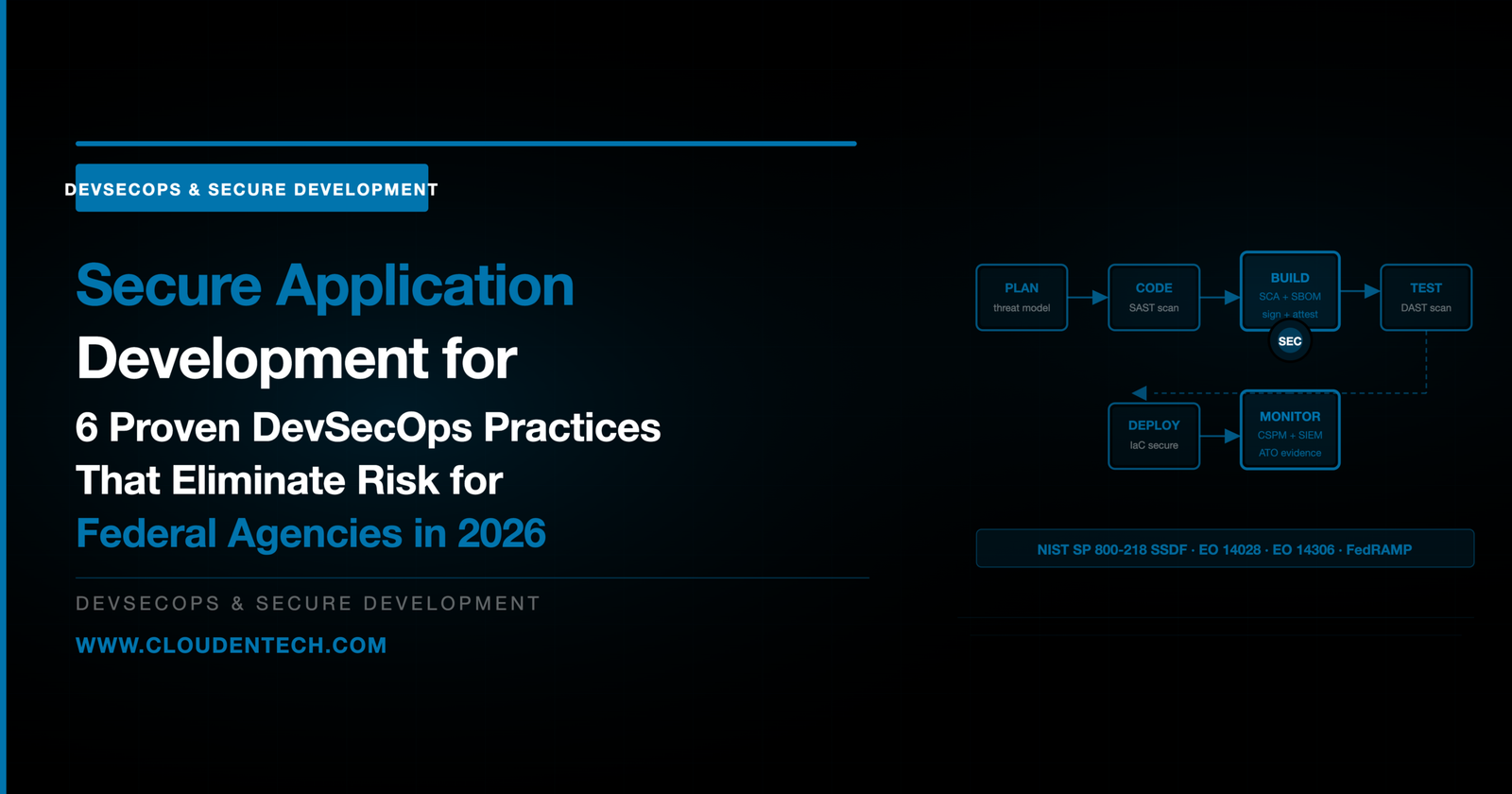
Secure application development for federal agencies is now one of the most precisely defined and actively enforced requirements in the federal IT landscape. What was once a best practice recommendation has been codified into law, operationalized through NIST frameworks, and made a condition of software procurement across the federal government.
Executive Order 14028, “Improving the Nation’s Cybersecurity,” directed federal agencies to require attestation from software suppliers that their development practices comply with U.S. government-specified secure software development standards. NIST responded with the Secure Software Development Framework, formally designated NIST SP 800-218, which defines how organizations must integrate security into every phase of the software development lifecycle. Executive Order 14306, signed in June 2025, extended and reinforced those requirements, directing NIST’s National Cybersecurity Center of Excellence to publish live DevSecOps implementation guidelines demonstrating SSDF practices using modern pipelines and commercially available technology. Those live guidelines were published in March 2026 and are updated on a rolling basis.
The NCCoE DevSecOps live guidelines released March 24, 2026 demonstrate how organizations can implement the security practices and tasks recommended in the NIST SSDF using modern DevSecOps pipelines. As part of NIST’s response to EO 14306, this project showcases secure software development practices that fundamentally bolster the security of DevSecOps pipelines by implementing the SSDF’s recommendations.
The policy and framework alignment is now complete. EO 14028, NIST’s SSDF, OMB’s zero trust strategy, and longstanding FISMA requirements all emphasize software integrity, vulnerability management, and supply chain transparency. What varies is not intent but execution. Frameworks define what good looks like. Programs must still determine how to achieve it at scale. Manual reviews, static documentation, and point-in-time attestations cannot keep pace with modern software factories or continuous delivery models.
This post covers the six proven DevSecOps practices that translate NIST SSDF requirements into operational reality for federal development teams and their contractor partners in 2026.
The Federal Secure Development Mandate: What Agencies and Vendors Must Understand
Before examining the six practices, it is worth precisely understanding what the federal secure development mandate requires — because it applies more broadly than many organizations realize.
Federal agencies, as software purchasers, are required under EO 14028 to receive attestation from software producers that the software’s development complies with U.S. government-specified secure software development practices. Software providers will invariably be impacted due to trickle-down requirements. While a software provider may not categorize itself as a federal contractor since it does not directly sell to the U.S. government, it will still get caught up in requirements that flow down from its customers that do sell products or provide services to the government. This is the reality of how FAR and DFARS clauses work — those clauses trickle down throughout the supply chain.
The NIST SSDF underpins federal software security requirements and increasingly influences private-sector expectations. EO 14028 directed federal agencies to require NIST SSDF attestation from software suppliers, making compliance a prerequisite for government contracts and a signal of maturity for commercial buyers. NIST SSDF defines practice outcomes, not specific implementations. Organizations choose the tools, processes, and technologies that satisfy each practice within their context.
OMB Memorandum M-26-05, issued January 23, 2026, updated the federal approach to SBOM and attestation requirements, moving agencies to an agency-led, risk-based approach. Federal agencies are no longer uniformly required to collect a standardized attestation form, but they may still require SBOMs contractually based on their own risk assessment. M-26-05 specifically notes that agencies requiring an SBOM from a cloud service provider should ask for one covering the runtime production environment. For cloud service providers and software producers seeking FedRAMP authorization, this means two compliance tracks converge: the FedRAMP control assessment a 3PAO performs, and the SSDF attestation required as a software producer. Both are far easier to satisfy when the same underlying evidence — component inventory, provenance, vulnerability state — serves both simultaneously.
Software supply chain security, the DoD’s Cybersecurity Risk Management Construct, and CMMC 2.0 reinforce that software assurance is inseparable from mission assurance. For federal development programs, this means that secure application development is not a security team responsibility added to the end of a development program. It is a development program requirement that shapes architecture decisions, tool selection, pipeline design, and team structure from the beginning.
6 Proven DevSecOps Practices That Eliminate Risk in Federal Application Development
Practice 1: Threat Modeling Before the First Line of Code
The most cost-effective security investment in any software development program is threat modeling during the design phase. The cost to fix a security vulnerability discovered at design review is measured in hours. The same vulnerability discovered during an ATO review or post-deployment is measured in months of remediation work and potential mission disruption.
Threat modeling identifies attack surfaces, trust boundaries, and potential threat actors before architectural commitments are made. For federal applications, threat modeling must be aligned to the specific compliance context of the system being developed — the FISMA categorization level, the data classification of information the system handles, the zero trust controls that govern how components communicate, and the FedRAMP authorization boundary that defines what is in scope for security controls.
The NIST SSDF’s Prepare the Organization practice family specifically addresses the need for organizations to establish security-aware development environments and requirements before development work begins. This includes defining security requirements derived from the mission context of the application, establishing the threat model that informs every subsequent architectural and implementation decision, and ensuring that developers understand the security requirements that apply to what they are building from day one.
For federal development programs operating under CMMC 2.0, threat modeling is also directly relevant to access control and configuration management requirements. A system whose threat model has not been documented cannot demonstrate that its access controls are appropriately calibrated to the actual threat environment it operates in. This is exactly the type of gap that C3PAO assessors find during Level 2 certification reviews.
Practice 2: Automated Static Application Security Testing Integrated Into Every Commit
Static Application Security Testing analyzes source code for security vulnerabilities without executing the application. When integrated directly into the development pipeline — running automatically on every code commit before it can be merged — SAST becomes the first automated security gate in the pipeline, catching vulnerabilities at the earliest possible point in the development lifecycle.
The adoption of DevSecOps, a methodology that integrates security into every phase of software development, is accelerating in the federal environment. The key word is integrates. SAST tools that run periodically as separate scans, outside the development workflow, produce findings that developers must address in batches, often long after the code in question was written. SAST tools integrated into the commit pipeline produce findings immediately, in the context of the code that caused them, when the developer is still actively working in that area of the codebase.
For federal development programs, SAST integration must produce findings in formats that the ATO package can consume. The NIST SSDF SP 800-218 framework requires that organizations review and test code to identify and address vulnerabilities and coding errors throughout the development lifecycle, and that the evidence of those reviews and tests be retained. SAST pipeline integration, when properly configured to retain scan results with timestamp and version information, produces exactly this evidence automatically as a byproduct of normal development activity rather than as a manually compiled compliance artifact.
SAST tools must be tuned for federal environments. Default SAST configurations produce false positive rates that overwhelm development teams, creating alert fatigue that causes real vulnerabilities to be dismissed alongside false positives. Federal development programs should establish a baseline false positive rate target — industry SOC teams target below 5 percent for security alerting generally — and tune SAST rules against that baseline before integrating the tool into the primary development pipeline.
Practice 3: Software Composition Analysis and Real-Time Dependency Monitoring
Modern federal applications are built substantially from third-party components — open-source libraries, commercial frameworks, containerized dependencies, and cloud platform services. The Log4j vulnerability, which affected thousands of applications globally including many federal systems, demonstrated how a single vulnerability in a widely-used open-source library can create immediate, severe risk across an entire software portfolio.
In 2026, securing the software supply chain means establishing absolute control over source code and dependencies — curation of open-source libraries at the point of entry — and over build pipelines, ensuring the integrity of the environment where code becomes binaries. Software Composition Analysis tools maintain an inventory of every third-party component in an application, track known vulnerabilities against that inventory, and alert development and security teams when a component in use receives a new CVE rating.
Maintaining an up-to-date SBOM and inventory of open-source and third-party components, scanning code bases and container images for known vulnerabilities as part of the CI/CD pipeline, and using SCA tools early in development to block high-risk libraries before they enter production are all now standard expectations in federal software supply chain security. EO 14028 specifically accelerated the federal standards, attestation forms, and procurement language that software vendors building for the federal government must satisfy.
A Software Bill of Materials is the formal, machine-readable output of a mature SCA program. Under OMB M-26-05, agencies may require SBOMs contractually based on their own risk assessment, and the DoD’s Army SBOM mandate and FDA medical device requirements continue in force regardless of M-26-05’s changes to the uniform attestation approach. Federal development programs should generate SBOMs automatically for every build, using established formats such as CycloneDX or SPDX, and maintain those SBOMs as continuously accurate records of the runtime production environment.
The queryable, immutable record of supply chain data answers three questions that auditors and Authorizing Officials regularly ask: what is in our software, how did it get there, and is it safe right now. When an auditor asks whether a vulnerable library was present in production on a specific date, a mature SBOM program answers that question with a database query rather than a manual investigation.
Practice 4: Secure CI/CD Pipeline Hardening and Code Integrity
The build pipeline itself is an attack surface. The SolarWinds supply chain attack succeeded by compromising the build pipeline, injecting malicious code into software that was then digitally signed and distributed as legitimate. Federal development programs that focus exclusively on securing application code without securing the environment where that code is built, tested, and packaged have addressed half the problem.
Secure CI/CD hardening for federal development programs requires strong CI/CD hardening including requiring automated code signing for all builds and storing signing keys in hardware security modules. Running static and dynamic analysis on code changes, using isolated build agents for external contributions, and implementing a zero-trust model even within development environments are all standard practices for federal-grade pipeline security.
Code signing provides integrity verification — confirming that a software artifact has not been modified since it was built by an authorized pipeline. For federal applications, code signing is also a SSDF attestation artifact. The NIST SSDF Practice PO.5.1 requires that organizations implement appropriate protections of software releases, including protecting software release artifacts from tampering and unauthorized access. A signed build artifact with a verified signature chain from source code through release represents exactly this protection.
Container security deserves specific attention. Federal development programs increasingly deploy applications in containerized environments — Kubernetes clusters on FedRAMP-authorized cloud platforms, container registries within agency-controlled infrastructure, and container images pulled from external registries. Each layer of this environment is a potential supply chain attack surface. Container images must be scanned for vulnerabilities before deployment, signed to verify integrity, and pulled only from verified, approved registries. Runtime container security monitoring must detect anomalous behavior within running containers that static pre-deployment scanning cannot anticipate.
Practice 5: Dynamic Application Security Testing and Pre-Production Security Validation
Dynamic Application Security Testing tests running applications for security vulnerabilities that only emerge at runtime — SQL injection, cross-site scripting, authentication bypasses, insecure API endpoints, and similar vulnerabilities that static analysis cannot reliably detect because they depend on the interaction between code and its runtime environment.
DAST must be integrated into the pipeline at the pre-production stage, running against a staging environment that accurately reflects the production configuration. DAST scans run against non-representative staging environments produce findings that do not reflect production risk. Federal development programs must maintain staging environments that mirror production security controls, including authentication mechanisms, network security configurations, and data handling policies.
For federal applications seeking FedRAMP authorization or maintaining existing authorizations, DAST serves a dual purpose. It is a security quality gate for the application and it produces evidence of application security testing that the ATO package and continuous monitoring program require. When DAST is integrated into the pipeline and run regularly as part of pre-production validation, the evidence it produces is automatically timestamped, versioned, and retained — satisfying the SSDF’s evidence retention requirements without additional documentation effort.
API security deserves particular attention within federal DAST programs. Federal applications increasingly expose functionality through APIs, and those APIs represent access points to sensitive data and mission-critical functions. DAST tools configured to test API endpoints against OWASP API Security Top 10 vulnerabilities provide specific, actionable security validation for a surface area that generic DAST configurations frequently undertest. For applications serving as data sources or service providers in a larger federal data ecosystem, API security validation is not optional.
Practice 6: Automated Compliance Artifact Generation and ATO-Ready Evidence
The sixth practice is the one that most directly distinguishes federal secure development from commercial secure development. Federal development programs do not just need to produce secure applications. They need to produce the documented evidence that the ATO process, FedRAMP continuous monitoring, and SSDF attestation requirements demand. And they need to produce that evidence continuously, not as a manual compilation exercise before each assessment.
The NCCoE’s March 2026 DevSecOps live guidelines specifically address automatic generation of security and compliance artifacts throughout the development process, including software development, builds, packaging, distribution, and deployment stages. These artifacts provide the evidence an authorizing official, a 3PAO assessor, or a FedRAMP reviewer needs to verify that security controls are working as documented, without requiring the development team to stop everything and compile a package from scratch.
FedRAMP rewards CSPs whose supply chain evidence is a natural output of how they build software, not a scramble before an assessment. Structure data once and let it serve both the control baseline and the SSDF attestation. This principle extends to all federal compliance artifacts — the development pipeline should be designed so that security evidence is a byproduct of normal development activity rather than a separate compliance documentation effort.
In practical terms, this means configuring SAST scan results to be retained with build metadata, SBOM outputs to be stored in versioned repositories, DAST reports to be archived with environment configuration snapshots, code signing records to be maintained with artifact provenance information, and pipeline execution logs to be captured with sufficient detail to reconstruct the security validation history of any deployed artifact. When all of these evidence streams are automatically generated and retained, the ATO documentation package is assembled from verified operational records rather than from retrospective accounts of what the development team believes it did.
The move toward OSCAL-formatted compliance documentation, which FedRAMP is advancing under CR26 with enforcement beginning January 2027, creates an additional incentive for automated evidence generation. Machine-readable compliance artifacts in OSCAL format are the expected submission standard for the next era of federal software authorization. Development pipelines that generate OSCAL-compatible evidence automatically will be significantly better positioned for CR26 compliance than those requiring manual document conversion.
The SSDF Attestation: What Federal Vendors Must Provide
For software producers selling to or through the federal government, SSDF attestation is a practical procurement requirement that shapes how development programs are documented and governed.
Software producers selling to the federal government are expected to attest that they follow secure development practices aligned with NIST SSDF SP 800-218, using the attestation form CISA and OMB have published. First-party attestation is recommended for meeting EO 14028 requirements for most procurement scenarios, with second or third-party attestation required when a risk-based approach determines the additional verification is necessary for higher-risk software.
The attestation is not a checkbox. It is a declaration by the software producer that their development practices satisfy SSDF requirements, backed by the evidence that the development pipeline generates. Organizations that produce credible SSDF attestations supported by automated pipeline evidence are in a fundamentally stronger compliance position — and a stronger competitive position for federal contracts — than those that generate attestations from manual documentation without verifiable underlying evidence.
How ClouDen Technologies Builds Secure Federal Applications
At ClouDen Technologies, our application development practice builds secure-by-design federal applications where the six DevSecOps practices described in this post are embedded in the development architecture from the first sprint, not added as compliance steps before delivery.
We design development pipelines with SAST, SCA, DAST, and container security scanning integrated as automated gates, producing the compliance artifact streams that federal ATO packages and SSDF attestation requirements demand. Our DevSecOps services provide the pipeline engineering, security tooling integration, and DevSecOps operational support that federal development programs require — including DevSecOps consulting, DevSecOps as a service, and embedded DevSecOps support for agencies building internal capability.
Our cybersecurity practice provides the threat modeling, application security architecture, and continuous monitoring integration that connects secure development practices to the broader security posture that FedRAMP authorization and FISMA compliance require. Our cloud solutions practice ensures that the cloud environments where federal applications are deployed and operated satisfy the infrastructure security requirements that complement application-level security controls.
As an SBA-certified 8(a) small business operating under ISO 27001:2022, ISO 9001:2015, and ISO/IEC 20000-1:2018, we bring the governance discipline that federal software development programs require. We have built and secured applications for the U.S. Department of the Interior, the Federal Reserve Board, and the Defense Finance Agency — environments where application security failures carry real mission consequences and where compliance evidence must withstand rigorous scrutiny.
If your agency or organization is building secure federal applications, establishing a DevSecOps program aligned with NIST SSDF requirements, or preparing for SSDF attestation, contact ClouDen Technologies today.
Key Takeaways
Secure application development for federal agencies is mandated through EO 14028, EO 14306, NIST SP 800-218 SSDF, FedRAMP, and FISMA. The NCCoE published live DevSecOps implementation guidelines in March 2026 demonstrating how organizations can implement SSDF practices using modern pipelines, updated on a rolling basis.
The federal secure development mandate applies through the supply chain. Software producers who do not sell directly to the government but supply software to companies that do are subject to SSDF attestation requirements through FAR and DFARS flow-down clauses.
OMB M-26-05, January 2026, moved federal agencies to an agency-led, risk-based approach to SBOM and attestation requirements. Agencies may still require SBOMs contractually, and the DoD Army mandate, FDA medical device requirements, and agency-specific policies continue in force.
The six proven DevSecOps practices are: threat modeling before the first line of code, automated SAST integrated into every commit, SCA and real-time dependency monitoring with SBOM generation, secure CI/CD pipeline hardening with code signing, DAST pre-production validation including API security testing, and automated compliance artifact generation that produces ATO-ready evidence as a byproduct of normal development activity.
FedRAMP CR26 enforcement begins January 2027, introducing OSCAL-format machine-readable compliance documentation as the expected standard. Development pipelines that generate OSCAL-compatible evidence automatically will be significantly better positioned for CR26 compliance than those requiring manual document conversion.
The SSDF attestation required of federal software producers is a declaration backed by verifiable pipeline evidence. Organizations that produce attestations supported by automated, retained compliance artifacts are in a stronger legal and competitive position than those generating attestations from manual documentation alone.
About ClouDen Technologies
ClouDen Technologies is an SBA-certified 8(a) small business delivering cloud, cybersecurity, DevSecOps, enterprise architecture, application development, and management services to U.S. federal agencies, educational institutions, and commercial organizations. ClouDen operates under ISO 9001:2015, ISO/IEC 20000-1:2018, and ISO/IEC 27001:2022