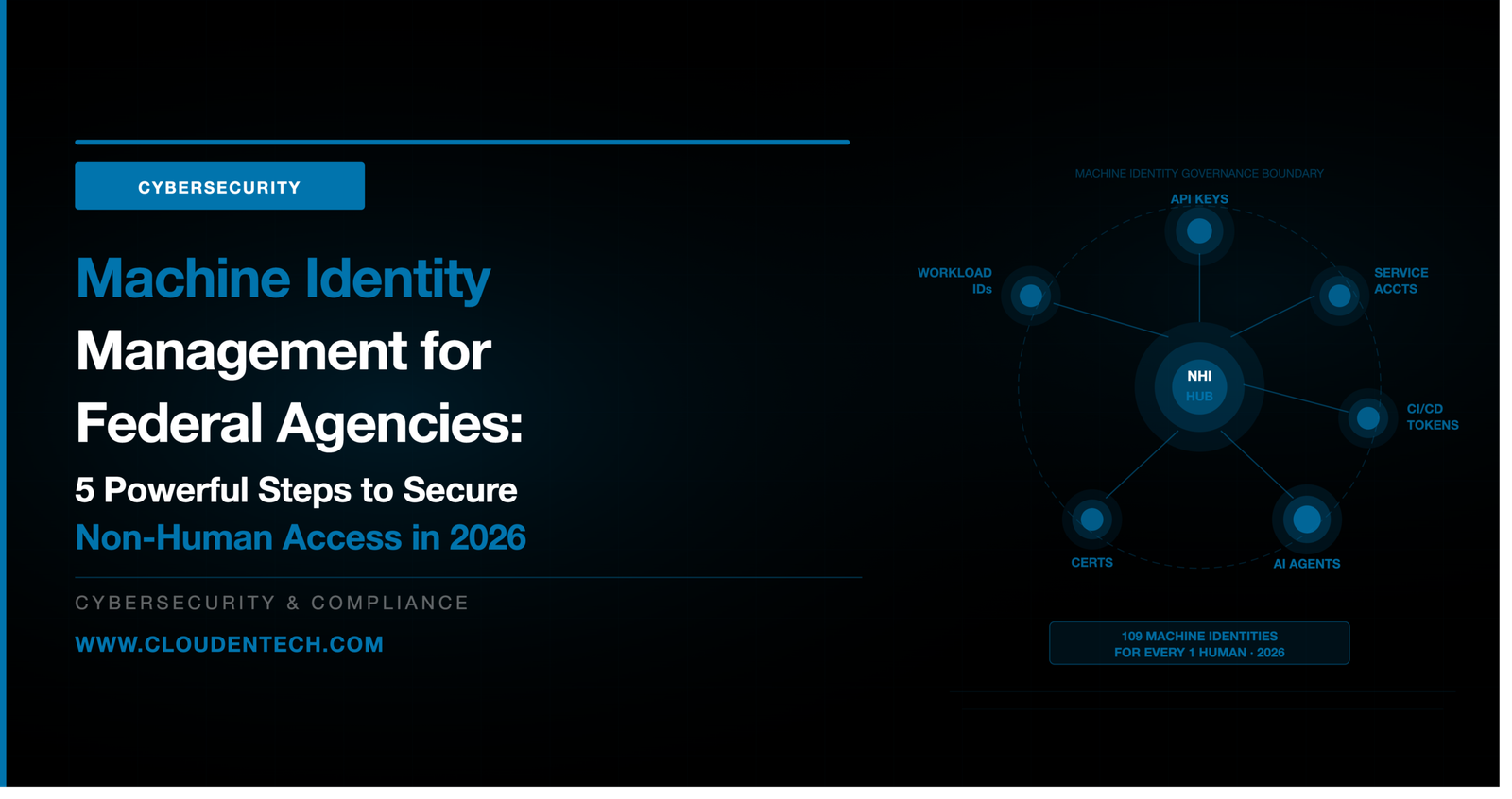
Machine identity management for federal agencies is the most critical gap in the federal zero trust implementation picture in 2026. Federal zero trust efforts have largely focused on securing human users through identity, authentication, and access controls. But inside agency environments, a growing amount of network activity now comes from nonhuman identities such as service accounts, application programming interfaces, and automated workloads that often operate with broad privileges and limited oversight.
The scale of the problem is specific and measurable. Machine identities now outnumber humans 109 to 1 in 2026, up from 82 to 1 the year prior. According to the GitGuardian State of Secrets Sprawl Report 2026, non-human identities — the API keys, service accounts, and machine tokens that keep the lights on — now outnumber human users by a staggering 80 to 1 ratio, and in 2025 alone, 29 million secrets were detected on public GitHub, with AI coding assistants fueling an 81 percent year-over-year jump in AI-service credential leaks. Axis IntelligenceNhimg
Two thirds of enterprises have suffered a breach via a compromised non-human identity specifically. Ninety percent of organizations report at least one identity-related breach in the past twelve months, and 83 percent report two or more, per Palo Alto Networks’ 2026 Identity Security Landscape report. VeeamAxis Intelligence
For federal agencies, the consequences of these statistics are operational. Service accounts, APIs, applications, containers, and automated workloads increasingly operate across federal networks with elevated privileges and persistent access to sensitive systems and data. Unlike human identities, however, many of these nonhuman identities lack centralized governance, consistent lifecycle management, or even basic visibility. The result is an expanding attack surface that many agencies still struggle to fully inventory or secure. FedTech Magazine
FedTech Magazine identified machine identity management as the nonhuman side of federal zero trust and one of the most critical federal IT priorities for 2026. NIST and CISA jointly released draft Interagency Report 8587 in December 2025 — the most comprehensive federal guidance on token and assertion security since the SolarWinds incident — specifically providing implementation guidance to help federal agencies and cloud service providers protect identity tokens and assertions from forgery, theft, and misuse.
This post covers exactly what machine identities are, why they represent such a significant and underaddressed risk in federal environments, what NIST IR 8587 requires, and the five concrete steps every federal agency must take to govern machine identities with the same rigor applied to human access.
What Machine Identities Are and Why Federal Agencies Have So Many
A machine identity is any digital identity that belongs to software rather than a person. These are the automated actors in federal environments — the service accounts, workloads, RPA bots, CI/CD pipelines, and AI agents that authenticate and take action without a human driving each step. Each one relies on credentials such as API keys, tokens, certificates, or passwords to prove who it is.
Studies show non-human identities — service accounts, API keys, certificates, machine tokens — have grown by over 40 percent year-on-year, and now outnumber human identities in some enterprises by ratios ranging from 40 to 1 to over 100 to 1. Medium
The growth rate in federal environments specifically reflects three converging trends. First, cloud migration. Every federal application that moves to a FedRAMP-authorized cloud platform generates new machine identities — IAM roles, managed identities, workload service principals, and API credentials that the application uses to authenticate to cloud services. A single cloud-native federal application may generate dozens of distinct machine identities across its components.
Second, DevSecOps adoption. Every automated pipeline that builds, scans, tests, and deploys federal software requires machine credentials to authenticate to source code repositories, artifact registries, container platforms, security scanning tools, and deployment targets. A mature DevSecOps pipeline generates and consumes machine credentials at every stage of every pipeline execution.
Third, AI deployment. As public sector organizations begin deploying AI copilots, autonomous workflows, and agentic AI systems, identity governance requirements become more critical. Agencies need to answer questions such as: what can this AI agent access, how does it authenticate, what data can it read and write, and how is its access revoked when its task is complete. A CyberArk-backed analysis found machine identities now outnumber humans approximately 45 to 1 — that is 98 percent of accounts being non-human. Agentic AI adds more autonomy, deeper data access, and complex delegation. Using service accounts as AI agent identities means shared credentials, unclear lifecycle, and zero auditability. Federal News NetworkIden
The Federal Policy Framework: NIST IR 8587 and What It Requires
Developed in coordination with CISA’s Joint Cyber Defense Collaborative and in response to Executive Order 14144, NIST Interagency Report 8587 provides implementation guidance to help federal agencies and cloud service providers protect identity tokens and assertions from forgery, theft, and misuse. Building on updates to NIST SP 800-53, the report outlines principles for cloud service providers and consuming agencies, details architectural considerations for identity providers and authorization servers, and recommends enhancements to key management, token verification, and lifecycle controls. The report also addresses threats demonstrated in recent high-profile attacks, emphasizes the importance of secure and configurable cloud services, and provides technical recommendations to safeguard single sign-on, federation, and API access scenarios. nist
NIST IR 8587 matters for machine identity management specifically because tokens and assertions are the primary credential mechanism for machine-to-machine authentication. When a service account authenticates to another service, it presents a token — an assertion of its identity and permissions. When a CI/CD pipeline deploys to a cloud environment, it presents a token. When an AI agent calls an agency API, it presents an assertion. The security of all of these interactions depends on how those tokens are generated, signed, validated, and revoked.
The report covers five specific areas of guidance. Key protection and isolation addresses how the signing keys that produce tokens must be protected, including hardware security module requirements. Token validity periods address how long tokens should remain valid before requiring re-authentication — a critical control for limiting the damage from stolen tokens. Signing key validity periods address certificate and key rotation requirements. Token verification requirements address how relying parties must validate tokens before granting access. And federation architecture guidance addresses how identity assertions should be structured and validated in multi-agency and cloud service provider contexts.
NIST IR 8587 mentions “non-person entity” exactly once, in the base control statement: “Employ identity providers and authorization servers to manage user, device, and non-person entity identities, attributes, and access rights.” For a 47-page document about protecting tokens and assertions, the absence of substantive guidance on AI agent authentication is a notable gap. The Model Context Protocol Authorization Specification was finalized in June 2025, and OAuth 2.1 is now the standard for AI agent authentication. Federal agencies deploying AI agents need governance frameworks that IR 8587 alone does not yet fully address. Rockcybermusings
This gap means that federal agencies implementing machine identity management programs must go beyond NIST IR 8587 and apply the broader zero trust principles of NIST SP 800-207 to non-person entity identities — which requires verifying communication between every single component with the same rigor applied to a human user, where no entity, human or machine, gets a free pass based on where it is sitting on the network. Nhimg
The Certificate Lifecycle Crisis Federal Agencies Must Address Immediately
One specific dimension of machine identity management that federal agencies cannot defer is TLS certificate lifecycle management. Under CA/Browser Forum Ballot SC-081v3, approved unanimously on April 11, 2025, maximum public TLS certificate validity drops from 398 days to 200 days starting March 15, 2026, to 100 days starting March 15, 2027, and to 47 days starting March 15, 2029 — an 8.47 times increase in annual renewal frequency from today’s baseline. Axis Intelligence
The 2026 deadline of 200-day maximum validity is the first to take effect, giving organizations roughly nine months from publication to establish automated certificate lifecycle management before manual renewal processes become operationally unsustainable. Axis Intelligence
For federal agencies that currently manage TLS certificate renewals through manual processes — which describes the majority of federal civilian agencies — this timeline is already past the point where the transition to automation can be comfortable. Manual certificate management at the renewal frequency that 100-day maximum validity requires in 2027 is operationally impossible at the scale of a medium or large federal agency. Certificate expiration failures — which cause service outages, authentication failures, and compliance findings — will become a routine occurrence for agencies that have not automated certificate lifecycle management before the shorter validity windows take effect.
5 Powerful Steps to Secure Machine Identity in Federal Environments
Step 1: Build a Complete Machine Identity Inventory Before Any Governance Program Can Work
A practical governance framework — continuous inventory, ownership, least privilege, rotation, monitoring, and zero trust — cuts NHI risk without slowing automation down. But that framework cannot be applied to machine identities that the agency does not know exist. The starting point for every machine identity management program is a complete, continuously maintained inventory of every non-human identity in the federal environment. Veeam
The inventory must cover every service account in every system — including the accounts that were created years ago for specific integrations and have not been reviewed since. It must cover API keys, including those embedded in application configuration files, stored in secrets managers, and issued to third-party integrations. It must cover TLS certificates, including all internal certificates for service-to-service communication and all public-facing certificates. It must cover machine tokens issued to CI/CD pipelines, monitoring agents, and automation tools. And it must cover the AI agent identities that are being created as agencies deploy copilots and autonomous workflow tools.
NHIs are scattered across secrets managers, CI/CD pipelines, Kubernetes clusters, and cloud environments. Without a centralized inventory, the potential for lateral movement across the network is a statistical certainty when any one of those identities is compromised. Nhimg
For federal agencies, the inventory must also capture the specific permissions associated with each machine identity — what it can access, what operations it can perform, and whether those permissions are consistent with the principle of least privilege. Most agencies will find that their machine identity inventory reveals hundreds or thousands of over-privileged accounts that have accumulated permissions through years of operational additions without corresponding removals.
Step 2: Eliminate Long-Lived Static Credentials Through Short-Lived Tokens and Workload Identity Federation
The most common and most dangerous form of machine identity credential in federal environments is the long-lived static credential — an API key, password, or access token that is generated once, distributed to the services that need it, and then left in place indefinitely because rotating it is operationally complex. Long-lived credentials that are never rotated, never reviewed, and often forgotten are the primary mechanism through which machine identity compromises occur.
Zero trust becomes meaningful when access is re-evaluated at runtime and tied to current identity state, task scope, and system context. For non-human identities, that means no standing assumption that yesterday’s approval still applies today. Nhimg
Workload identity federation is the technical mechanism that enables this dynamic model for machine credentials. Instead of distributing a static API key to every service that needs to authenticate, workload identity federation allows each service to authenticate using its runtime identity — the identity that the cloud platform or Kubernetes cluster assigns to the workload based on its configuration. That runtime identity is short-lived, scoped to the specific workload, and does not require a static credential that can be exfiltrated and misused.
For Kubernetes workloads, OIDC-based workload identity enables pods to authenticate to cloud services using their Kubernetes service account token, which is automatically generated and rotated by the cluster rather than manually managed. For CI/CD pipelines, OIDC federation allows pipelines to authenticate to deployment targets using assertions about the pipeline run rather than static deployment credentials that must be stored and rotated. These patterns eliminate the class of static credential that represents the most pervasive machine identity security risk in federal environments.
Step 3: Apply Zero Trust Least Privilege to Every Machine Identity
That challenge is becoming more urgent as agencies modernize applications, adopt cloud-native architectures, and automate more operational workflows. Federal zero trust strategies cannot stop at human users. Machine identities like service accounts, APIs, and automated workloads require the same governance rigor. FedTech Magazine
Zero trust least privilege for machine identities means that each machine identity has access only to the specific resources and operations that its defined function requires — and that access is granted for the minimum duration necessary and revoked when the function is complete. A CI/CD pipeline identity that needs to push a container image to a specific registry should have permission to push to that registry and nothing else. It should not have permission to read secrets, modify cluster configurations, or access other registries that are not part of its deployment function.
In practice, federal agencies apply least privilege to machine identities by defining the specific permissions each machine identity needs before it is created, using IAM policy frameworks that enable fine-grained, resource-specific, operation-specific permission grants rather than broad role assignments, and reviewing machine identity permissions on the same cadence as human identity access reviews. Both human and machine identities use only about 2 percent of their granted permissions — leaving the rest unused and representing unnecessary attack surface that adversaries can exploit if they compromise the identity. Iden
Separation of duties applies to machine identities as well as human identities. An AI agent that processes financial transactions should not also have access to the audit log system that records those transactions. A monitoring agent that reads security event data should not have permission to delete or modify that data. These separation requirements must be explicitly designed into machine identity permission structures rather than assumed to be enforced by the underlying systems.
Step 4: Implement Automated Secrets Detection and Rotation to Eliminate Secrets Sprawl
In 2025 alone, 29 million secrets were detected on public GitHub. AI coding assistants have fueled an 81 percent year-over-year jump in AI-service credential leaks. Internal repositories — the ones federal development teams think are safe — are actually six times more likely to contain hardcoded secrets than public ones. If an attacker gains a foothold, the potential for lateral movement across the network is a statistical certainty. Nhimg
Secrets sprawl — the accumulation of machine credentials embedded in source code, configuration files, container images, and CI/CD pipeline configurations — is the most pervasive machine identity security failure in federal development environments. Every hardcoded API key, database password, or access token embedded in source code is a credential that persists for the lifetime of that code, that is replicated into every repository fork and clone, and that cannot be easily rotated without modifying and redeploying every system that uses it.
Addressing secrets sprawl requires three parallel programs. First, automated secrets detection scanning must run on every code repository — including internal repositories — continuously, identifying credentials embedded in code and configuration files before they can be exploited. Pre-commit hooks that reject commits containing credential patterns prevent new secrets from being introduced. Repository-wide scanning identifies existing secrets that must be rotated and removed.
Second, a centralized secrets manager must replace all hardcoded credentials in federal applications. Applications should retrieve credentials from the secrets manager at runtime, receiving short-lived dynamic credentials that are automatically rotated rather than static credentials that persist until manually changed.
Third, certificate and key rotation must be automated. Gartner now identifies certificate lifecycle complexity as a bigger operational challenge for many organizations than multi-factor authentication deployment. Automated certificate lifecycle management that discovers, monitors, renews, and rotates certificates without manual intervention is not optional for federal agencies facing the 100-day maximum validity requirement taking effect in March 2027. Axis Intelligence
Step 5: Extend Continuous Monitoring to Cover Machine Identity Behavior, Not Just Human User Activity
Federal security operations centers that monitor human user behavior for anomalies but do not apply equivalent monitoring to machine identity behavior have instrumented half their identity attack surface. Zero trust programs in 2026 are increasingly extending continuous verification and least privilege to service-to-service traffic, not just person-to-application traffic. Swif
Machine identity behavioral monitoring applies the same principles as user and entity behavior analytics — establishing baselines, detecting deviations, and alerting on anomalies — to service accounts, API credentials, CI/CD pipeline identities, and AI agent behaviors. A service account that has been making the same types of API calls to the same set of endpoints for months, suddenly accessing a new resource or executing an unusual operation sequence, is exhibiting exactly the behavioral anomaly that could indicate compromise.
IAM teams need metrics, ownership, and zero trust evaluation models that can govern machine and agent identities continuously, not just at review time. This means that machine identity monitoring must produce real-time alerting on behavioral anomalies — not periodic reports reviewed monthly — and that the governance structure for machine identities must include defined response procedures for anomalous machine identity behavior that are as mature as the incident response procedures for human account compromise. NHI Management Group
For AI agent identities specifically, behavioral monitoring must address the unique characteristics of AI agent behavior: the delegation chains through which agents act on behalf of human users, the tool-use patterns that agents follow when executing tasks, and the data access patterns that distinguish legitimate agent operation from compromised or misbehaving agent activity. AI agents are becoming the largest unseen workforce inside critical systems — and current identity and zero trust controls were never designed for them. Building the behavioral monitoring capability to govern AI agent identities is one of the most forward-looking and most necessary investments federal agencies can make in 2026. Medium
The Connection to Federal Zero Trust Requirements
Machine identity management is not a separate program from federal zero trust compliance. It is the missing half of zero trust that most agency implementations have not yet addressed.
OMB M-22-09 requires that federal agencies employ centralized identity management systems and enforce phishing-resistant multi-factor authentication. These requirements are expressed primarily in terms of human user identity — but NIST SP 800-207, the zero trust architecture standard that underlies the federal mandate, is explicit that no entity, human or machine, should be trusted implicitly based on network location. Every service-to-service call, every API interaction, and every machine authentication must be validated against identity and authorization policy.
The CISA Zero Trust Maturity Model’s identity pillar includes non-person entity management as a specific domain within the identity pillar — one of the less mature areas across the federal civilian enterprise as of CISA’s most recent maturity assessment. Agencies that have achieved intermediate or advanced maturity for human identity controls but have not addressed non-person entity governance have not achieved the identity pillar maturity that their zero trust programs claim.
For DoD agencies and defense contractors, the DoD Zero Trust Strategy’s User pillar specifically addresses the governance of machine identities as a Target Level zero trust requirement. Machine identities that operate without least-privilege access controls, without lifecycle management, and without behavioral monitoring are a direct gap in DoD zero trust compliance that will surface during DoD authorization reviews as the FY2027 deadline approaches.
How ClouDen Technologies Supports Machine Identity Management
At ClouDen Technologies, our cybersecurity services include the identity security architecture, risk management, and compliance support that federal machine identity management programs require. We help agencies inventory their machine identity environments, design least-privilege governance frameworks aligned with NIST IR 8587 and NIST SP 800-207, implement automated secrets detection and rotation programs, and build the behavioral monitoring capability that extends continuous verification to non-human identities.
Our DevSecOps practice addresses the specific machine identity management challenges that emerge in federal development pipelines — implementing workload identity federation to eliminate static CI/CD credentials, integrating secrets scanning into development pipelines, and designing container and Kubernetes identity architectures that apply zero trust principles to service-to-service communication. Our cloud solutions practice designs the FedRAMP-authorized cloud identity architectures that enable short-lived dynamic credentials, workload identity, and automated certificate lifecycle management aligned with the CA/Browser Forum’s shortened validity requirements.
Our enterprise architecture practice addresses the cross-system identity governance decisions that determine whether a machine identity management program produces consistent governance across an agency’s full technology portfolio or leaves governance gaps at the boundaries between systems. Our application development practice builds federal applications that consume machine credentials from centralized secrets managers rather than hardcoding credentials in source code or configuration — eliminating secrets sprawl at the source rather than remediating it after the fact.
As an SBA-certified 8(a) small business operating under ISO 27001:2022, ISO 9001:2015, and ISO/IEC 20000-1:2018, we bring the governance discipline that machine identity management programs demand.
If your agency is developing a machine identity inventory, building a non-human identity governance program, or addressing the certificate lifecycle automation requirements that CA/Browser Forum Ballot SC-081v3 is driving, contact ClouDen Technologies today.
Key Takeaways
Machine identity management for federal agencies is the most critical unaddressed gap in federal zero trust implementation. Machine identities now outnumber human identities 109 to 1 in 2026, and two thirds of enterprises have suffered a breach via a compromised non-human identity specifically.
NIST and CISA jointly released Interagency Report 8587 in December 2025, providing the most comprehensive federal token security guidance since SolarWinds. It covers key protection, token validity periods, signing key rotation, and federation architecture — but has a notable gap on AI agent identity that agencies must address through NIST SP 800-207 and emerging OAuth 2.1 guidance.
The CA/Browser Forum approved a reduction in maximum TLS certificate validity from 398 days to 200 days effective March 15, 2026, to 100 days effective March 15, 2027. Agencies managing certificates manually are already operationally unprepared for the 2027 requirement.
In 2025 alone, 29 million secrets were detected on public GitHub. Internal repositories are six times more likely to contain hardcoded secrets than public ones. AI coding assistants drove an 81 percent year-over-year increase in AI-service credential leaks.
The five steps are: build a complete machine identity inventory, eliminate long-lived static credentials through short-lived tokens and workload identity federation, apply zero trust least privilege to every machine identity, implement automated secrets detection and rotation, and extend continuous monitoring to cover machine identity behavior alongside human user activity.
Machine identity management is not a separate program from zero trust compliance. The CISA Zero Trust Maturity Model’s identity pillar explicitly includes non-person entity management, and the DoD Zero Trust Strategy’s User pillar requires machine identity governance as a Target Level requirement for the FY2027 deadline.
About ClouDen Technologies
ClouDen Technologies is an SBA-certified 8(a) small business delivering cloud, cybersecurity, DevSecOps, enterprise architecture, application development, and management services to U.S. federal agencies, educational institutions, and commercial organizations. ClouDen operates under ISO 9001:2015, ISO/IEC 20000-1:2018, and ISO/IEC 27001:2022.