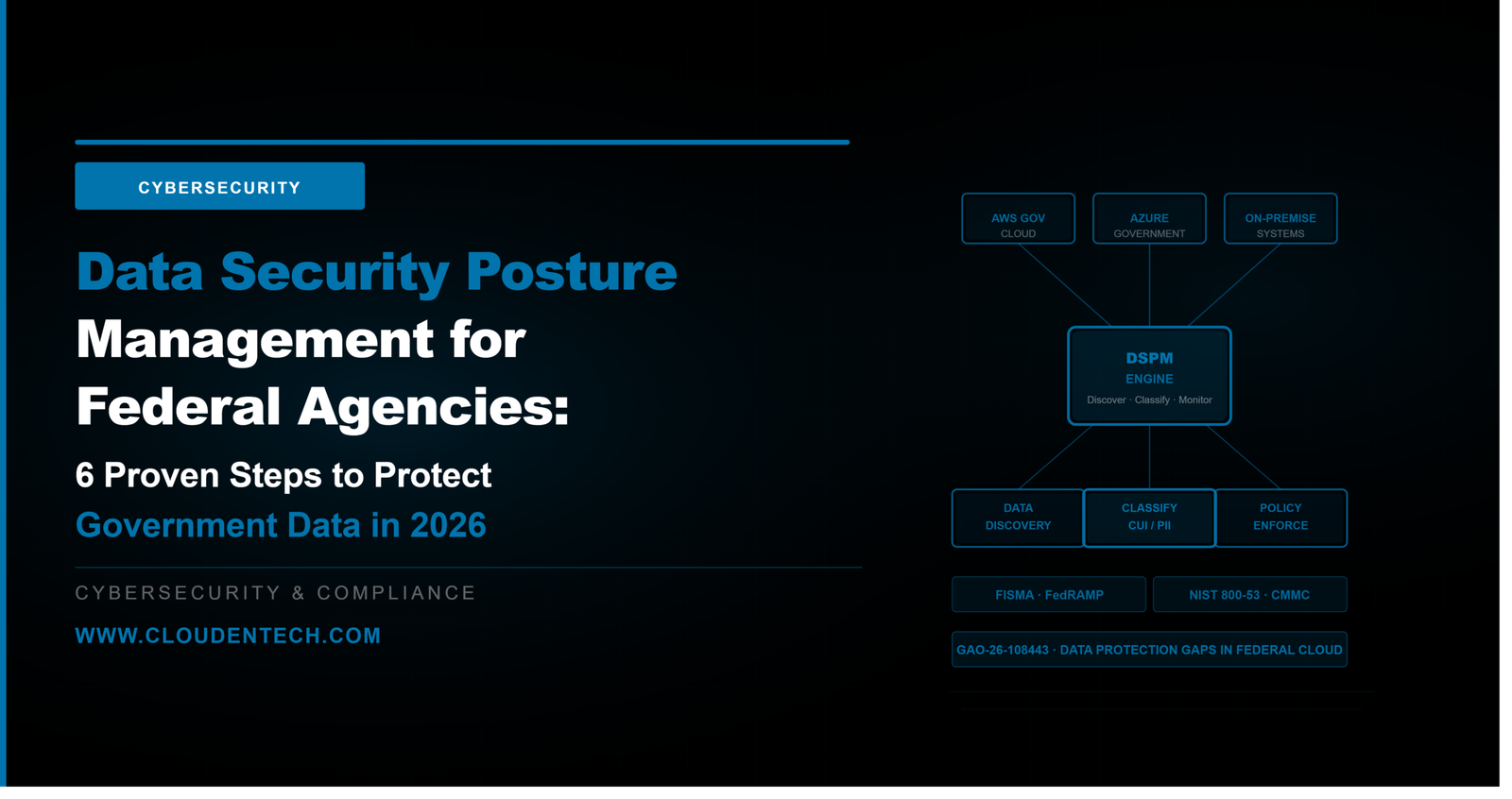
Data security posture management for federal agencies has moved from a vendor marketing term to an active federal procurement priority in the span of twelve months. The catalyst is a combination of audit findings, new compliance requirements, and the fundamental shift in how federal data is stored and accessed that cloud migration, AI deployment, and hybrid work have together produced.
In July 2026, the Government Accountability Office published GAO-26-108443, “Cybersecurity: Selected Agencies Need to Better Protect Cloud Data,” finding that selected agencies have not fully implemented key cloud security practices. Of the 35 inspector general reports the GAO working group analyzed, 15 — nearly half — had findings related to data protection and monitoring. These are not theoretical vulnerabilities. They are documented gaps in how federal agencies currently know where their sensitive data resides, who has access to it, and whether that access is appropriate.
In September 2026, Proofpoint announced investments in FedRAMP High authorization specifically for Data Security Posture Management, multi-channel Data Loss Prevention, and Insider Threat Management for federal agencies — a signal that the commercial market has recognized federal DSPM as an active procurement category, not a future planning item. The planned scope reinforces that for federal organizations, these are not just security priorities but compliance requirements under FISMA, NIST SP 800-53, and the federal Zero Trust Strategy.
Washington Technology identified DSPM as one of five IT security priorities shaping federal procurement in 2026. The reasons are structural: federal cloud adoption has created data environments that no single security tool was designed to govern. Agencies using multiple FedRAMP-authorized cloud platforms — plus on-premise systems, third-party SaaS services, and AI-enabled applications — have data distributed across environments that operate under different security configurations, different access control models, and different compliance requirements. DSPM is the discipline that provides unified visibility and governance across that entire data landscape.
This post covers what DSPM is and how it differs from Cloud Security Posture Management, why federal agencies need it now, and the six proven steps to implement it effectively.
What DSPM Is and How It Differs From CSPM
Data Security Posture Management and Cloud Security Posture Management address different layers of the same problem. DSPM and CSPM address different layers of the security stack. CSPM focuses on the security configuration of cloud infrastructure — ensuring that compute instances, storage buckets, network configurations, and identity policies conform to security baselines. DSPM protects the information within those systems by identifying sensitive data and governing its access and use.
The distinction matters because a cloud environment can be correctly configured from a CSPM perspective and still have significant data security failures. A storage bucket with correct access control policies that contains improperly classified data — CUI that was written to a system authorized only for unclassified workloads, or PII that was replicated to a development environment with weaker access controls than production — is an infrastructure configuration success and a data security failure simultaneously. CSPM cannot detect it because it is checking configurations, not content.
DSPM provides actionable insights into where sensitive data resides and helps visualize which systems and identities have access, helping organizations proactively manage data security risks. For federal agencies, this means DSPM answers the questions that CSPM cannot: what sensitive data do we have, where is it, who can access it, and is that access appropriate given the data’s classification and the system’s authorization level?
DSPM automates the discovery of sensitive data types across multi-cloud environments. It applies classification models that identify CUI, PII, PHI, financial data, and other regulated data categories within the volumes of unstructured content that federal agencies generate. It maps access relationships — showing exactly which users, service accounts, and applications have what level of access to each sensitive data asset. And it continuously monitors for changes in data exposure, access patterns, and risk posture that indicate emerging security problems before they become audit findings.
The shift from CSPM to DSPM represents a shift from infrastructure-centric to data-centric security — the approach that the federal Zero Trust Strategy’s data pillar requires. Zero trust mandates that access controls be applied based on data sensitivity, not network location. That mandate cannot be implemented without knowing what data is sensitive, where it lives, and what access controls currently apply to it. DSPM is the foundational capability that makes data-pillar zero trust implementation operationally achievable.
Why Federal Agencies Need DSPM Now
Several converging factors in 2026 make DSPM adoption urgent for federal agencies rather than optional.
The first is the scale and distribution of federal data growth. Federal agencies are generating and storing more data than at any previous point, across more environments than ever before. Cloud migration has moved data from on-premise data centers into FedRAMP-authorized cloud platforms where it interacts with cloud-native services, AI capabilities, and cross-agency data sharing mechanisms. AI-generated content and AI-processed data adds additional unstructured data volumes that agencies often do not have classification frameworks to handle. Each new data asset that is not classified and governed represents a potential compliance gap and a potential security risk.
The second is the AI-generated classification challenge. AI-generated classification identifies sensitive information agencies did not know to look for, while effective access analysis shows who and what can actually reach it. Federal agencies deploying AI capabilities are generating outputs — documents, summaries, analyses, recommendations — that may contain sensitive information derived from inputs but that are not themselves governed by the same classification rules as the original data. DSPM with AI-powered classification can identify this derived sensitive content and apply appropriate governance before it becomes an exposure.
The third is the continuous monitoring gap that GAO’s July 2026 report documents. According to federal guidance, agencies are to perform continuous monitoring of their cloud systems. Continuous monitoring helps agencies ensure that their ongoing awareness of the system security and privacy posture supports organizational risk management decisions. The GAO found that selected agencies have not fully implemented this requirement, specifically noting data protection and monitoring as the most frequently cited gap area in IG reports. FISMA requires federal agencies to implement continuous monitoring of FISMA-accredited systems. DSPM provides the continuous data-layer visibility that satisfies this requirement for the data pillar specifically.
The fourth is the growing AI and insider threat risk. Proofpoint’s investment in federal DSPM, DLP, and Insider Threat Management explicitly connects data security posture to the insider threat challenge. AI coding assistants, AI-enabled productivity tools, and agentic AI systems are creating new pathways for sensitive data to be accessed, processed, and potentially exfiltrated in ways that traditional DLP tools — designed for email and file transfer — were never designed to detect. DSPM provides the visibility into where sensitive data resides and how it is being accessed that makes both insider threat detection and AI-related data risk management operationally effective.
The Federal Compliance Framework for Data Security Posture
DSPM is not a standalone security tool. In a federal environment, it operates within and supports a specific compliance framework that agencies must satisfy. Understanding how DSPM maps to federal compliance requirements is essential for both justifying DSPM investment and designing a DSPM program that produces auditable compliance evidence.
FISMA requires agencies to develop, document, and implement information security programs to protect the information and systems that support the agencies’ operations and assets. The FY2026 and FY2027 CIO FISMA Metrics, published by CISA in August 2026, specifically measure the security posture of agency systems designated as High Value Assets, focusing on logging and monitoring effectiveness, telemetry centralization, and context changes including device, posture, and network. DSPM directly supports these metrics by providing the data-layer telemetry that FISMA continuous monitoring requires.
NIST SP 800-53 Rev 5 includes multiple control families that DSPM addresses. The Data Governance (DG) controls in the SP 800-53 Rev 5 overlay address data management, data quality, data integrity, and data retention — all capabilities that a DSPM program implements operationally. The Audit and Accountability (AU) controls require agencies to create, protect, retain, and review audit records that include data access events relevant to security and compliance investigations. DSPM that generates continuous data access logs aligned to NIST audit requirements satisfies these controls as a byproduct of its core operations.
FedRAMP adds cloud-specific requirements. Multi-cloud environments require unified security posture management. Government agencies using multiple cloud platforms need centralized visibility and control to ensure consistent protection policies across all environments handling classified or sensitive data. DSPM provides this unified visibility across FedRAMP-authorized cloud platforms, including the ability to confirm that CUI is only processed in systems with the appropriate FedRAMP Moderate or High authorization.
CMMC 2.0 Level 2 requires that contractors handling CUI implement the 110 controls of NIST SP 800-171, many of which directly address data discovery, classification, and access control. A DSPM program aligned to CMMC Level 2 provides the technical foundation for satisfying the Access Control, Identification and Authentication, System and Communications Protection, and Audit and Accountability families that most frequently generate audit findings during C3PAO assessments.
6 Proven Steps to Implement Data Security Posture Management for Federal Agencies
Step 1: Conduct a Comprehensive Data Asset Inventory Before Any DSPM Tool Is Deployed
The prerequisite for effective DSPM implementation is understanding what data the agency holds and where it lives — not at the system level, but at the data asset level. A system-level inventory that identifies the databases and storage platforms the agency operates does not answer the DSPM question. The DSPM question is: what sensitive data is in those databases and storage platforms, how is it classified, and how is access to it governed?
This foundational data asset inventory must cover all environments where agency data resides, including FedRAMP-authorized cloud platforms, on-premise data centers and storage systems, SaaS applications that process or store agency data, collaboration platforms and document management systems, AI systems that process agency data to produce outputs, and data that is shared with or accessible by other agencies, contractors, and partners. Agencies should develop and maintain a comprehensive data inventory, using appropriate standards and formats to facilitate agency data management, sharing, and use. The DSPM implementation builds on this inventory — automating its maintenance and expanding it to include access control mapping and sensitivity classification that manual inventory processes cannot produce at scale.
Federal agencies that approach DSPM implementation without completing this inventory will find that their DSPM tool generates findings that they lack the governance context to act on. A DSPM alert that reports CUI in an unexpected location is only actionable if the agency knows what the expected location is and who the data owner is.
Step 2: Deploy Automated Sensitive Data Discovery and AI-Powered Classification
Manual data classification processes — where employees are expected to classify documents and data records as they create them — consistently produce incomplete classification coverage. The volume of data that federal agencies generate exceeds the capacity of manual review for anything but the highest-priority documents. DSPM closes this gap through automated discovery and AI-powered classification that scans all stored data and applies classification labels based on content analysis rather than relying on creator-applied tags.
DSPM automates the discovery of sensitive data types across multi-cloud environments. For federal agencies, the classification taxonomy must align to the federal data classification framework — distinguishing between classified information (which should not be in commercial cloud environments at all), Controlled Unclassified Information in its various subcategories, personally identifiable information, protected health information, law enforcement sensitive information, and general unclassified information. Each category carries different handling requirements, different access control requirements, and different retention and disposal requirements.
AI-powered classification specifically addresses the challenge of data that agencies did not know to look for. AI models trained on federal data classification standards can identify sensitive content in documents, emails, database records, and code repositories that traditional pattern-matching classification tools would miss — including CUI that is present in AI-generated summaries, code comments, or system log files rather than in the explicitly marked documents where agencies typically focus their classification efforts.
The classification output from automated DSPM discovery feeds directly into the access control and policy enforcement capabilities that the subsequent steps require. Classification that is not connected to access control is documentation without protection. The value of DSPM classification is realized when it drives real-time access policy decisions.
Step 3: Map Data Access Rights to Identify Unauthorized and Excessive Access
DSPM provides actionable insights into where sensitive data resides and helps visualize which systems and identities have access, helping organizations proactively manage data security risks. For federal agencies, this access mapping capability is critical because the access control landscape in a modern federal environment includes human users, service accounts, AI agents, contractor personnel, partner agency personnel, and automated processes — each with different access rights that may have accumulated over time without systematic review. wiz
Access mapping in a federal DSPM program must answer several specific questions for every sensitive data asset. Who can read this data? Who can modify it? Who can delete it? Who can share it outside the agency? Which service accounts and automated processes have access to it, and is that access consistent with those accounts’ documented mission functions? Have access rights to this data been reviewed and reauthorized within the required timeframe?
Both human and machine identities use only about two percent of their granted permissions — leaving the rest unused and representing unnecessary attack surface. For sensitive data access rights specifically, this statistic means that most users and service accounts have been granted access to sensitive data assets they never actually need to access. Revoking those unnecessary access rights is the lowest-risk, highest-return data security improvement available to most federal agencies. DSPM’s access mapping capability makes this exercise operationally manageable by automating the discovery and analysis of actual access rights rather than requiring manual review of access control lists across hundreds of systems.
Step 4: Implement Continuous Risk Scoring and Policy-Based Remediation
Static access reviews conducted annually or quarterly cannot keep pace with the rate at which data risk posture changes in modern federal environments. New data is created, data is moved between systems, access rights are modified, and cloud configurations change continuously. A data risk posture that was compliant at the last review may have accumulated significant violations in the months since.
Security posture must be tracked in real time, with controls reassessed as threats evolve. For data security specifically, this means continuous risk scoring — assigning a risk score to each data asset based on its classification level, the number and type of identities with access, recent access activity, and the security configuration of the systems where it resides. Changes that increase risk — a new service account gaining access to a CUI dataset, a CUI file being copied to a storage bucket with lower access controls, a significant increase in data access volume from a specific identity — should trigger automated alerts and, where appropriate, automated remediation.
Policy-based remediation is the capability that transforms DSPM from a detection tool into a prevention tool. Rather than alerting that a sensitive data asset has been found in an inappropriate location after the fact, DSPM policy enforcement can prevent that data from being written to unauthorized systems in the first place — blocking data movements that violate classification-based policy before they occur rather than detecting and remediating them after.
For federal agencies, policy-based remediation must be designed with appropriate human oversight built in. Automated enforcement actions that are too aggressive — blocking legitimate data movements that are in fact authorized — create mission disruption that erodes trust in the DSPM program. Starting with automated alerting and manual remediation, then progressively automating the most clear-cut violation categories as the policy framework matures, is the implementation approach that builds the organizational trust required for a sustained data security posture program.
Step 5: Integrate DSPM With the Zero Trust Data Pillar and Continuous Monitoring Program
DSPM does not stand alone as a security capability. Its maximum value is realized when it is integrated with the broader security architecture — feeding data risk insights into zero trust access control decisions, contributing to the SIEM-based continuous monitoring program, and producing the compliance evidence that FedRAMP and FISMA reporting require.
Integration with zero trust access control means that DSPM’s classification output and risk scoring directly inform access decisions. A user attempting to access a data asset classified as CUI from a device that has not completed health validation should receive a different access decision than the same user accessing the same data from a fully verified, compliant device. The data sensitivity context that DSPM provides — who should be able to access this data, under what conditions, for what purpose — enriches the access control decision with exactly the information that attribute-based access control requires.
Agencies can reduce exposure through bulk or delegated access remediation, while the same understanding of sensitive data from DSPM can be directly protected through DLP across email, cloud, endpoints, collaboration, and AI. This integration between DSPM and DLP is particularly important for preventing data exfiltration. DSPM identifies which data is sensitive and how it should be governed. DLP enforces those governance policies at the moment data is transmitted — preventing CUI from being emailed to unauthorized recipients, uploaded to unsanctioned cloud services, or processed by AI tools that are not authorized for that data classification level.
Integration with the FISMA continuous monitoring program means that DSPM’s data access logs, risk score changes, and policy violation alerts feed into the SIEM infrastructure and produce the audit records that FISMA metrics and IG reviews evaluate. Agencies that operate DSPM as a standalone tool and manually compile its findings for compliance reporting are getting partial value from their DSPM investment. Agencies that integrate DSPM telemetry into their continuous monitoring infrastructure are producing compliance evidence automatically as a byproduct of operational security activity.
Step 6: Build DSPM Evidence Generation Into the FedRAMP Authorization Process
For federal agencies operating under FedRAMP, DSPM implementation produces compliance evidence that is directly relevant to multiple control families in the FedRAMP baseline. Rather than treating DSPM as a separate operational security tool and compliance as a separate documentation exercise, agencies that design their DSPM implementation to produce FedRAMP-aligned evidence simultaneously satisfy operational security needs and authorization documentation requirements.
DSPM automates classification, policy enforcement, and continuous monitoring for sensitive cloud data, and enables organizations to automate classification, policy enforcement, and continuous monitoring for their sensitive cloud data. For FedRAMP, this means that DSPM provides the data inventory and access control evidence for the FedRAMP Data Governance control overlay, the continuous monitoring evidence for the FedRAMP continuous monitoring program requirements, and the access control audit records for the Access Control (AC) and Audit and Accountability (AU) control families.
The shift toward OSCAL-formatted compliance documentation — which FedRAMP CR26 is advancing with enforcement beginning January 2027 — creates an additional incentive for integrated DSPM evidence generation. DSPM platforms that produce compliance evidence in machine-readable formats and map findings directly to NIST SP 800-53 control identifiers will be significantly more efficient in the CR26 compliance environment than those requiring manual evidence compilation and format conversion.
DSPM and the October 2026 Federal Compliance Context
DSPM implementation is particularly timely in October 2026. With CMMC Phase 2 enforcement beginning November 10, 2026 — less than four weeks from today — defense contractors handling CUI must demonstrate that their CUI is properly identified, classified, protected, and access-controlled. DSPM provides the technical foundation for demonstrating CUI governance in exactly the way C3PAO assessors expect to see it: automated discovery, documented classification, access control mapping, and continuous monitoring evidence.
The FY2027 budget cycle that began October 1 provides the appropriations context for agencies to fund DSPM programs that were in the planning stage during FY2026. Agencies that justified DSPM investment during the FY2027 budget process, framing it as both a GAO-identified data protection gap remediation and a zero trust data pillar implementation, are well positioned to execute implementation programs in Q1 and Q2 of FY2027.
How ClouDen Technologies Supports Federal DSPM Implementation
At ClouDen Technologies, our cybersecurity services include the security architecture, risk management, and compliance support that federal DSPM implementation programs require. We help agencies design DSPM architectures that integrate with their FedRAMP-authorized cloud environments, their zero trust access control frameworks, and their FISMA continuous monitoring programs — producing a unified data security posture capability rather than an isolated tool deployment.
Our approach to federal DSPM begins with the data asset inventory that every effective DSPM program requires. We work with agencies to build comprehensive, FedRAMP-aligned data inventories that document data classification, access rights, handling requirements, and system authorization levels — producing the governance foundation that automated DSPM discovery and classification tools build on.
Our cloud solutions practice designs the FedRAMP-authorized cloud environments where agency data resides, ensuring that authorization boundaries, storage configurations, and access control policies are aligned to the classification requirements that DSPM will discover and enforce. Our enterprise architecture practice addresses the cross-system data governance decisions that determine whether DSPM produces consistent, actionable visibility across the agency’s full data landscape or generates findings that lack the governance context to act on.
Our DevSecOps services ensure that the applications and pipelines that generate and process agency data do so in ways that are compatible with DSPM classification and monitoring — embedding data classification requirements into development pipelines so that sensitive data is identified and governed from the point of creation rather than discovered retrospectively.
As an SBA-certified 8(a) small business operating under ISO 27001:2022, ISO 9001:2015, and ISO/IEC 20000-1:2018, we bring the governance discipline and compliance expertise that federal DSPM programs require at every level — from the technical architecture of the DSPM discovery engine to the compliance evidence that FedRAMP authorization reviews, FISMA CISO metrics reporting, and C3PAO assessments will evaluate.
If your agency is implementing a DSPM program, addressing the data protection gaps identified in the July 2026 GAO report, building the data-layer zero trust capability required by OMB M-22-09, or preparing CUI governance documentation for CMMC Level 2 C3PAO assessment, contact ClouDen Technologies today.
Key Takeaways
Data security posture management for federal agencies is an active GAO-identified priority. The July 2026 GAO report GAO-26-108443 found that 15 of 35 IG reports analyzed had findings related to data protection and monitoring — making it the most frequently cited cloud security gap across the federal enterprise.
DSPM and CSPM are complementary but distinct capabilities. CSPM governs infrastructure configuration. DSPM governs the data within that infrastructure — discovering what sensitive data exists, classifying it, mapping who has access to it, and continuously monitoring for risk posture changes. A cloud environment can be CSPM-compliant and still have significant DSPM gaps.
The Zero Trust Strategy’s data pillar mandates data-centric access control — applying access decisions based on data sensitivity rather than network location. This mandate is not implementable without DSPM, because agencies cannot apply data-sensitivity-based access controls without first knowing what data is sensitive, where it resides, and who has access to it.
AI-generated content creates classification gaps that traditional tools cannot address. AI-generated summaries, analyses, and outputs may contain sensitive information derived from classified or CUI inputs but not themselves marked with appropriate classification labels. AI-powered DSPM classification discovers and governs this derived sensitive content.
The six steps are: conduct a comprehensive data asset inventory before deploying tools, deploy automated sensitive data discovery and AI-powered classification, map data access rights to identify unauthorized and excessive access, implement continuous risk scoring and policy-based remediation, integrate DSPM with the zero trust data pillar and continuous monitoring program, and build DSPM evidence generation into the FedRAMP authorization process.
CMMC Phase 2 enforcement begins November 10, 2026. Defense contractors handling CUI need documented CUI discovery, classification, access control, and continuous monitoring evidence for C3PAO assessments. DSPM provides the technical foundation for all four requirements simultaneously.
About ClouDen Technologies
ClouDen Technologies is an SBA-certified 8(a) small business delivering cloud, cybersecurity, DevSecOps, enterprise architecture, application development, and management services to U.S. federal agencies, educational institutions, and commercial organizations. ClouDen operates under ISO 9001:2015, ISO/IEC 20000-1:2018, and ISO/IEC 27001:2022.