Platform engineering for federal agencies is the next evolution of the DevSecOps movement — and it is happening right now across the Department of Defense and, increasingly, across civilian agencies that have watched the DoD’s software factories prove the model works.
The evidence is specific and recent. In January 2026, the U.S. Army Software Engineering Center announced a major reorganization, building a consolidated DevSecOps platform with the Army CIO and Army Cyber Command — an acknowledgment that the traditional approach to military software development is not just slow but operationally dangerous. In June 2026, federal IT leaders across agencies were publicly discussing how DevSecOps, platform engineering, and AI-enabled development tools are being used to streamline software delivery and improve operational agility. The Pentagon’s broader trajectory in 2026 confirms the shift is systemic, not experimental.
Platform engineering addresses a problem that DevSecOps practices alone cannot fully solve. DevSecOps taught federal development teams to integrate security into their pipelines. But as agencies built more pipelines, for more applications, across more teams, the cost of maintaining each team’s own security tooling, compliance configuration, and infrastructure setup created a new kind of technical debt: pipeline fragmentation. Every team solving the same infrastructure and security problems independently, with different tool choices, different configurations, and different compliance documentation approaches, produces exactly the kind of heterogeneous, expensive, difficult-to-secure development environment that DevSecOps was supposed to eliminate.
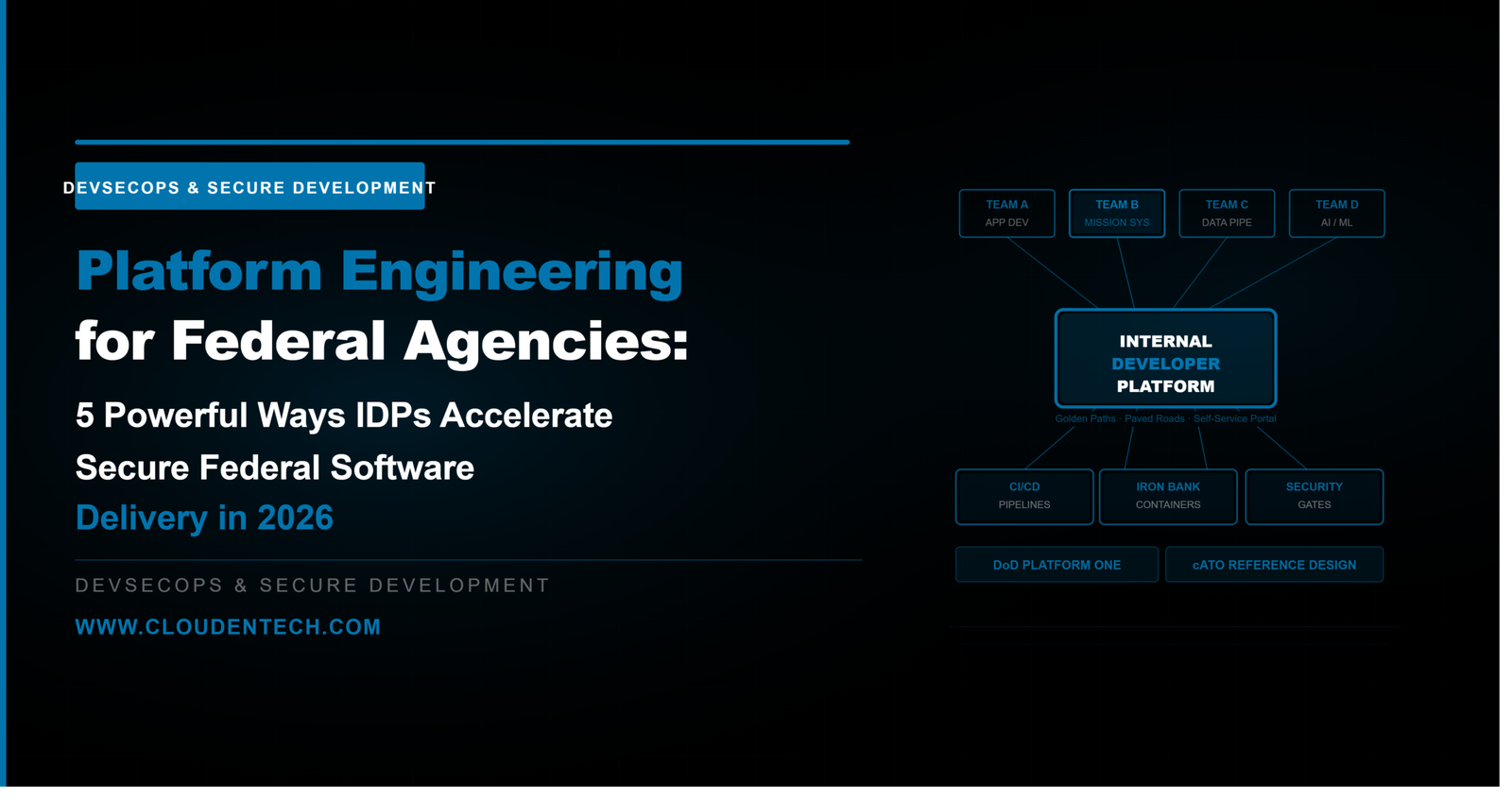
Platform engineering — specifically the Internal Developer Platform model — solves this by giving development teams a paved road: a pre-built, pre-approved, pre-secured software delivery platform that lets them focus on writing mission-enabling software rather than configuring pipelines, negotiating authorizations, and managing security tooling. The security is baked in. The compliance documentation is generated automatically. The containers come from Iron Bank. The pipelines run on an approved DoD DevSecOps Reference Design. The developer’s job is the application logic. Everything else is the platform’s job.
This post covers what platform engineering and IDPs are in a federal context, why the DoD’s software factory experience matters for all agencies, and the five powerful ways that IDPs are accelerating secure software delivery in 2026.
What Platform Engineering and IDPs Are in a Federal Context
Platform engineering is the discipline of designing, building, and maintaining the internal platforms that development teams use to build, test, deliver, and operate software. An Internal Developer Platform is the product that platform engineering produces — a curated set of tools, workflows, infrastructure configurations, and self-service capabilities that developers access through a unified portal or API rather than configuring themselves from scratch for each project.
The goal of a DoD Software Factory — which is the federal government’s primary implementation model for platform engineering — is aimed at creating an ecosystem that enables continuous delivery of secure software that meets the needs of end-users while ensuring cyber resilience, emphasizing the transition from point-in-time security compliance to continuous security compliance.
The distinction between DevSecOps pipelines and an Internal Developer Platform is important and often confused. A DevSecOps pipeline is what each application team builds to automate the build, test, security scan, and deployment of their specific application. An Internal Developer Platform is the infrastructure layer that multiple application teams build their pipelines on — the shared services, standard configurations, pre-approved tooling, and common infrastructure that every pipeline uses. The IDP is the platform. The pipelines are what run on it.
Platform One — the Air Force’s enterprise DevSecOps platform — is the canonical federal IDP implementation. Platform One provides the enterprise DevSecOps platform that other defense organizations use to build and deploy software. Instead of developing software that already exists or using existing software components with dubious origins and vulnerabilities, software development activities across the DoD reuse vetted, hardened, and standardized software components that Platform One has already secured. Platform One helps DoD software teams shift away from legacy tools that are out of date and not well integrated, resulting in a fragmented and expensive developer experience that is extremely difficult to keep secure.
By having a common platform across classification levels, DoD software teams develop at the unclassified level and then promote the software to higher classification levels — a capability that is operationally transformative for programs that need to deploy the same application across multiple security domains.
The Federal Software Factory Landscape in 2026
The federal government now operates a significant and growing inventory of software factories and DevSecOps platforms, centered primarily in the DoD but expanding into civilian agencies.
Platform One remains the flagship. Operated by the Air Force’s LevelUP team, it provides DevSecOps and Software Factory managed services with baked-in security to Air Force and Department of Defense programs. Platform One operates at Impact Level 2 and IL-4, providing the hardened Kubernetes platform, CI/CD pipelines, Iron Bank container registry, and security tooling that programs across the DoD inherit rather than build themselves.
Kessel Run — the Air Force’s agile software development organization — pioneered the software factory model in the DoD before Platform One formalized it at the enterprise level. Black Pearl is the Navy’s software factory. The Army Software Factory, established at Fort Sam Houston, has expanded to include a Warrant Officer functional area for software operations technicians, graduating its first warrant officer cohort on June 10, 2026. Space CAMP provides software factory services for the U.S. Space Force’s mission applications.
Operation StormBreaker, run by Marine Corps Community Services Chief Digital Business Officer Dave Raley, is a pioneering DevSecOps and pipeline-as-a-service framework that accelerates secure software delivery across the Department of Defense — demonstrating that the software factory model can be implemented at the component and mission level, not just at the enterprise platform level.
The civilian agency trajectory is following the DoD lead with a phase lag. Federal agencies are modernizing software development as missions increasingly depend on secure, scalable, and rapidly deployable digital capabilities. The same forces that drove DoD software factory adoption — the operational danger of slow software delivery, the security cost of fragmented development environments, and the compliance burden of manual authorization documentation — apply equally to civilian agencies whose modernization programs depend on software.
Why Platform Engineering Enables Continuous ATO
The connection between platform engineering and Continuous Authority to Operate is direct and consequential. A cATO requires that software is deployed on an Approved DoD Enterprise DevSecOps Reference Design. If an agency builds its own DevSecOps platform that meets the criteria for the reference design, it has effectively built a software factory — and software deployed on that platform inherits the platform’s authorization rather than requiring a separate, from-scratch authorization for every application.
This inheritance model is the most significant compliance benefit of platform engineering for federal agencies. The authorization for each individual application that runs on Platform One is dramatically simpler than it would be for the same application running on custom infrastructure, because the platform-level controls — infrastructure security, network configuration, container runtime security, audit logging, vulnerability scanning — are already authorized. The application team documents only the application-specific controls, not the entire control baseline from scratch.
For agencies pursuing continuous ATO, the platform is a prerequisite. Continuous authorization requires that the system’s security posture is continuously monitored, that configuration changes are automatically validated against the authorization baseline, and that compliance evidence is generated automatically at every deployment. These capabilities require the infrastructure and tooling discipline that only a properly governed IDP provides. A development team operating on ad-hoc infrastructure cannot achieve cATO. A team operating on a governed platform that implements the DoD Enterprise DevSecOps Reference Design can.
Space CAMP explicitly notes that its software teams provide small, rapid capability-based operational releases that meet DevSecOps security standards in a fraction of the time, and that their products inherit a platform level of Continuous Authority to Operate. This is the model that federal platform engineering programs should aspire to: platform-level authorization that cascades down to the applications running on it, enabling mission delivery at operational speed.
5 Powerful Ways Internal Developer Platforms Accelerate Secure Federal Software Delivery
Way 1: Golden Paths Eliminate Security Inconsistency Across Development Teams
The single most important concept in platform engineering for federal agencies is the golden path — a curated, pre-approved, pre-secured path from code to deployment that development teams follow rather than designing their own. The golden path includes the approved source control configuration, the approved container base images from Iron Bank, the approved CI/CD pipeline configuration, the approved testing frameworks, the approved deployment targets, and the approved monitoring and logging setup.
When every development team uses the same golden path, security is consistent by construction rather than by convention. The security choices embedded in the golden path — which base images to use, how to configure the pipeline, which scanning tools to run with which rules, how to generate compliance evidence — are made once by the platform engineering team and applied uniformly across every application built on the platform. Security inconsistency between teams — different teams making different choices about whether to run DAST, which SAST rule sets to enable, whether to scan container images before deployment — is structurally eliminated.
For federal agencies where different program offices have historically maintained independent development environments with different tool choices and different security configurations, the golden path model represents a fundamental shift in how security governance works. Instead of auditing each program’s DevSecOps practices individually and finding gaps specific to each team’s configuration, the ATO process validates the platform’s golden path once and all programs using that path inherit the validation.
Way 2: Self-Service Developer Portals Remove the Manual Overhead That Slows Delivery
Platform engineering teams build self-service portals — software catalogs and developer portals like Backstage or its federal equivalents — that let development teams provision new services, environments, and infrastructure through a governed self-service interface rather than through ticket queues, manual approvals, and weeks-long provisioning cycles.
This shift has a direct impact on the speed of federal software delivery. The traditional federal provisioning process — a developer needs a new development environment, submits a ticket, waits for the infrastructure team to manually provision it, waits for the security team to approve the configuration, waits for the ATO package to be updated — takes weeks. A platform engineering team that has pre-built, pre-approved environment templates accessible through a self-service portal can provision the same environment in minutes, with the security configuration already correct because it was designed into the template.
For federal agencies under pressure to deliver software capabilities faster — to respond to operational threats, to deploy AI tools that mission users need immediately, to patch vulnerabilities within CISA BOD 26-04’s compressed remediation timelines — the self-service provisioning capability that platform engineering enables is not a developer experience improvement. It is a mission delivery improvement.
The self-service portal also provides the service catalog that organizations need to understand what software they have deployed, what versions are running, which teams own which services, and how services depend on each other. This visibility is critical for vulnerability response — when CISA identifies an exploited vulnerability in a library that multiple agency services use, a service catalog allows the security team to identify all affected services immediately rather than conducting a manual inventory that takes days.
Way 3: Pre-Built Security Gates Produce Compliance Evidence Automatically
The compliance evidence challenge is one of the most significant operational burdens in federal software development. For every application seeking an ATO or maintaining an existing authorization, the program team must document that security controls are implemented, produce evidence that automated security tools are running and producing findings, demonstrate that vulnerabilities are being tracked and remediated, and show that configuration management is governing what is deployed in production.
When this evidence must be manually compiled, the process is slow, expensive, and error-prone. When it is generated automatically as a byproduct of a governed IDP’s pipeline execution, it is continuous, accurate, and always current.
Platform engineering pre-builds the security gates that every pipeline must pass — SAST scanning, SCA with SBOM generation, container image scanning against Iron Bank baselines, DAST for pre-production validation, STIG compliance checks — and configures those gates to retain output in OSCAL-compatible formats. Every pipeline execution produces a compliance artifact trail that documents what was scanned, when, with what tools, against what baselines, and what findings were produced and addressed.
The shift to OSCAL-formatted compliance documentation that FedRAMP CR26 is advancing with enforcement beginning January 2027 creates an additional incentive for this approach. IDPs that are designed from the start to generate OSCAL-compatible compliance evidence will be significantly more efficient in the new FedRAMP compliance environment than those requiring manual evidence compilation and format conversion. Platform engineering is the architectural pattern that makes OSCAL-native compliance evidence generation operationally achievable at scale.
Way 4: Shared Platform Infrastructure Eliminates Duplicated Security Investment
Every federal development team that builds its own DevSecOps pipeline from scratch is rebuilding the same security infrastructure that every other team has already built — with slightly different tool choices, slightly different configurations, and slightly different authorization documentation. This duplication is enormously expensive and produces inconsistent security outcomes despite the investment.
A shared IDP eliminates this duplication. The platform engineering team invests once in selecting, configuring, authorizing, and maintaining the security tooling. Every development team that uses the platform inherits that investment rather than rebuilding it. The Iron Bank container registry, the STIG-compliant Kubernetes platform, the automated vulnerability scanning integration, the SIEM-connected audit logging — these are built once and reused by every program that runs on the platform.
DoD software teams develop at the unclassified level and then promote the software to higher classification levels using the platform’s cross-domain capabilities, rather than maintaining separate development environments at each classification level with separate tool stacks, separate authorizations, and separate security configurations. For DoD agencies and defense contractors operating across multiple classification levels, this shared infrastructure capability represents cost savings and security improvements that are not achievable through any other architectural approach.
For civilian federal agencies, the shared infrastructure model applies at the agency level — a single IDP serving multiple program offices, rather than each program office maintaining its own development infrastructure. The Office of Personnel Management, the Department of Homeland Security, and the Department of Veterans Affairs have all invested in shared development infrastructure models that reduce duplicated investment and produce more consistent security outcomes across agency programs.
Way 5: Platform Engineering Enables AI-Assisted Development Within a Governed Security Boundary
The intersection of platform engineering and AI development tools is the most forward-looking benefit of the federal IDP model in 2026. Federal agencies are deploying AI coding assistants, AI-powered code review tools, and AI-assisted security scanning to improve developer productivity and reduce the time between capability requirement and deployed software. The governance challenge is ensuring that AI tools operate within the security boundary that federal data classification and handling requirements demand.
An IDP provides the governance context that makes AI-assisted development safe in federal environments. Rather than allowing developers to use public AI coding assistants that may train on or store federal code and data, the IDP can provide access to approved, FedRAMP-authorized AI development tools through the same governed portal that provides access to other platform services. AI-generated code passes through the same security gates as human-authored code — SAST scanning, dependency analysis, container security scanning — before it can be deployed to any environment.
For agencies building AI capabilities on their IDP, the platform also provides the standardized service interfaces, API gateway configurations, and identity governance patterns that AI agent integrations require. An AI agent that needs to call agency data APIs, access CUI datasets, or interact with mission-critical systems does so through the platform’s governed interfaces rather than through custom integrations that each team builds independently — ensuring that AI access controls, audit logging, and rate limiting are consistent across every AI application the agency deploys.
The DoD Enterprise DevSecOps Reference Design: The Architecture Foundation
For DoD agencies and defense contractors, the DoD Enterprise DevSecOps Reference Design is the authoritative specification that an IDP must satisfy to support continuous ATO. The reference design specifies that a DevSecOps software factory must avoid vendor lock-in, must support hosting in any DoD general-purpose compute environment, must implement the Sidecar Container Security Stack for runtime monitoring, and must use OCI-compliant containers sourced from DoD Hardened Container registries like Iron Bank.
The reference design also specifies the software factory concept of operations — the workflow through which applications move from development through security testing, staging, and production deployment — and the authorization process that applies to the platform and its component software factories. A DevSecOps platform and its software factories must complete an authorization. Once authorization is approved, the DevSecOps platform and its software factories can expedite future authorizations through the cATO process.
This authorization inheritance model is the practical mechanism through which platform engineering accelerates federal software delivery. A new application deployed on a properly authorized platform inherits the platform’s authorization for all platform-managed controls and must only document the application-specific controls in its own system security plan. The authorization timeline for platform-based applications is dramatically shorter than for applications on custom infrastructure.
For civilian agencies that do not operate under DoD authorization requirements, the reference design provides the blueprint that equivalent civilian IDPs should follow. The architectural patterns — shared infrastructure, Iron Bank containers, automated compliance evidence, security gates, cATO-compatible deployment workflows — apply equally to civilian agency software development programs, even when the specific DoD compliance requirements do not.
How ClouDen Technologies Supports Federal Platform Engineering
At ClouDen Technologies, our DevSecOps services include platform engineering support for federal agencies building or maturing their IDP capabilities. We help agencies design the platform architecture, select and configure the tooling stack, implement the security gates and compliance evidence generation workflows, and build the self-service developer portal capabilities that transform platform engineering from a concept into an operational capability that development teams actually use.
Our DevSecOps as a service model is particularly well-suited to the federal platform engineering challenge. Rather than agencies building and maintaining their entire platform infrastructure internally — which requires significant platform engineering expertise that many agencies do not currently have on staff — we provide the platform engineering capability as a managed service, delivering the IDP capability while building agency staff expertise to own and operate it over time.
Our application development practice builds the mission applications that run on these platforms — applications designed from their first sprint to operate within the IDP’s security boundary, consume platform services through their standard interfaces, and generate the compliance evidence that cATO programs require. Our cloud solutions practice designs the FedRAMP-authorized cloud infrastructure that the IDP runs on, ensuring that platform-level authorization aligns with the FedRAMP baselines that agency workloads require.
Our cybersecurity services provide the security architecture review, threat modeling, and continuous monitoring integration that connect the IDP’s security gates to the agency’s broader security posture — ensuring that platform-level security controls complement rather than conflict with the agency-level zero trust and FISMA compliance programs.
As an SBA-certified 8(a) small business operating under ISO 27001:2022, ISO 9001:2015, and ISO/IEC 20000-1:2018, we bring the governance discipline and federal compliance expertise that federal platform engineering programs demand — from the technical architecture of the IDP to the authorization documentation that the cATO process requires.
If your agency is building an Internal Developer Platform, maturing an existing software factory, designing the platform infrastructure for a continuous ATO program, or seeking to eliminate the duplicated security investment that fragmented development environments create, contact ClouDen Technologies today.
Key Takeaways
Platform engineering for federal agencies is the next evolution of DevSecOps — moving from individual team pipelines to shared platform infrastructure that provides pre-built, pre-authorized, pre-secured development environments to every development team in the agency.
The DoD’s software factory model — Platform One, Kessel Run, Black Pearl, Army Software Factory, Space CAMP — has proven that platform engineering works in the most demanding federal security environments. The January 2026 Army Software Engineering Center reorganization and the June 2026 GovCIO Media coverage confirm that platform adoption is accelerating, not plateauing.
Continuous ATO requires a platform. A cATO requires software to be deployed on an Approved DoD Enterprise DevSecOps Reference Design. Platform engineering is the architectural approach that makes this requirement achievable: platform-level authorization cascades down to applications running on it, eliminating the from-scratch authorization burden for every new application.
The five ways IDPs accelerate secure federal software delivery are: golden paths eliminate security inconsistency, self-service developer portals remove manual overhead, pre-built security gates produce compliance evidence automatically, shared platform infrastructure eliminates duplicated security investment, and platform engineering enables AI-assisted development within a governed security boundary.
The shift to OSCAL-formatted compliance documentation under FedRAMP CR26 (enforcement January 2027) creates an immediate incentive to build OSCAL-native compliance evidence generation into the IDP from the start. Platforms designed for OSCAL output will be dramatically more efficient in the new compliance environment than those requiring manual evidence compilation.
For civilian agencies, the DoD reference design provides the architectural blueprint even when DoD compliance requirements do not apply. The patterns — shared infrastructure, Iron Bank containers, automated security gates, cATO-compatible workflows — are the right patterns for any federal agency building secure software at scale.
About ClouDen Technologies
ClouDen Technologies is an SBA-certified 8(a) small business delivering cloud, cybersecurity, DevSecOps, enterprise architecture, application development, and management services to U.S. federal agencies, educational institutions, and commercial organizations. ClouDen operates under ISO 9001:2015, ISO/IEC 20000-1:2018, and ISO/IEC 27001:2022.