Continuous ATO for federal agencies is no longer a concept paper or a DoD-only aspiration. It is an active, approved, and expanding authorization model that is demonstrably accelerating secure software delivery across defense and civilian agencies alike — and FY2027 is the year that agencies without a cATO strategy begin to fall visibly behind those that have one.
The evidence from April 2026 is specific. At Federal News Network’s DoD Modernization Exchange 2026, Army CIO Leo Garciga confirmed that the Army is on the cusp of getting full approval from the DoD CIO’s Office to implement a new cATO policy across the service. The Army currently has four approved cATO platforms — one at a command level and three within program offices. Garciga described the move to continuous ATO as already demonstrating how the Army can add speed to capability, contrasting it with the standard ATO process that was not only time-consuming but bureaucratic.
That bureaucratic weight is the problem. Many DoD components identify obtaining an Authorization to Operate as the longest step in developing and deploying software. The traditional ATO model — document a system’s security posture at a point in time, submit the package for review, receive authorization, and then maintain that authorization unchanged for up to three years while the system and its threat environment evolve — was designed for an era when software changed infrequently and security threats moved slowly. Neither condition describes federal IT in 2026.
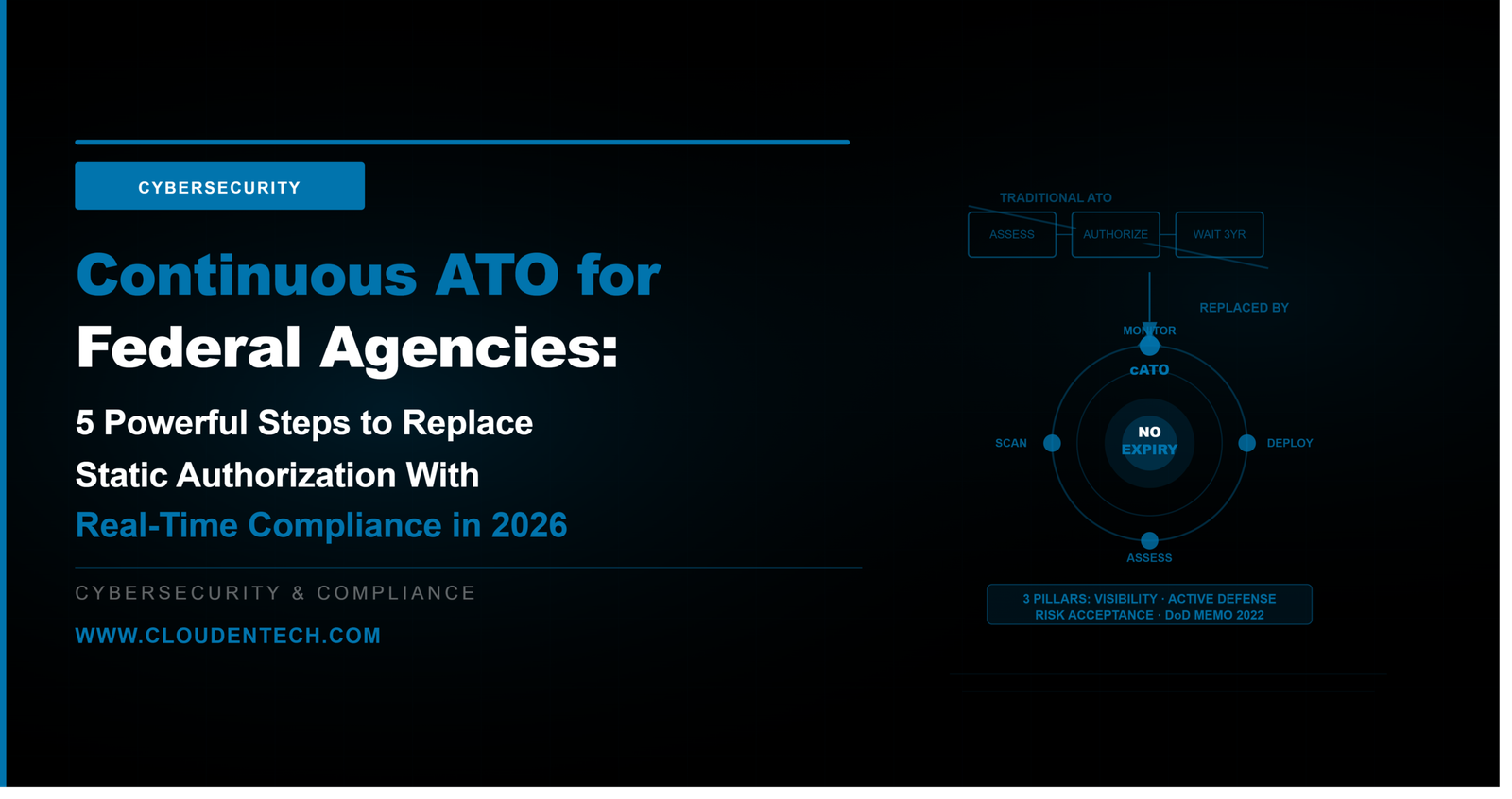
Continuous authorization to operate replaces that static cycle with ongoing authorization based on the real-time security state of the system. A cATO does not expire as long as the required real-time risk posture is maintained. The security posture is continuously monitored. Changes are continuously validated. Compliance evidence is continuously generated. The Authorizing Official has continuous visibility rather than a snapshot reviewed every three years.
This post covers what cATO requires, how the DoD’s three-pillar framework applies to both DoD and civilian agency programs, and the five steps every federal agency must take to replace static authorization with real-time compliance in FY2027.
What Continuous ATO Is and How It Differs From Traditional ATO
The traditional ATO model operates on a snapshot principle. At a defined point in time, a security assessment team evaluates a system’s security controls, produces a security assessment report, and the Authorizing Official reviews the findings and issues an authorization decision. That authorization is typically valid for up to three years, after which the process repeats.
This model has two structural failures in a continuous deployment environment. First, the system changes continuously between authorization cycles through software updates, configuration changes, and infrastructure evolution — but the authorization does not update with it. By the time the three-year authorization expires, the system being reauthorized may bear little resemblance to the system that was originally authorized, and the security posture documented in the original package may no longer accurately reflect the production environment.
Second, the gap between assessments creates detection gaps. A security control that drifts out of compliance in year two of a three-year authorization cycle may not be discovered until the reassessment in year three — if it is ever discovered at all without continuous monitoring. In the threat environment of 2026, where adversaries operate at machine speed and exploit vulnerabilities within hours of disclosure, a security posture that is reviewed every three years is not a security program. It is a compliance exercise.
Continuous Authorization to Operate addresses both failures. It is a modernized security process that enables faster software deployment by shifting from traditional document-based assessments to continuous risk monitoring and management. It enhances security standards beyond the traditional ATO by promoting ongoing evaluation and cultural change within software delivery organizations.
Critically, a cATO does not replace the underlying system ATO. The cATO determination does not affect the underlying system ATO. The foundational authorization package — the System Security Plan, the security assessment report, the Plan of Action and Milestones — still exists and is still required. What cATO adds is the continuous monitoring infrastructure that keeps the authorization current and eliminates the artificial three-year expiration cycle for programs that maintain the required real-time risk posture.
The Three Pillars of DoD cATO
The DoD cATO framework rests on three pillars defined in the DoD CIO’s Continuous Authorization to Operate memo and the DevSecOps Continuous Authorization Implementation Guide.
The first pillar is continuous visibility and monitoring of key cybersecurity activities within the system boundary. This requires ongoing visibility of key cybersecurity activities inside the system boundary with robust continuous monitoring of Risk Management Framework controls. Real-time or near real-time data analytics for reporting security events is essential to achieve the level of cybersecurity required to combat today’s cyber threats and operate in contested spaces. Visibility is the foundational pillar — without it, neither of the other two pillars can function.
The second pillar is active cyber defense — the capability to detect and respond to security events in real time rather than discovering them during a periodic review. This pillar requires the deployment of endpoint detection and response, SIEM integration, behavioral monitoring, and automated alerting capabilities that give the Authorizing Official ongoing confidence that the system is actively defended against current threats, not just validated as secure at a point in time.
The third pillar is the risk acceptance model — the governance framework through which the Authorizing Official continuously evaluates the system’s current risk posture and maintains an authorization decision based on real-time information rather than periodic reassessment. This pillar requires defining what constitutes an acceptable risk posture, what monitoring indicators signal a change in that posture, and what processes govern the AO’s ongoing authorization decisions as the posture changes.
These three pillars together define what makes an authorization continuous rather than periodic. A system that has continuous visibility without active defense is observable but not protected. A system with active defense but no risk acceptance framework has detection capability without governance. All three pillars must be implemented and functioning for a cATO to be valid and sustainable.
The cATO-DevSecOps Connection: Why Platform Is the Prerequisite
To achieve a cATO, a system must embrace the DoD Enterprise DevSecOps Strategy. The cATO and the DevSecOps platform are inseparable. A system cannot achieve continuous authorization without a DevSecOps platform that generates the continuous compliance evidence, performs the automated security validation, and provides the real-time monitoring visibility that the three pillars require.
Delivering new features rapidly requires an authorization process that can keep pace with continuous change for a developing capability. An organization with a cATO is allowed to continuously assess and deploy subsystems that meet the risk tolerances for use within a system authorization boundary. That continuous deployment capability only exists when the deployment process itself — the CI/CD pipeline, the security gates, the compliance artifact generation — is governed and automated in a way that guarantees every deployment has been assessed before it reaches production.
This is the operational reason why the DoD’s cATO framework specifically requires deployment on an Approved DoD Enterprise DevSecOps Reference Design. The reference design specifies the minimum platform capabilities — continuous security scanning, automated testing, SIEM-connected audit logging, container security monitoring — that make continuous compliance assurance technically possible. A program deployed on ad-hoc infrastructure cannot generate the continuous evidence that cATO requires. A program deployed on a reference design-compliant platform generates that evidence as a byproduct of every deployment.
DHS and DoD have already begun implementing cATO models, proving that automation can work at scale in high-security environments. The DoD’s Platform One framework integrates continuous security scanning, automated testing, and Zero Trust principles to maintain compliance at speed. These initiatives provide a roadmap for other agencies looking to transition from outdated ATO models.
cATO for Civilian Federal Agencies
The cATO model originated in the DoD but its benefits apply equally to civilian federal agencies operating under FISMA and FedRAMP. NIST RMF does not explicitly reference continuous ATO but does use the term ongoing authorization. FedRAMP’s continuous monitoring program represents the civilian agency equivalent — the ongoing monitoring obligation that replaces the periodic point-in-time assessment model for cloud-hosted systems.
The GSA CISO has stated that agencies looking to adopt cATO standards need to use a robust and formalized continuous monitoring solution which requires the ability to maintain ongoing situational awareness and ready response in the event of security events. That description is precisely what a mature FedRAMP continuous monitoring program, paired with a DevSecOps platform and automated compliance evidence generation, provides.
For civilian agencies, the path to continuous ATO runs through the same technical prerequisites as the DoD model: a DevSecOps platform that generates continuous compliance evidence, SIEM integration that provides the security event visibility that Authorizing Officials need for ongoing risk decisions, and the governance framework that defines how authorization decisions are maintained continuously rather than periodically.
FedRAMP 20x — the modernized FedRAMP framework advancing in FY2027 — explicitly moves toward continuous, automated security assurance rather than point-in-time document-based authorization. Civilian agencies that invest in cATO capability now will be positioned for FedRAMP 20x compliance as it becomes the expected standard, rather than scrambling to catch up when FedRAMP CR26 enforcement begins in January 2027.
5 Powerful Steps to Achieve Continuous ATO in Federal Agencies
Step 1: Establish Continuous Monitoring Infrastructure Before Attempting cATO
The foundational prerequisite for any cATO program is a comprehensive continuous monitoring infrastructure that provides real-time visibility across all three pillars. Without this, there is no continuous authorization — there is just a claim of continuous authorization unsupported by actual real-time posture data.
Continuous monitoring for cATO purposes requires centralized security information and event management that ingests logs from all system components and provides real-time correlation and alerting. It requires endpoint detection and response deployed across all endpoints in the system boundary. It requires vulnerability scanning that runs continuously rather than on a periodic schedule, with findings feeding directly into the SIEM. It requires configuration compliance scanning that detects configuration drift from the authorized baseline in real time, not during annual assessments. And it requires the OSCAL-formatted compliance artifact generation that produces machine-readable evidence of each monitoring activity for the Authorizing Official’s review.
The standard ATO process was not only time-consuming but bureaucratic. Validation of active cyber defense, data, and updated artifacts can be added to a system of record for continuous agency review, eliminating the fire drill created with the 3-year ATO re-certification efforts. Building this system of record — the continuous evidence repository that replaces the point-in-time assessment package — is the most important infrastructure investment in any cATO program.
Step 2: Deploy on an Approved DevSecOps Platform or Build a Reference Design-Compliant Platform
Systems desiring to move from a traditional ATO model to a cATO model must demonstrate deployment on a DevSecOps platform that already has an ATO, or must build a platform that meets the criteria for an Approved DoD Enterprise DevSecOps Reference Design.
For DoD programs, the approved path is deploying on Platform One or another approved platform from the DoD DevSecOps Platform and Software Factory Inventory. For civilian agencies, the equivalent is deploying on FedRAMP-authorized cloud infrastructure with DevSecOps tooling configured to meet the continuous monitoring and compliance evidence generation requirements of the FedRAMP continuous monitoring program.
The platform is not just infrastructure. It is the governance layer that makes continuous compliance assurance technically possible. A platform that runs automated security gates at every deployment, generates OSCAL-formatted compliance evidence for every pipeline execution, and provides real-time monitoring telemetry to the security operations center is a cATO-capable platform. A platform that does not do these things cannot support continuous authorization regardless of how it is labeled.
Step 3: Define and Document the Continuous Monitoring Plan Aligned to the Authorization Boundary
Continuous authorization requires a formally documented continuous monitoring plan that defines what is monitored, at what frequency, with what tools, against what baselines, and how the results inform the Authorizing Official’s ongoing risk decisions. This plan replaces the periodic security assessment report in the cATO model — it is the governance document that describes how continuous authorization is maintained rather than how a point-in-time assessment was conducted.
The continuous monitoring plan must be aligned precisely to the system’s authorization boundary. Every component within the boundary must be covered by a monitoring capability specified in the plan. Gaps between the authorization boundary and the monitoring coverage are the most common finding when cATO programs are evaluated by DoD CISOs or civilian agency Authorizing Officials — a component that is within the authorization boundary but outside the monitoring program means the AO does not have complete visibility into the system’s current security posture, which is the foundational requirement for continuous authorization.
Systems desiring to move to a cATO model must demonstrate complete understanding of activities inside of the system boundary. That completeness requirement applies equally to the monitoring plan and the authorization boundary documentation.
Step 4: Establish Automated Risk Scoring and AO Reporting Cadence
Continuous authorization requires that the Authorizing Official have continuous visibility into the system’s current risk posture — but it does not require the AO to review a dashboard in real time every minute of every day. What it requires is an automated risk scoring system that aggregates monitoring data into a current risk posture assessment, compares that posture against the defined acceptable risk threshold, and alerts the AO when the posture approaches or exceeds the threshold.
This automated risk scoring system is the mechanism that makes continuous authorization governable at the AO level. Without it, continuous monitoring generates a volume of security events that no individual Authorizing Official can review comprehensively. With it, the AO receives a current, automated risk score — green, yellow, or red — that reflects the aggregated monitoring data, with drill-down capability for specific findings when the score changes.
DoD CIO-approved cATOs do not have an expiration date and will remain in effect as long as the required real-time risk posture is maintained. Defining what constitutes the required real-time risk posture — the specific thresholds that trigger a yellow or red risk score, the specific findings that require AO notification, and the specific conditions that would cause the cATO privilege to be revoked — is the governance work that enables continuous authorization to function as described in the policy.
Step 5: Build the cATO Evidence Package and Transition Documentation
Moving from a traditional ATO to cATO requires producing a specific body of documentation that the DoD CISO or equivalent civilian agency authority reviews before approving the cATO transition. The cATO determination requires a complete understanding of activities inside the system boundary, evidence that the three pillars are implemented and functioning, and documentation of the continuous monitoring plan and risk acceptance framework.
This transition package is not a replacement for the underlying ATO documentation. The system security plan, the security assessment report, and the Plan of Action and Milestones all remain in force. The cATO transition documentation supplements them by describing how the traditional point-in-time controls are being maintained through continuous monitoring rather than periodic reassessment.
Organizations should have had permission to operate under a cATO may have this revoked for several reasons: failure of continuous monitoring or external assessments, changes in risk tolerance, or a cybersecurity incident. Building the evidence package with sufficient documentation to support revocation analysis — demonstrating that the monitoring program would have detected the triggering condition — is the governance maturity that distinguishes sustainable cATO programs from ones that lose authorization at the first security event.
How ClouDen Technologies Supports Continuous ATO Implementation
At ClouDen Technologies, our cybersecurity services include the continuous monitoring architecture, risk management framework implementation, and compliance evidence automation that cATO programs require. We help agencies design the monitoring infrastructure that satisfies all three cATO pillars, configure the automated risk scoring that makes continuous authorization governable, and build the compliance evidence repository that replaces the point-in-time assessment package.
Our cloud solutions practice designs the FedRAMP-authorized cloud environments and DevSecOps platform infrastructure that cATO requires — ensuring that the platform provides the continuous compliance evidence generation and real-time monitoring telemetry that Authorizing Officials need for ongoing risk decisions. Our DevSecOps services implement the automated security gates, SIEM integration, and OSCAL-compatible artifact generation that transform each pipeline execution into a compliance evidence event rather than a manual documentation obligation.
Our enterprise architecture practice addresses the authorization boundary definition and monitoring coverage alignment that determine whether a cATO program provides genuine continuous assurance or creates the appearance of continuous authorization without the underlying evidence to sustain it.
As an SBA-certified 8(a) small business operating under ISO 27001:2022, ISO 9001:2015, and ISO/IEC 20000-1:2018, we bring the governance discipline and compliance expertise that cATO transition programs demand — from the technical infrastructure of the continuous monitoring solution to the documentation that DoD CISOs and civilian agency Authorizing Officials evaluate when approving cATO status.
If your agency is evaluating a transition from traditional ATO to continuous ATO, building the DevSecOps platform infrastructure that cATO requires, or developing the continuous monitoring plan and risk acceptance framework for a specific program, contact ClouDen Technologies today.
Key Takeaways
Continuous ATO for federal agencies is an active and expanding authorization model. As of April 2026, the Army has four approved cATO platforms and is on the cusp of full service-wide approval from the DoD CIO. DHS and DoD have proven that automated continuous compliance works at scale in high-security environments.
The three pillars of DoD cATO are continuous visibility and monitoring of key cybersecurity activities, active cyber defense capability, and a formal risk acceptance framework for ongoing AO authorization decisions. All three must be implemented and functioning for a cATO to be valid.
A cATO does not replace the underlying system ATO. The foundational authorization documentation — SSP, SAR, POA&M — remains in force. cATO supplements it with continuous monitoring infrastructure that keeps the authorization current without the artificial three-year expiration cycle.
A cATO requires deployment on an Approved DoD Enterprise DevSecOps Reference Design or equivalent. The DevSecOps platform is the technical prerequisite that makes continuous compliance evidence generation possible — not just a preferred architectural approach.
The five steps are: establish continuous monitoring infrastructure before attempting cATO, deploy on an approved DevSecOps platform or build a reference design-compliant platform, define and document the continuous monitoring plan aligned to the authorization boundary, establish automated risk scoring and AO reporting cadence, and build the cATO evidence package and transition documentation.
FedRAMP 20x and CR26 are moving civilian agency authorization in exactly the same direction — continuous, automated, evidence-driven assurance rather than periodic document-based assessment. Agencies investing in cATO capability now are building the compliance infrastructure that FedRAMP’s next era will require.
About ClouDen Technologies
ClouDen Technologies is an SBA-certified 8(a) small business delivering cloud, cybersecurity, DevSecOps, enterprise architecture, application development, and management services to U.S. federal agencies, educational institutions, and commercial organizations. ClouDen operates under ISO 9001:2015, ISO/IEC 20000-1:2018, and ISO/IEC 27001:2022.