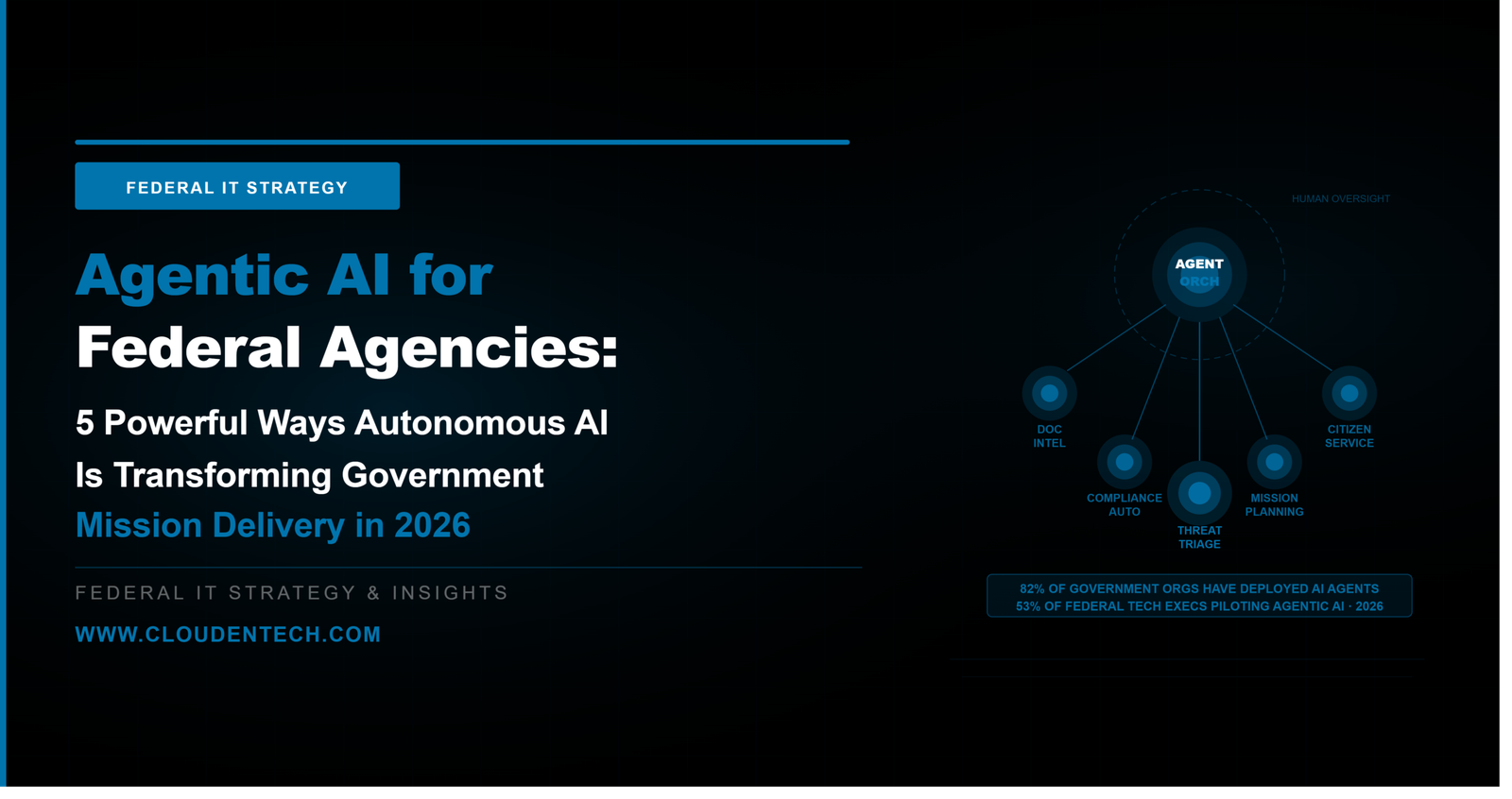
Agentic AI for federal agencies has crossed the threshold from experimentation to operational deployment faster than almost any previous technology cycle in government IT. The adoption numbers from mid-2026 are unambiguous: 82 percent of government organizations have deployed AI agents, according to IDC research for Salesforce. A March 2026 Market Connections survey of more than 200 technology executives across civilian and defense agencies found that 53 percent are exploring agentic AI or actively planning pilots, with another 15 percent already implementing the technology. Only 6 percent said they are still considering it.
That last number — 6 percent — may be the most telling. The conversation in federal IT has shifted from whether to adopt agentic AI to how to deploy it responsibly at scale, how to govern AI agents that take actions in mission-critical systems, and how to move from the pilots that most agencies have running to the production deployments that deliver sustained mission value.
The scale of the opportunity is equally specific. Gartner’s first Hype Cycle for Agentic AI, published in 2026, puts a number on what many in the public sector are already seeing: 40 percent of enterprise applications will embed task-specific AI agents by end of 2026. A federal agency with 5,000 employees running AI-powered workflows that used to take hours per task can reclaim millions of labor-hours per year. Ninety-four percent of government leaders believe AI agents will fundamentally transform the nature of work.
The concrete deployments confirm the trajectory. The Department of Veterans Affairs awarded Salesforce a $1.6 billion three-year Agentic Enterprise License Agreement to deploy AI agents across VA operations using Missionforce, with the agents designed to modernize care and service delivery and provide around-the-clock support to veterans. The Air Force is using Salesforce’s Missionforce National Security to transform operations and modernize mission readiness. The Defense Logistics Agency has approximately 55 active AI business use cases in production with another 200 in the backlog.
This post covers what agentic AI actually means in a federal operational context, the governance framework that responsible deployment requires, and the five powerful ways autonomous AI agents are transforming government mission delivery in 2026.
What Agentic AI Actually Means in Federal Government Contexts
Agentic AI is generally defined as autonomous systems capable of pursuing complex goals and reasoning, with the ability to take independent actions across software systems with minimal human oversight. NVIDIA describes agentic AI systems as the new digital workforce — a new breed of AI systems that are semi- or fully autonomous and thus able to perceive, reason, and act on their own.
The distinction that matters for federal agencies is the difference between AI that responds and AI that acts. A conversational AI assistant that answers questions and summarizes documents responds to prompts. An agentic AI system that can take a procurement request, search government databases, draft the contract language, route it through approval workflows, and schedule the kickoff meeting — taking each of those steps autonomously based on an initial instruction — acts. The agentic system produces work product and changes system state, not just text.
IDC research shows that the transformation of agentic AI in government includes three focus areas: operational orchestration, citizen service delivery, and decision support for policy and planning. All three represent domains where federal agencies currently spend enormous human capacity on tasks that AI agents can perform faster, more consistently, and at greater scale — freeing skilled federal employees for the judgment-intensive work that machines cannot replicate.
The governance implications of the distinction between responding and acting are significant. When an AI system responds with text, the human reads it, evaluates it, and decides what to do. When an AI agent acts — sending an email, modifying a record, initiating a workflow, calling an API — the human must decide in advance what actions the agent is authorized to take, under what conditions, with what oversight, and how those actions are audited. This governance design is the most important and most consistently underestimated element of federal agentic AI deployment.
The Federal Governance Framework for Agentic AI
Most federal AI deployments to date — the chatbots, the document summarization tools, the analyst assistants — have been systems that produce text outputs for human review. The governance requirements are manageable: output review, accuracy validation, bias assessment, and the standard OMB M-25-21 high-impact AI requirements for systems whose outputs inform consequential decisions.
Agentic AI systems that take actions require a more demanding governance framework. NIST 800-53 control families around audit and accountability translate directly to agentic AI requirements: who initiated the agent action, what tools were called, what data was accessed, what output was produced, and whether a human reviewed the output before any consequential step was taken. Agencies building this audit infrastructure now are creating a foundation that will make future agent deployments faster, not harder.
The survey data confirms that federal agencies are taking governance seriously. To ensure accountability for agentic AI solutions, 84 percent of respondents said their agencies had documented escalation policies, while 78 percent had structured post-incident review processes. Agencies must act now to define intervention triggers, ensure agents escalate to humans when uncertain, and build audit trails for every autonomous action.
The OWASP Top 10 for Agentic Applications, published in March 2026, adds a specific security governance dimension. The vulnerability classes that affect AI agents — goal hijacking, insecure inter-agent communication, privilege escalation through delegation chains — require governance design decisions that must be made before agents are deployed in production, not discovered in post-incident reviews. Every AI agent must have a unique, auditable identity with specific, documented access permissions. Delegation chains must implement proper scope limitation. And agent behavior must be continuously monitored against expected task boundaries.
The machine identity management challenge directly intersects with agentic AI governance. AI agents are machine identities — they authenticate to APIs, access data systems, and execute actions using credentials that must be governed with the same rigor applied to service accounts and CI/CD pipeline identities. The governance failure mode is treating AI agent credentials as service account credentials — shared, persistent, broadly privileged, and inadequately monitored. The correct model is purpose-specific credentials with minimum necessary permissions, short-lived tokens, and behavioral monitoring that detects when an agent acts outside its defined scope.
5 Powerful Ways Agentic AI Is Transforming Federal Mission Delivery
Way 1: Document Intelligence Agents Eliminate the Federal Backlog Crisis
The federal government processes enormous volumes of documents — procurement packages, FOIA requests, benefits applications, regulatory comments, intelligence reports, medical records, contract modifications. This document workload represents one of the most significant productivity constraints in government: highly trained federal employees spending substantial portions of their workday on document processing that requires literacy and attention but not the specialized expertise those employees were hired to provide.
Document intelligence agents address this directly. Production maturity for document intelligence agents is assessed at 88 percent — one of the highest maturity scores across federal AI use cases, reflecting that the technology is proven, the use cases are well-defined, and the governance frameworks are established.
The VA and HUD deployments illustrate the range. In collaboration with HUD, CGI deployed AI agents to call centers to record, transcribe, analyze, and categorize tenant calls and provide data on a dashboard — a deployment that turns unstructured call center data into structured, searchable intelligence for program management. The VA’s Missionforce deployment addresses the broader challenge of modernizing care delivery and providing around-the-clock support to veterans, with document intelligence as a foundational capability that enables agents to retrieve, summarize, and act on veteran records at scale.
For federal agencies, the document intelligence use case also provides the lowest-governance-risk entry point for agentic AI. Agents that read, summarize, and classify documents — with human review of outputs before any consequential action is taken — provide substantial productivity value while operating in a governance model that maps cleanly to existing federal AI oversight frameworks.
Way 2: Compliance Automation Agents Transform the ATO and Reporting Burden
Federal compliance obligations — FISMA reporting, FedRAMP continuous monitoring evidence, CMMC documentation, OMB AI use case inventories, Section 508 accessibility assessments, data privacy impact assessments — consume enormous quantities of skilled federal IT staff time. Much of this compliance work involves gathering data from systems, comparing it against policy requirements, documenting the findings, and routing the documentation through review and approval processes. These are exactly the structured, multi-step, tool-calling tasks that agentic AI performs well.
Compliance automation agents at 85 percent production maturity represent one of the most immediately deployable agentic AI use cases for federal IT programs. An agent that continuously monitors system configuration against FedRAMP control baselines, gathers the evidence artifacts that continuous monitoring requires, populates the compliance documentation templates with current system state, and routes the package to the Authorizing Official for review is performing work that currently requires hours of manual effort per reporting cycle — work that can be reduced to minutes of human review of agent-generated documentation.
This use case directly supports the continuous ATO programs that agencies are building for FY2027. The evidence generation burden that cATO requires — continuous, OSCAL-formatted compliance artifacts documenting the current security posture of every system component — is a task that human teams cannot sustain at the frequency and granularity that continuous authorization demands. Compliance automation agents are the mechanism that makes cATO operationally sustainable rather than theoretically achievable.
Built by Accenture Federal Services experts using Google Cloud and Gemini models, the SAFe Team Coach Assistant for the Defense Logistics Agency illustrates the broader pattern: AI agents that previously handled fragmented, labor-intensive processes now orchestrate complex, multi-step workflows — and the speed at which agencies can introduce new features, functions, or even new products is extremely accelerated.
Way 3: Threat Triage Agents Multiply Federal SOC Capacity
The federal cybersecurity workforce gap — 4.8 million unfilled roles globally, with government agencies among the most severely affected — makes the threat triage use case for agentic AI one of the most operationally critical in the federal portfolio. Federal security operations centers receive thousands of alerts per day. Human analysts cannot review all of them comprehensively. Real threats are missed in the noise.
Threat triage agents at 78 percent production maturity perform the first-line investigation that human analysts cannot keep pace with. They receive an alert, gather context from multiple data sources — EDR telemetry, network logs, identity events, threat intelligence feeds — correlate that context against known attack patterns, assess the likelihood that the alert represents a genuine threat versus a false positive, and present the human analyst with a prioritized, contextualized case rather than a raw alert requiring manual investigation from scratch.
The agentic model extends beyond triage to response orchestration. For well-defined, high-confidence threat scenarios — a compromised credential detected accessing sensitive data, a container executing unusual system calls, a phishing link clicked by an agency employee — an agentic system can initiate defined containment actions autonomously, within governance boundaries that human oversight has pre-approved, while simultaneously notifying the analyst team and generating the incident documentation that post-incident review requires.
The governance boundary for autonomous threat response is the most important design decision in this use case. Automated containment actions that are too aggressive — isolating endpoints or revoking credentials based on low-confidence signals — create mission disruption. Actions that are too conservative — requiring human approval for every response action at 3 AM when no analyst is watching — miss the response window that limits breach impact. The governance design that defines the confidence threshold and scope of authorized autonomous response is the human judgment investment that makes automated response both effective and safe.
Way 4: Mission Planning and Decision Support Agents Compress the Federal Decision Cycle
At the core of the Department of Defense’s AI approach is the integration of multi-agent architectures that support tasks such as campaign planning, logistics coordination, intelligence fusion, and dynamic targeting, with interconnected AI agents that can autonomously analyze inputs and coordinate actions across mission systems.
For civilian agencies, the equivalent is the complex analytical and planning work that consumes disproportionate amounts of senior staff time — budget projections, program performance analysis, policy impact assessments, grant portfolio management, regulatory impact modeling. Mission planning and decision support agents at 72 percent production maturity are earlier on the maturity curve than document intelligence or compliance automation, reflecting that the tasks are more complex, the judgment requirements are higher, and the governance frameworks for high-stakes decision support are still maturing.
The deployment model that federal agencies are proving out in 2026 is not autonomous decision-making — it is decision acceleration. The agent gathers and synthesizes the information a senior analyst needs to make a decision, reducing the time from question to decision-ready analysis from days to hours. The human makes the decision. The agent does the research, synthesis, and documentation that previously consumed most of the human’s decision preparation time.
This model directly addresses the federal workforce gap. Agencies that cannot hire enough senior analysts for their mission planning and policy work can use agentic decision support to multiply the effective capacity of the analysts they have. That is a structural workforce solution, not a workaround — and it is one that 94 percent of government leaders believe will fundamentally transform how government work gets done.
Way 5: Citizen Service Agents Deliver 24/7 Government Services at Scale
The Department of Veterans Affairs deploying AI agents to provide around-the-clock support to veterans is the most prominent example of a citizen service transformation that multiple federal agencies are pursuing in parallel. The citizen service use case addresses a fundamental constraint of government service delivery: agency staff are available for 8 hours a day, 5 days a week, while citizen needs arise around the clock and across time zones.
AI agents that can handle benefits status inquiries, guide citizens through application processes, answer questions about program eligibility, schedule appointments, and process routine service requests — at any hour, in multiple languages, without queue times — represent a service delivery transformation that no amount of additional federal hiring could achieve at equivalent cost.
The governance requirement for citizen-facing agents is explicit in OMB M-25-21: any AI system whose outputs serve as the basis for consequential decisions affecting individuals’ rights, opportunities, access to services, or safety is a high-impact AI system that must meet minimum practice requirements including documented human oversight, bias assessment, and regular performance monitoring. Citizen service agents that determine eligibility, route applications, or provide guidance that citizens act on are high-impact AI systems by definition.
This means that citizen service agents require more governance overhead than back-office automation agents, but that overhead is justified by the mission impact. A citizen who receives incorrect benefits eligibility information from an AI agent and acts on it — not filing an appeal, not pursuing a benefit they are entitled to, making life decisions based on an AI error — has been harmed by a government AI system. The governance framework that prevents this harm is the investment that makes citizen-facing agentic AI responsible.
Moving from Pilot to Production: The Challenge Federal Agencies Must Solve
Findings indicated that some agencies struggle moving agentic AI pilots from the sandbox to production environments. This production gap — where promising pilots that worked in controlled settings fail to scale into operational systems — is the primary barrier to realizing the mission value that agentic AI promises.
The production gap has three consistent causes. The first is data quality — AI agents operating on production data encounter quality, completeness, and consistency issues that controlled pilot datasets did not have. The second is integration complexity — connecting agents to production systems, with their authentication requirements, rate limits, and data governance policies, is significantly more complex than connecting them to pilot APIs. The third is governance maturity — the human oversight protocols, escalation procedures, and audit logging requirements that OMB M-25-21 mandates for high-impact AI must be operational before production deployment, not developed after agents are in production.
Agencies that treat their pilot as a proof of concept for the technology and their production deployment as the time to solve governance are doing these in the wrong order. The pilot should also be the governance development environment — where the escalation policies, intervention triggers, audit infrastructure, and human oversight workflows are designed, tested, and validated alongside the agent’s functional capabilities.
Most AI delivered to federal agencies is a chatbot wrapped around a vendor API, fielded as a proof of concept, and abandoned after the demo. The agencies that avoid this pattern are those that treat production governance as an equal requirement with production technical performance — and that build the data infrastructure, integration architecture, and human oversight framework before the pilot phase ends.
How ClouDen Technologies Supports Federal Agentic AI Deployment
At ClouDen Technologies, our application development practice builds production agentic AI systems for federal agencies — systems designed from the first sprint for the compliance, security, and governance requirements that federal AI deployment demands. We do not build pilots that demonstrate a capability without building the governance infrastructure that production requires.
Our AI development engagements address the full production readiness stack: the data quality and integration architecture that agents require to operate reliably on production data, the machine identity governance that gives each agent a unique, auditable, least-privilege identity, the NIST 800-53 audit and accountability infrastructure that logs every agent action for oversight review, and the human oversight workflows that satisfy OMB M-25-21 requirements for high-impact AI.
Our cloud solutions practice designs the FedRAMP-authorized cloud environments where federal AI agents operate — including the GovCloud infrastructure for agentic workloads, the API gateway configurations that govern agent access to agency systems, and the monitoring infrastructure that provides the behavioral visibility that responsible agentic AI deployment requires. Our cybersecurity services address the specific security architecture requirements of agentic systems — including the OWASP Agentic Top 10 vulnerability classes, the machine identity governance for AI agent credentials, and the behavioral monitoring that detects when agents act outside their defined scope.
Our management services practice supports the program management and change management work that moving agentic AI from pilot to production requires — including the workforce transition planning that 94 percent of government leaders recognize will be necessary as AI agents become part of the federal operational workforce.
As an SBA-certified 8(a) small business operating under ISO 27001:2022, ISO 9001:2015, and ISO/IEC 20000-1:2018, we bring the governance discipline that federal agentic AI deployment demands — both the technical governance of AI agent identity and access, and the compliance governance of OMB M-25-21 high-impact AI requirements.
If your agency is moving an agentic AI pilot toward production, building the governance infrastructure for autonomous AI operations, or designing the multi-agent architecture for a specific mission use case, contact ClouDen Technologies today.
Key Takeaways
Agentic AI for federal agencies has reached scale. 82 percent of government organizations have deployed AI agents, 53 percent of federal tech executives are exploring or actively piloting agentic AI, and 15 percent have already implemented it. Only 6 percent are still considering adoption.
The VA awarded Salesforce a $1.6 billion three-year Agentic Enterprise License Agreement for AI agents across VA operations. The Defense Logistics Agency has 55 active AI use cases in production with 200 more in the backlog. The Air Force is using Missionforce National Security to transform operations. Federal agentic AI is in production, not in pilot.
The governance framework for agentic AI must address: unique machine identities with least-privilege credentials for each agent, NIST 800-53 audit and accountability infrastructure logging every agent action, documented escalation policies and intervention triggers, and OMB M-25-21 high-impact AI compliance for agents whose outputs affect citizens’ rights or access to services.
The five highest-impact use cases are: document intelligence agents (88% production maturity), compliance automation agents (85%), threat triage agents (78%), mission planning and decision support agents (72%), and citizen service agents.
The production gap — pilots that work but fail to scale to production — has three causes: data quality issues with production data, integration complexity with production systems, and governance maturity gaps. Governance infrastructure must be developed during the pilot phase, not after.
By 2030, 89 percent of government leaders see a hybrid workforce of humans and AI agents, and 75 percent expect every manager who manages subordinates today to also manage AI agents. Federal agencies investing in agentic AI governance and deployment infrastructure now are building the operational model for government’s next decade.
About ClouDen Technologies
ClouDen Technologies is an SBA-certified 8(a) small business delivering cloud, cybersecurity, DevSecOps, enterprise architecture, application development, and management services to U.S. federal agencies, educational institutions, and commercial organizations. ClouDen operates under ISO 9001:2015, ISO/IEC 20000-1:2018, and ISO/IEC 27001:2022.