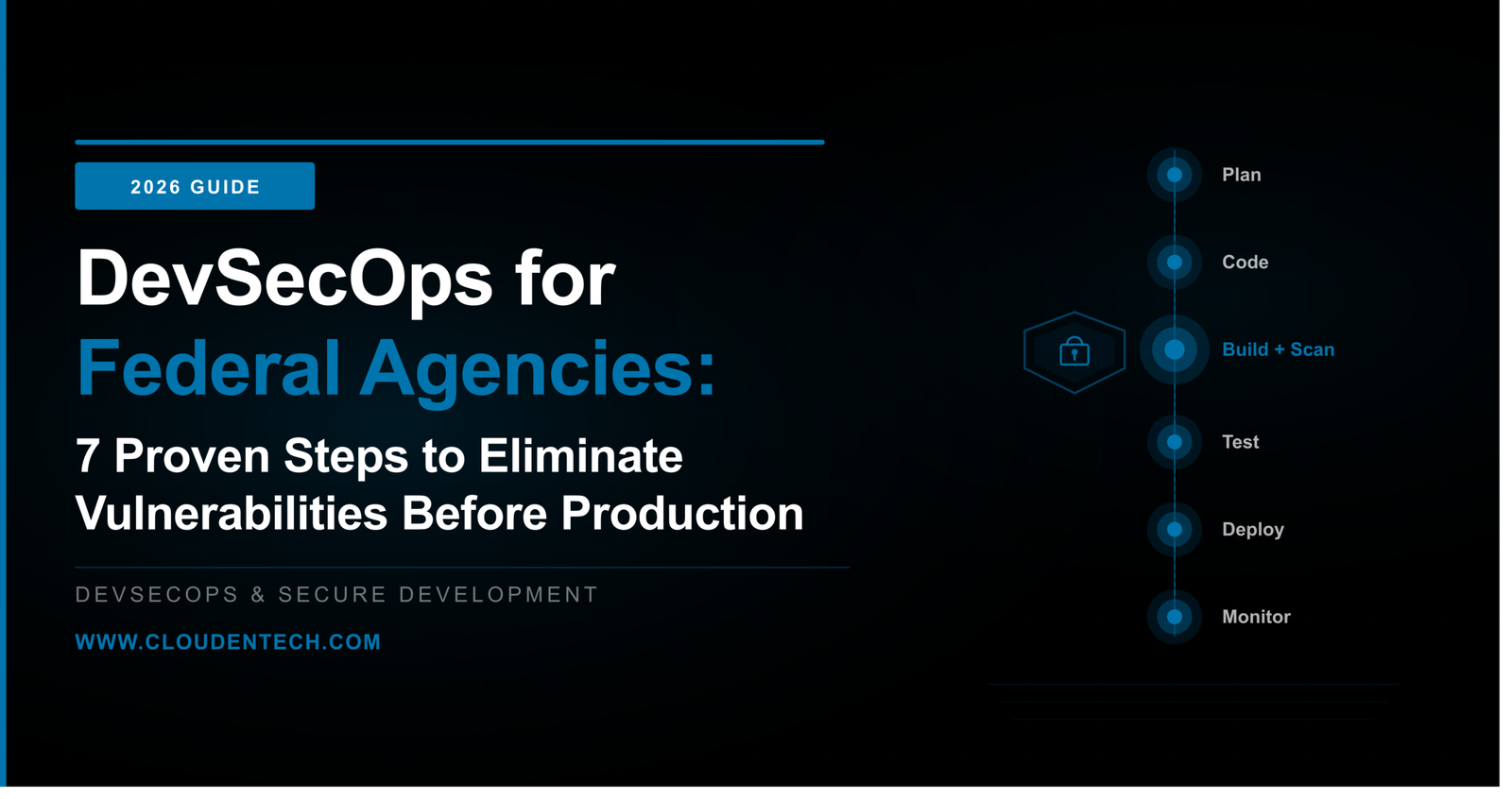
DevSecOps for federal agencies has moved from a recommended practice to a formal compliance requirement. If your agency or organization is developing, maintaining, or modernizing software for government use, security can no longer be something you address at the end of the development cycle. The rules, the frameworks, and the consequences have all changed in 2026.
NIST’s National Cybersecurity Center of Excellence published updated live guidelines for DevSecOps practices in March 2026, demonstrating and documenting risk-based approaches aligned with the Secure Software Development Framework (SSDF), NIST SP 800-218. The guidance specifically addresses how security integrates into every phase of the software development lifecycle, not just testing and deployment. Federal News Network
This is the government’s clearest signal yet: DevSecOps is the expected standard, not an advanced option.
This post walks through what DevSecOps actually means in a federal context, why the shift-left model matters for mission-critical systems, and the seven concrete steps government IT teams and their contractor partners must take to build and sustain a secure development program in 2026.
What DevSecOps Means in a Federal Context
The term gets used loosely. In a federal context, DevSecOps has a specific meaning with specific implications.
Traditional software development treated security as an afterthought, addressed as a separate concern in later stages or post-deployment. DevSecOps offers a fundamentally different model: a before-thought approach that integrates security practices from the very beginning and throughout every phase of the development process. Federal News Network
For federal agencies and their contractors, that definition matters because it directly intersects with authorization to operate (ATO) processes, FedRAMP compliance, CMMC requirements, and the NIST Secure Software Development Framework. A software system that was built without security embedded in the pipeline will carry more vulnerabilities, require more remediation before authorization, and cost significantly more to fix than one built with DevSecOps from the start.
NIST’s SSDF-aligned DevSecOps framework emphasizes automated production flows, noting that when security controls are not embedded early, those automated pipelines can quickly propagate security risks directly into production environments. In a federal agency operating mission-critical systems, a vulnerability that reaches production is not just a technical problem. It is a compliance failure, an ATO risk, and potentially a national security concern.
Why 2026 Is the Right Year to Get This Right
Several converging factors make DevSecOps adoption urgent for federal agencies and contractors right now, not eventually.
Executive Order 14306, signed in 2025, explicitly directs agencies to strengthen cybersecurity through secure software development practices aligned with the NIST SSDF. NIST’s NCCoE published its live DevSecOps guidelines directly in response to EO 14306, aiming to demonstrate secure software development practices that fundamentally bolster the security of DevSecOps pipelines using the SSDF’s recommendations.
CMMC 2.0 Phase 2 enforcement begins November 10, 2026. Every defense contractor building or maintaining software that processes CUI must demonstrate that their software development practices meet the security controls required by NIST SP 800-171. That includes access controls, configuration management, incident response, and audit logging requirements that are all directly addressed through a mature DevSecOps program.
The Zero Trust Architecture mandates that OMB has issued for federal agencies also connect directly to DevSecOps. NIST’s DevSecOps framework specifically explores Zero Trust principles as a strategy to strengthen the resiliency of DevSecOps environments, including scanning for vulnerabilities, ensuring the integrity of artifacts, and verifying code commits and signatures.
The agencies and contractors who invest in DevSecOps now will spend less time remediating vulnerabilities during ATO reviews, face fewer findings in C3PAO assessments, and deliver software that works more reliably in production.
The 7 Proven Steps to Eliminate Vulnerabilities Before Production
Step 1: Define Your Secure Software Development Framework Baseline
Before your team writes a single line of code or configures a single pipeline, you need a documented baseline that defines what security means for your project. For federal agencies and government contractors, that baseline is the NIST Secure Software Development Framework (SSDF), NIST SP 800-218.
The SSDF provides practical and actionable guidelines that meaningfully integrate security practices into development methodologies, covering software development, builds, packaging, distribution, and deployment. Your baseline documentation maps your team’s actual practices against SSDF tasks, identifies gaps, and produces the evidence an auditor or ATO reviewer expects to see. SBA
This is not a checkbox exercise. Your System Security Plan and your development process documentation need to accurately reflect each other. Inconsistency between the two is one of the most common findings in federal software assessments.
Step 2: Shift Security Left — Integrate It at Design, Not Testing
Shift left is the core philosophy of DevSecOps, and it means moving security decisions and controls as early in the development lifecycle as possible. The later a vulnerability is discovered, the more it costs to fix. A flaw caught in design review takes hours to correct. The same flaw discovered in a C3PAO assessment or an ATO review can delay a program by months.
Practically, shifting left means threat modeling during the design phase to identify attack surfaces before architecture is finalized. It means peer security reviews of system designs and data flow diagrams before development begins. It means your developers understand the security requirements that apply to what they are building, and that those requirements are part of their definition of done, not a separate audit step.
For regulated federal environments, the NIST SSDF usually becomes the anchor framework. It provides clear, auditable expectations that map well to ATO reviews and external assessments, making it well suited for the compliance demands of government contracting.
Step 3: Automate Static and Dynamic Security Testing in the Pipeline
Manual security review at the end of a sprint is not DevSecOps. A true DevSecOps pipeline integrates automated security testing at every stage, producing findings immediately rather than through periodic assessments.
Static Application Security Testing (SAST) analyzes source code and identifies vulnerabilities before the code is ever executed. Dynamic Application Security Testing (DAST) tests running applications for vulnerabilities that only emerge at runtime. Software Composition Analysis (SCA) scans third-party libraries and open-source dependencies for known vulnerabilities. The NIST NCCoE Live Guidelines for DevSecOps Practices specifically address open-source risk, software supply chain integrity, and Software Bill of Materials (SBOM) generation as critical pipeline components for federal-grade DevSecOps programs.
Every finding generated by these automated tools should be tracked, assigned, and resolved within defined Service Level Agreements based on severity. A critical finding that sits unresolved for 30 days is not a DevSecOps program. It is a documentation exercise.
Step 4: Implement Infrastructure as Code with Security Controls Embedded
Modern federal cloud environments are built on Infrastructure as Code (IaC). Terraform, Ansible, CloudFormation, and similar tools allow infrastructure to be defined, versioned, and deployed programmatically. The same logic that applies to application code applies to IaC: if security is not embedded in the infrastructure templates from the start, every deployment inherits the same vulnerabilities.
IaC security scanning should run automatically as part of your pipeline, validating that infrastructure configurations conform to your agency’s security baselines before anything is deployed to any environment. Misconfigurations of cloud infrastructure, particularly excessive permissions, open storage buckets, and unencrypted data at rest, remain among the most frequently exploited vulnerabilities in federal environments.
For agencies operating under FedRAMP, this step directly supports continuous monitoring requirements. IaC with embedded controls and configuration validation produces the evidence that FedRAMP continuous monitoring programs require.
Step 5: Secure Your Software Supply Chain and Manage SBOMs
Modern software is the synthesis of a wide array of components and processes, some of which are under the direct control of the software producer while others are part of a large, interconnected, and often opaque supply chain. Much of the DevSecOps methodology relies on automated production flows, which can quickly propagate security risks directly into production if they are not caught early. Virginia Business
Executive Order 14028, signed in 2021 and reinforced by subsequent agency directives, requires federal agencies procuring software to obtain a Software Bill of Materials (SBOM) from vendors. An SBOM is a formal, machine-readable inventory of all components in a piece of software, including third-party libraries, open-source dependencies, and their versions. When a new vulnerability is disclosed in a widely used library, an SBOM allows your team to immediately identify whether any of your systems are affected and take action before an attacker does.
Your DevSecOps pipeline should generate and maintain SBOMs automatically for every build. Combine SBOM generation with continuous dependency monitoring that alerts your security team when a component in your inventory receives a new CVE rating, particularly Critical or High severity findings.
Step 6: Automate Compliance Artifact Generation
One of the most underrated benefits of a mature DevSecOps program for federal agencies is the continuous, automated generation of compliance evidence. Traditional ATO processes involve months of manually compiling documentation to demonstrate that security controls are implemented. A DevSecOps pipeline that generates compliance artifacts automatically transforms that process entirely.
NIST’s DevSecOps guidance emphasizes automatically generating security and compliance artifacts throughout the development process, including software development, builds, packaging, distribution, and deployment stages. These artifacts provide the evidence an authorizing official, a C3PAO assessor, or a FedRAMP reviewer needs to verify that controls are working as documented, without requiring your team to stop everything and compile a package from scratch. SBA
Practically, this means your pipeline captures evidence of security scanning results, access control enforcement, configuration validation, and code signing at every build. That evidence is stored, version-controlled, and available on demand. When an auditor asks how you know your controls are working, you show them the system, not a spreadsheet.
Step 7: Establish Continuous Monitoring and a Defined Vulnerability Response Program
Authorization to operate is not a finish line. It is a starting point for the continuous monitoring obligations that every federal system carries after authorization. A DevSecOps program that stops at deployment has not finished its job.
Continuous monitoring in a federal DevSecOps context means ongoing vulnerability scanning of production systems, regular review of security event logs, defined escalation procedures when findings exceed threshold severity, and a formally documented vulnerability response program with response time requirements matched to severity level.
CISA’s Binding Operational Directive 22-01, which requires federal civilian agencies to remediate known exploited vulnerabilities within defined windows, applies directly here. Agencies without a functioning continuous monitoring program struggle to meet BOD 22-01 obligations consistently. A DevSecOps pipeline with automated scanning and documented response procedures makes compliance with these directives operationally manageable rather than reactive and manual.
DevSecOps as a Service: When to Use an External Partner
Not every federal agency or defense contractor has the internal capacity to build a full DevSecOps program from the ground up. Building the pipeline, training developers, integrating the right tooling, and maintaining the compliance documentation simultaneously is a significant operational investment.
That is where DevSecOps as a service becomes a practical solution. Rather than hiring and retaining a dedicated team of security engineers, DevSecOps consultants, and pipeline architects, agencies and contractors can partner with a firm that brings that capability as a managed offering, embedding security expertise directly into the development lifecycle on a project or program basis.
The most effective DevSecOps partnerships are those where the external partner integrates with your team rather than operating separately from it. Security consultants who attend sprint planning, review architecture decisions, and contribute directly to pipeline configuration produce fundamentally better outcomes than teams conducting periodic external audits of a program they have no context for.
How ClouDen Technologies Delivers DevSecOps for Federal Agencies
At ClouDen Technologies, our DevSecOps services are designed for exactly the environments described in this post: mission-critical federal systems where security failures carry real consequences, and where compliance evidence is not optional.
We offer DevSecOps consulting, DevSecOps as a service, and operational DevSecOps support, working directly with agency development teams and contractor program offices to embed security at every stage of the software lifecycle. Our approach is aligned with the NIST SSDF, CMMC 2.0 requirements, FedRAMP continuous monitoring expectations, and Zero Trust principles.
As an SBA-certified 8(a) small business operating under ISO 27001:2022 and ISO 9001:2015, we bring both the technical depth and the governance documentation discipline that federal DevSecOps programs demand. Our application development practice builds secure-by-design software using the same pipeline security principles described in this post, and our cybersecurity services provide the continuous monitoring and vulnerability management capabilities that keep authorized systems compliant between ATO reviews.
If your agency or organization is building or modernizing software and needs a partner who understands both the technology and the federal compliance landscape, contact ClouDen Technologies today.
Key Takeaways
DevSecOps for federal agencies is now a formal compliance requirement, aligned with EO 14306, NIST SSDF, CMMC 2.0, and FedRAMP continuous monitoring standards.
The shift-left model prevents vulnerabilities from reaching production by embedding security decisions into design and development, not just testing and deployment.
A mature DevSecOps pipeline includes automated SAST, DAST, SCA, IaC security scanning, SBOM generation, and automated compliance artifact generation — all producing continuous evidence without manual compilation.
Software supply chain security and SBOM management are now expected by federal agencies procuring software under EO 14028 requirements.
Continuous monitoring and a defined vulnerability response program are mandatory for maintaining ATO status. DevSecOps provides the operational infrastructure to meet those obligations consistently.
DevSecOps as a service is a viable model for agencies and contractors who need the capability without the overhead of building an internal team from the ground up.
About ClouDen Technologies
ClouDen Technologies is an SBA-certified 8(a) small business delivering cloud, cybersecurity, DevSecOps, enterprise architecture, application development, and management services to U.S. federal agencies, educational institutions, and commercial organizations. ClouDen operates under ISO 9001:2015, ISO/IEC 20000-1:2018, and ISO/IEC 27001:2022.