Federal enterprise architecture modernization has become the most consequential IT management challenge in government in 2026. Not because agencies lack awareness of the problem, but because the gap between what is known and what has been done continues to widen at significant cost.
About $83 billion — 79 percent — of planned total IT spending for fiscal year 2025 was intended for operations and maintenance, according to the federal IT dashboard for the 24 Chief Financial Officers Act agencies. That leaves just 21 cents of every IT dollar available for modernization, development, and innovation across the entire federal civilian enterprise. In June 2019, GAO identified 10 critical federal IT legacy systems that were most in need of modernization. As of February 2025, agencies have completed only three of the 10 modernizations. Of the seven remaining, agencies planned to complete four in the next few years, two in five or more years, and one does not yet have a planned completion date. PiTechFedRAMP
The fiscal reality is stark. Legacy system maintenance costs increase 10 to 15 percent annually because of four converging forces: hardware components become scarcer and more expensive after warranty expiration, the talent pool of developers with legacy expertise shrinks as specialists retire, third-party vendor support contracts escalate as vendors sunset legacy product lines, and each year of deferred modernization adds technical debt that makes the eventual migration more complex and costly. gsa
Enterprise architecture is the management discipline that changes this trajectory. Not by replacing legacy systems overnight, but by giving agency leadership the structured visibility, the investment sequencing logic, and the governance framework to make decisions that reduce technical debt systematically rather than accumulating it indefinitely.
This post explains what federal enterprise architecture actually delivers for agencies in 2026, what frameworks govern it, and the six proven approaches that agencies and their IT partners use to reduce technical debt and modernize mission systems without disrupting the services those systems support.
What Federal Enterprise Architecture Is and Why It Matters Now
Enterprise architecture is the practice of aligning an agency’s IT investments, systems, data, and technology capabilities with its mission objectives through a structured, documented, and governed framework. In a federal context, it is governed primarily by the Federal Enterprise Architecture Framework, established in 1999 by the Chief Information Officers Council in response to the Clinger-Cohen Act of 1996.
The purpose of FEAF is to facilitate shared development of common processes and information among federal agencies and other government agencies. Based on FEAF, a given architecture can be partitioned into business architecture — what is done, by whom, how, when, and why — data architecture, which covers the information used by the agency to do business, application architecture covering the computer applications and software that process the data, and technology architecture covering the hardware and communications infrastructure that supports all three. Executive Gov
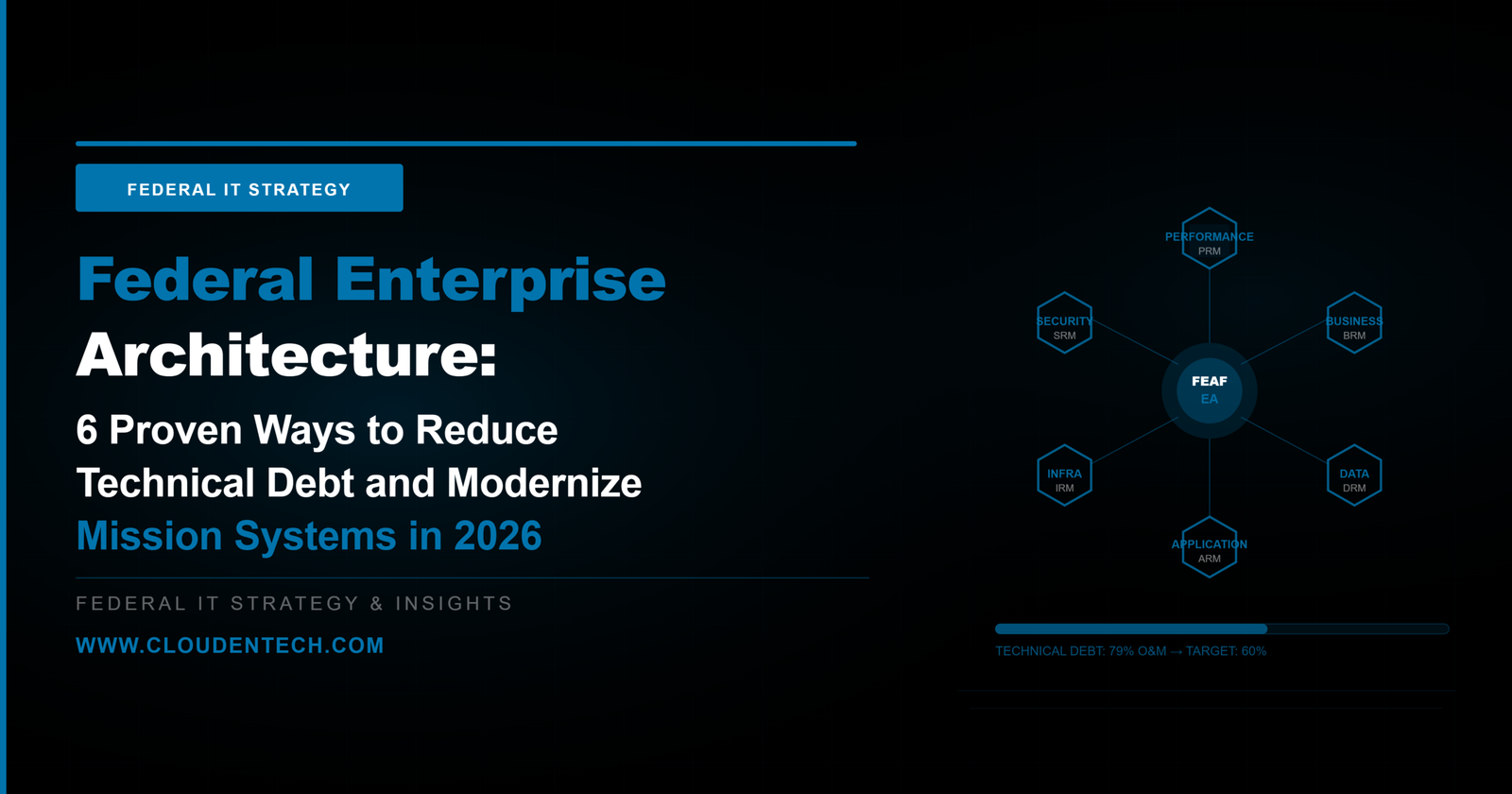
FEAF focuses on six main reference models: the Performance Reference Model, the Business Reference Model, the Data Reference Model, the Application Reference Model, the Infrastructure Reference Model, and the Security Reference Model, providing an integrated approach to managing IT and business processes. These six domains are not independent compliance tracks. They are interdependent layers of a single architectural model, where decisions made in one domain have direct consequences for the others. An agency that manages each domain independently without an overarching enterprise architecture practice will consistently discover those consequences at the worst possible time — during a major system failure, a failed modernization attempt, or a security audit. FedRAMP
Despite the availability of FEAF, many federal agencies face significant challenges in implementing enterprise architecture effectively. Fragmented IT environments, legacy systems, and siloed operations often hinder agencies’ ability to fully realize the benefits of the framework. These issues can lead to inefficiencies, redundant processes, and difficulties meeting evolving mission requirements. Moreover, the lack of a clear, cohesive strategy can result in misaligned IT investments, exacerbating operational challenges and increasing the risk of non-compliance with federal standards. Secureframe
The agencies that have reduced their technical debt most successfully in recent years share a common characteristic: they have a functioning enterprise architecture practice that connects IT investment decisions to mission outcomes, sequences modernization work to manage risk, and maintains a governed view of the current and target state of their technology portfolio.
TOGAF and FEAF in the Federal Context
Two frameworks dominate federal enterprise architecture practice: FEAF, which is specifically designed for the U.S. federal government, and TOGAF, the Open Group Architecture Framework, which is the most widely adopted EA framework globally.
While FEAF is oriented toward enterprise architecture, TOGAF is more oriented toward IT architecture. FEAF is designed to provide guidance to federal agencies for structuring their enterprise architecture specifically within a bureaucratic environment, promoting collaboration and highlighting cost-saving opportunities. Three of the four architecture domains covered by TOGAF correspond directly to the columns of the FEAF matrix. FedRAMP
TOGAF remains highly pertinent to the design and implementation of federal enterprise architecture solutions, particularly in the context of AI-driven transformation. TOGAF’s modular, iterative methodology provides a structured yet flexible approach to architecture development, encompassing architecture vision, business architecture, information systems architecture, and technology architecture. Its emphasis on stakeholder management, requirements traceability, and governance aligns well with the stringent accountability standards of federal agencies. Carahsoft
In practice, most mature federal enterprise architecture programs use elements of both frameworks rather than adopting one wholesale. FEAF provides the structure for aligning with federal mandate requirements, OMB reporting, and the specific governance expectations of the federal IT environment. TOGAF’s Architecture Development Method provides the process methodology for executing architecture work iteratively, managing stakeholder requirements, and sequencing transition architectures.
In 2026, enterprise architecture extends beyond documentation. Modern EA practices incorporate AI-driven insights, cloud-native design, and continuous strategy alignment. Enterprise architecture provides a structured governance model, reducing regulatory and operational risk while ensuring that every initiative traces back to strategic objectives. Ignyte
6 Proven Ways Federal Enterprise Architecture Reduces Technical Debt and Modernizes Mission Systems
Way 1: Build a Current State Portfolio Map Before Making Any Investment Decision
The most fundamental and most frequently skipped step in federal enterprise architecture is building an accurate, comprehensive map of the current state technology portfolio. Without this map, every modernization decision is made with incomplete information about dependencies, duplication, and risk.
According to the Information Technology and Innovation Foundation, Congress should appropriate $10 billion to address the federal government’s technical debt and replace costly legacy systems. But investment without visibility produces waste, not outcomes. Agencies that cannot precisely articulate which systems they run, how those systems interact, what mission functions they support, and what their risk profile is cannot make sequenced, risk-managed investment decisions. Secureframe
A current state portfolio map documents every significant IT system in the agency’s inventory, the mission functions each system supports, the age and technology currency of the system, its vendor support status and known vulnerabilities, its integration dependencies with other systems, and its annual operations and maintenance cost. This inventory is the foundation that every other enterprise architecture activity builds on. Agencies that skip it produce modernization roadmaps that look coherent on paper but encounter cascading failures during execution because the dependencies they missed in planning become blocking constraints in delivery.
Way 2: Prioritize Technical Debt Reduction as a Funded Budget Category
Developers spend 42 percent of their work week — roughly 17 hours out of 41 — on maintenance and technical debt, with legacy system maintenance cited as the primary cause. Applied to a team of 25 developers at an average fully loaded cost of $120,000 per year, that is approximately $990,000 annually in engineering capacity absorbed by maintenance rather than product development. FedRAMP
The fundamental budget problem in federal IT is that technical debt reduction is chronically underfunded because it does not produce visible new capabilities. Appropriations committees respond to new systems and new services. The work of removing an aging integration layer, migrating data off an unsupported database, or refactoring code that has accumulated years of patches is unglamorous, produces no ribbon-cutting moment, and is frequently deferred in favor of higher-profile initiatives.
A roadmap that only contains new capabilities becomes an implicit promise to keep paying the interest on existing complexity. Application-based roadmapping must explicitly call out technical debt reduction and modernization as a core reason roadmaps exist. Practically, organizations need a resource allocation model that sets aside a percentage of roadmap capacity for debt reduction so debt work is never permanently hidden in backlogs. Lazarusalliance
Federal agencies that have successfully reduced their technical debt burden treat debt reduction as a funded budget line item with defined targets, measurement methodology, and regular reporting to agency leadership. When debt reduction is measured and reported at the same level of visibility as new system development, it receives the management attention and funding priority it requires.
Way 3: Sequence Modernization Using a Risk-Value Framework, Not a Technology Framework
The sequence in which an agency modernizes its legacy systems is the single most important determinant of whether the modernization program succeeds. Agencies frequently sequence modernization work based on what is technically easiest to migrate, what vendors are promoting most aggressively, or what received the most attention in the last GAO report. None of these are the right criteria.
The right sequencing framework evaluates each system against two dimensions: the mission risk it creates if left in its current state, and the value that modernizing it delivers to the agency’s mission objectives. Systems that score high on both dimensions — high risk if left, high value when modernized — are the right starting points. Systems that score high on risk but low on value may need to be retired rather than modernized. Systems that score low on risk but high on value can wait for a later phase.
Effective modernization begins with a thorough systems assessment that maps the complex web of interdependencies between applications, documents how information flows across systems, and identifies which business processes rely on each component. Agencies can then target systems with the highest technical debt, security vulnerabilities, and maintenance costs, creating a prioritized roadmap that addresses pressing issues while recognizing connected dependencies. gsa
GAO’s current prioritization of eleven legacy systems specifically reflects a risk-value framework — systems that are old, costly, vulnerable, and mission-critical are the ones that GAO has consistently identified and that agencies have been slowest to address. The enterprise architecture practice gives agencies the analytical foundation to make those prioritization decisions rigorously and defensibly, rather than reacting to external pressure after the fact.
Way 4: Implement Transition Architectures That Deliver Value at Each Phase
The biggest risk in federal IT modernization programs is the gap between the current state and the target state. When that gap is large — as it almost always is for agencies with significant technical debt — the program must bridge the gap through a sequence of transition architectures, each of which is a stable, deployable intermediate state that delivers mission value and reduces risk.
TOGAF-aligned roadmapping explicitly positions transition architectures as intermediate states that deliver continuous business value and provide convergence points. Define two to four transition points that are each stable and deployable, validate each before proceeding, and transition version by version. The first work package should produce a measurable business outcome, not just infrastructure readiness. Lazarusalliance
For federal agencies, this means that a ten-year legacy modernization program should not produce its first mission-visible result in year eight. It should produce measurable improvements — reduced processing time, improved data quality, closed security vulnerabilities, reduced maintenance cost — at each transition point. This is not just a governance preference. It is a political and budget reality. Programs that cannot demonstrate value at interim milestones lose stakeholder support, face budget reductions, and frequently get cancelled before reaching their target state.
Transition architectures also manage the risk of operating both legacy and modernized systems simultaneously during the migration period. The enterprise architecture practice defines how the old and new systems interact during transition, what data migration strategy connects them, and what the cutover criteria are for each phase. Agencies that attempt modernization without this transition architecture definition frequently discover that their legacy and modern systems cannot interoperate during migration, creating exactly the mission disruption the phased approach was designed to prevent.
Way 5: Align Enterprise Architecture With Zero Trust and Cloud Security Mandates
Federal enterprise architecture in 2026 does not exist in isolation from the security and compliance mandates that govern agency IT operations. OMB M-22-09 zero trust requirements, FedRAMP authorization obligations, CMMC compliance for defense contractors, and FISMA continuous monitoring requirements all have direct implications for enterprise architecture decisions.
TOGAF facilitates the seamless integration of intelligent systems by enabling clear definition of data flows, service interfaces, and security protocols. The framework’s adaptability supports the incorporation of AI-specific considerations — such as algorithmic transparency and bias mitigation — into the broader enterprise architecture, ensuring that federal solutions remain robust, scalable, and compliant with evolving regulatory requirements. Carahsoft
The security reference model within FEAF is specifically designed to ensure that security architecture decisions are integrated with the other five domain reference models rather than addressed as a separate compliance track. An agency that designs its application architecture without simultaneously updating its security reference model will produce applications whose security requirements are discovered reactively rather than designed proactively.
Zero trust architecture, in particular, has significant implications for enterprise architecture decisions. Zero trust requires micro-segmentation at the network level, identity-based access control at the application level, and data-level classification and protection — all of which depend on the application architecture, data architecture, and infrastructure architecture being designed coherently around zero trust principles. Enterprise architecture is the governance framework that ensures those design decisions are coherent across all six FEAF domains.
Way 6: Establish Architecture Governance That Controls Investment and Prevents Accumulation of New Technical Debt
The final and most durable way that enterprise architecture reduces technical debt is through the governance function — the processes, decision bodies, and standards that ensure new investments do not accumulate new technical debt even as old debt is being reduced.
FEAF provides a solution by offering a structured, repeatable process for developing, implementing, and managing enterprise architecture. By following the framework’s guidelines, CIOs and IT leaders can create a more integrated and efficient IT environment that aligns with agency goals. FEAF’s emphasis on standardization and collaboration helps to break down silos, enabling better resource management and reducing redundancies. Secureframe
Architecture governance in a federal agency means that no significant IT investment proceeds without an architecture review that confirms alignment with the agency’s target state architecture, verifies that the investment does not introduce new dependencies that will become tomorrow’s technical debt, and ensures that security, data governance, and compliance requirements are addressed in the design rather than retrofitted afterward.
Of all the IT projects the government has underway, 90 percent are on time and 84 percent are on budget as of March 2026. The OMB reported about $2 billion in cost savings in 2025. These improvements are directly attributable to better governance of federal IT investments — the same governance discipline that enterprise architecture provides at the agency level. Agencies that establish functioning architecture review boards, investment review processes, and standards compliance checkpoints for new technology acquisitions consistently outperform those that allow individual program offices to make technology decisions independently. meritalk
Architecture governance also addresses the accumulation of shadow IT — cloud services, SaaS tools, and technology products acquired by individual program offices outside of the IT procurement process. Shadow IT is one of the fastest-growing sources of new technical debt in federal agencies, because services acquired outside the governance process are not assessed for security compliance, data classification requirements, or integration with the agency’s existing architecture. Enterprise architecture governance provides the framework for bringing shadow IT into a governed, compliant posture rather than discovering it during audits or security incidents.
The ROI of Federal Enterprise Architecture Investment
The financial case for enterprise architecture investment in federal agencies is well-established, but it requires presenting the ROI in terms that federal budget processes recognize.
According to research by Gartner, organizations that actively manage their technical debt can reduce their IT maintenance costs by up to 50 percent. The combined impact of rising maintenance costs, operational inefficiencies, security mitigation expenses, and workforce challenges means the total cost of inaction exceeds modernization investments within just two to three years for most organizations with significant legacy debt. Secureframe
Legacy system maintenance costs compound at 10 to 20 percent annually. Year over year, maintenance costs do not hold steady. They escalate in every category simultaneously: hardware replacement, talent premiums for legacy specialists, extended support subscriptions, and integration workarounds as the surrounding technology stack modernizes. FedRAMP
For federal agencies operating under fixed appropriations, these compounding costs translate directly into reduced capacity to invest in mission-enabling capabilities. Every dollar that escalating legacy maintenance consumes is a dollar not available for AI implementation, zero trust compliance, FedRAMP authorization, or new service delivery capabilities. Enterprise architecture investment — which typically costs a fraction of the annual maintenance premium it eliminates — is among the highest-ROI investments available to federal IT leaders.
How ClouDen Technologies Delivers Federal Enterprise Architecture Services
At ClouDen Technologies, our enterprise architecture practice delivers the full spectrum of federal enterprise architecture services — from current state portfolio assessment and FEAF-aligned architecture documentation through transition architecture design, modernization roadmap development, and architecture governance program establishment.
We design IT infrastructure frameworks specifically for federal agencies and their contractor partners, with alignment to FEAF reference models, TOGAF Architecture Development Method processes, and the OMB reporting and investment justification requirements that govern federal IT spending decisions. Our enterprise architecture engagements produce the documented, governed architectural baseline that agencies need to make defensible investment decisions, pursue FedRAMP authorizations, and satisfy the GAO and OMB reporting requirements that apply to legacy system modernization programs.
Our management services practice provides the IT program management support that enterprise architecture programs require — ensuring that architecture decisions translate into executable work packages, that governance processes are operationalized rather than documented and forgotten, and that modernization programs maintain stakeholder support and budget alignment through every phase of a multi-year transformation.
Our cloud solutions practice designs the FedRAMP-aligned cloud architecture that serves as the target state for most federal application modernization work. Our cybersecurity services ensure that the security reference model is integrated into enterprise architecture decisions from the start rather than addressed after applications have been designed and deployed. Our application development and DevSecOps practices execute the application modernization work that the enterprise architecture roadmap defines.
As an SBA-certified 8(a) small business operating under ISO 9001:2015, ISO/IEC 20000-1:2018, and ISO/IEC 27001:2022, we bring the quality management discipline, service management governance, and information security rigor that federal enterprise architecture programs demand. We have delivered IT infrastructure design and management services for the U.S. Department of the Interior, the Federal Reserve Board, and the Defense Finance Agency — agencies where enterprise architecture is not an academic exercise but an operational necessity for mission continuity.
If your agency is building or refreshing its enterprise architecture program, developing a technical debt reduction strategy, or planning a multi-year legacy system modernization initiative, contact ClouDen Technologies today.
Key Takeaways
Federal enterprise architecture modernization is driven by a fiscal reality that is unsustainable: 79 percent of the federal civilian IT budget is consumed by operations and maintenance of existing systems, leaving just 21 percent for modernization, development, and new capabilities.
The Federal Enterprise Architecture Framework organizes agency IT into six interdependent reference model domains: Performance, Business, Data, Application, Infrastructure, and Security. These domains must be managed coherently through a unified enterprise architecture practice, not independently as separate compliance programs.
TOGAF provides the iterative Architecture Development Method that most mature federal EA programs use to execute architecture work, while FEAF provides the specific framework alignment required for federal agency governance, OMB reporting, and investment justification.
The six proven approaches to technical debt reduction through enterprise architecture are: building a current state portfolio map, funding technical debt reduction as a dedicated budget category, sequencing modernization using a risk-value framework, implementing transition architectures that deliver value at each phase, aligning enterprise architecture with zero trust and cloud security mandates, and establishing architecture governance that prevents the accumulation of new technical debt.
Organizations that actively manage technical debt can reduce IT maintenance costs by up to 50 percent according to Gartner research. The total cost of inaction exceeds modernization investment costs within two to three years for agencies with significant legacy debt, given 10 to 20 percent annual cost escalation.
Architecture governance — the processes, decision bodies, and standards that control new IT investments — is the most durable mechanism for technical debt reduction, because it prevents new debt from accumulating even as existing debt is being retired.
About ClouDen Technologies
ClouDen Technologies is an SBA-certified 8(a) small business delivering cloud, cybersecurity, DevSecOps, enterprise architecture, application development, and management services to U.S. federal agencies, educational institutions, and commercial organizations. ClouDen operates under ISO 9001:2015, ISO/IEC 20000-1:2018, and ISO/IEC 27001:2022.