Federal application modernization has moved from a long-term strategic priority to an immediate operational necessity. The data from the government’s own oversight body makes the stakes impossible to ignore.
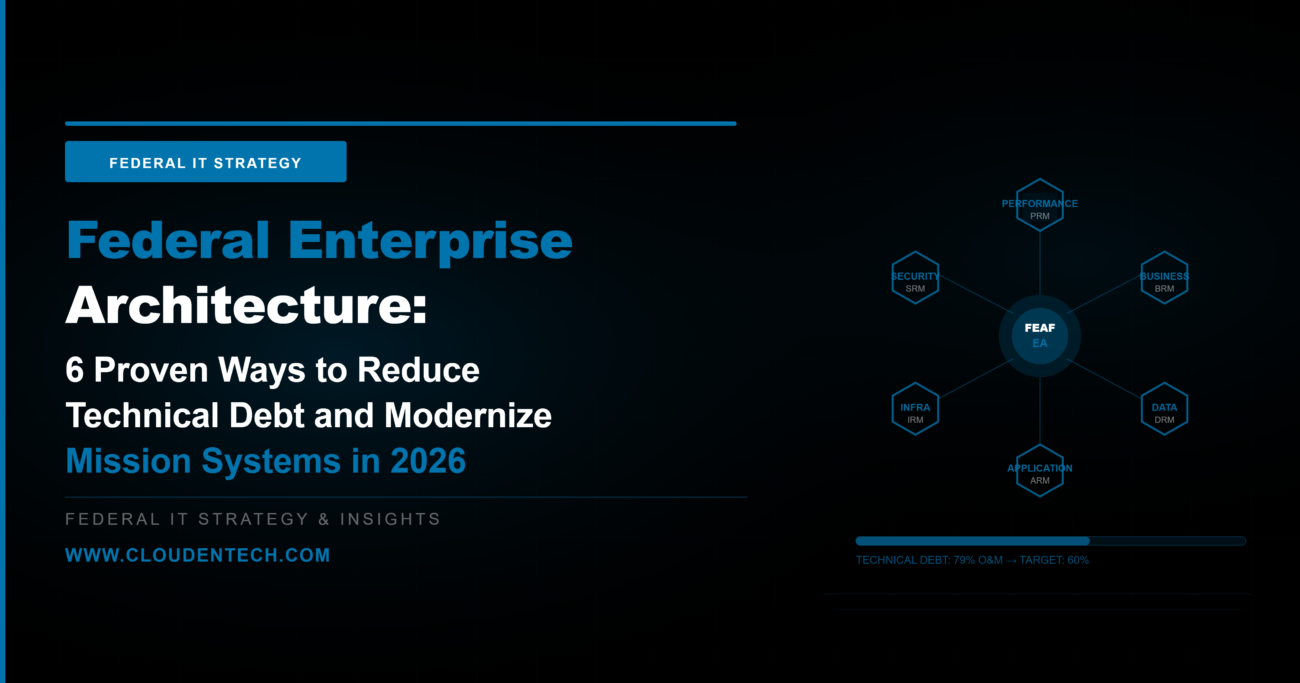
The federal government spends more than $100 billion on IT and cyber-related investments each year. Of that amount, agencies typically spend about 80 percent on operations and maintenance of existing IT, including aging legacy systems that are costly to maintain and vulnerable to hackers. That leaves just 20 percent for development, modernization, and new capabilities. A GAO report identified the 10 critical legacy federal systems most in need of modernization. Those systems range from 8 to 51 years old and collectively cost approximately $337 million annually to operate and maintain. Several use older programming languages such as COBOL. The IRS still relies on applications that are over 60 years old. Morgan LewisERP Today
In July 2025, GAO published an updated review identifying 11 legacy systems as most in need of modernization. Eight of the 11 use outdated languages, four have unsupported hardware or software, and seven are operating with known cybersecurity vulnerabilities. As of February 2025, agencies had completed only three of the original ten modernizations identified in 2019. Two of the remaining systems have no planned completion date. Workstreet
The conclusion is unambiguous: continuing to operate legacy federal applications is no longer a conservative choice. It is the highest-risk choice available. In 2026, U.S. government agencies still allocate up to 80 percent of their IT budgets to operations and maintenance of legacy systems, leaving little room for innovation. The 2025 to 2026 data is clear: continuing with legacy infrastructure is now the higher-risk choice. Dickinson Wright
This post is a practical guide for federal IT leaders and their contractor partners who are ready to move from that maintenance trap to a modern, cloud-native application architecture. It covers why cloud-native is the right target state for federal application modernization, the most common failure patterns in federal modernization programs, and the six proven steps that produce successful outcomes.
Why Cloud-Native Is the Right Target for Federal Application Modernization
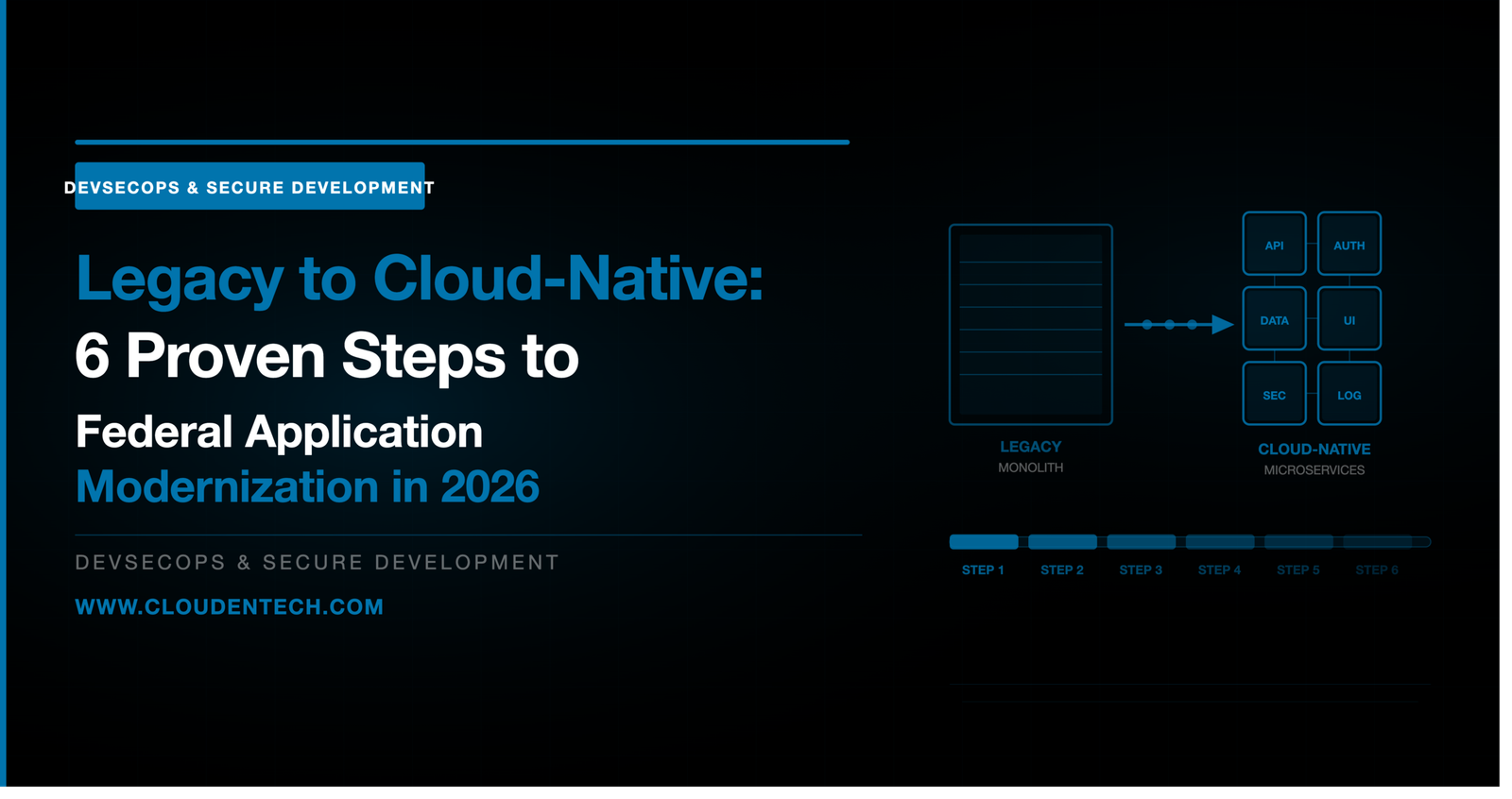
Cloud-native application architecture replaces monolithic, tightly coupled legacy applications with modular, independently deployable services built specifically to run in cloud environments. The components — containerized microservices, APIs, serverless functions, and managed cloud platform services — are designed for the operational characteristics of modern cloud infrastructure: elasticity, automated scaling, continuous deployment, and built-in observability.
For federal agencies, cloud-native architecture is not just a technical preference. It directly enables compliance with the mandates that agencies are operating under in 2026.
FedRAMP authorization, NIST 800-53 control families, and the federal move toward Zero Trust architecture all assume a level of automation, telemetry, and control granularity that is difficult to achieve on legacy infrastructure. Modern cloud platforms provide these capabilities natively and are audited against the same frameworks. A cloud-native application built on a FedRAMP-authorized platform inherits significant control coverage from the platform’s existing authorization, dramatically reducing the documentation burden for the agency’s own ATO package. CMMC
Zero trust architecture — mandated by OMB M-22-09 and required at Target Level for DoD components by September 30, 2027 — is architecturally much easier to implement around cloud-native applications than legacy monoliths. Microservices with well-defined APIs have explicit boundaries where access controls can be enforced. Legacy monoliths typically have no such boundaries internally, making zero trust policy enforcement at the application layer nearly impossible without a rebuild.
DevSecOps practices, which federal agencies are required to implement under NIST SP 800-218 and Executive Order 14306, integrate with cloud-native architecture naturally. To ensure resilience in the face of future disruption, agencies must replace legacy systems with modular, containerized, platform-agnostic alternatives. These modern applications offer repeatable processes that agencies can run consistently across different cloud environments, and allow updates with little or no downtime. With this approach, technology goes from being a liability to an opportunity. gsa
The Most Common Failure Patterns in Federal Application Modernization
Before describing what works, it is worth examining why federal modernization programs fail — because the failure patterns are consistent and avoidable.
About 80 percent of cloud migration projects go beyond initial budgets and timelines due to poor planning and execution. According to Gartner, only half of organizations attain the projected business value from their migration projects. Washington Technology
Poor workload classification is the most common starting failure. Latency-sensitive applications end up on public cloud. Stateful systems are lifted and shifted without refactoring, and cloud costs exceed on-premise costs within six months. Missing dependencies in the migration plan compound the problem. Legacy applications carry invisible dependencies — database calls, shared file systems, network paths — that surface only at cutover. 47 percent of migration delays trace directly to undiscovered legacy dependencies. Accorian
Data quality is the top obstacle to modernization success, cited by 72 percent of IT leaders as their primary challenge. Talent gaps follow at 53 percent, compounded by the COBOL demographic cliff — the average COBOL programmer is 55 years old, and approximately 10 percent retire annually. For federal agencies with COBOL-dependent systems, this talent supply problem is structural and worsens every year modernization is deferred. Secureframe
Underestimating change management is another common failure. Modernization is as much a people challenge as a technology challenge. Employees who have used the same system for years will resist change unless they understand why it is happening and how the new system will make their work easier. E-N Computers
The single most consequential mistake is treating modernization as a migration project rather than an architectural transformation. Lifting and shifting a legacy monolith to the cloud produces a cloud-hosted legacy application — with all the same structural limitations, security gaps, and compliance burdens as before, but now with cloud hosting costs added on top. True cloud-native modernization requires rethinking how the application is structured, not just where it runs.
6 Proven Steps from Legacy to Cloud-Native
Step 1: Conduct a Comprehensive Application Portfolio Assessment
No modernization program should begin with a technology decision. It should begin with a rigorous inventory and assessment of every application in the agency’s portfolio. This assessment produces the information that every subsequent decision depends on.
For each application, the assessment must document the application’s age, programming language, hardware and software dependencies, and vendor support status — this directly mirrors the attributes GAO uses to score legacy systems in its criticality assessments. It must capture the application’s data classification and sensitivity requirements, its compliance obligations, its availability and performance requirements, its user base and mission criticality, and the estimated cost and complexity of different modernization approaches.
Not every legacy system needs immediate replacement. Some applications continue to support critical business operations. Organizations should prioritize applications based on how they reach end-users and their impact, their operational dependency to prevent workflow disruptions, their revenue or mission contribution, and their security and compliance risk profile. E-N Computers
The assessment output is a prioritized modernization roadmap that sequences applications by risk, complexity, and mission impact — not by which ones are easiest to migrate. This sequence drives the phasing of the entire program.
Step 2: Choose the Right Modernization Strategy for Each Application
Cloud-native migration is not a single approach. There are several distinct strategies, and the right one for each application depends on the assessment findings from Step 1. Choosing the wrong strategy is the most common cause of budget overruns in federal modernization programs.
Rehosting, commonly called lift and shift, moves an application to cloud infrastructure with minimal changes. It is appropriate for applications that are already reasonably modern, have no deep legacy dependencies, and will be refactored in a later phase. It is not appropriate as a permanent solution for aging monoliths.
Replatforming makes targeted changes to optimize an application for cloud deployment without fundamentally changing its architecture. Moving from a proprietary database to a managed cloud database service is a replatforming change. It produces meaningful operational benefits without the full cost and risk of a refactor.
Refactoring is the transformation that produces true cloud-native architecture — breaking a monolith into microservices, implementing API-based communication between components, containerizing services for deployment on Kubernetes or equivalent platforms, and rebuilding data layers around managed cloud services. This is the highest-effort strategy and the one that produces the most durable long-term outcomes in terms of security, compliance, and operational efficiency.
Retiring applications that are no longer needed, and retaining applications where the modernization cost exceeds the benefit for specific workloads, are valid outcomes of the assessment process. Not every legacy application needs to become cloud-native. Some need to be decommissioned.
Step 3: Design Security and Compliance Into the Target Architecture From Day One
This step is where federal modernization programs most commonly diverge from commercial best practices. In the federal environment, security and compliance architecture is not an addition to the modernization plan. It is a constraint that shapes every architectural decision from the beginning.
The target architecture must address FedRAMP authorization requirements before a line of code is written or a container image is deployed. If the modernized application will process, store, or transmit federal data, every component of its cloud infrastructure must be FedRAMP-authorized, and the authorization boundary must be defined before implementation begins. The control inheritance from the underlying FedRAMP-authorized platform must be identified, and the residual controls that the agency and its contractor must implement must be documented in the system security plan.
Zero trust principles must be embedded in the application architecture itself. Each microservice should authenticate incoming requests independently, validate the identity and authorization context of every call, and operate with the minimum permissions necessary for its specific function. An application whose internal services trust each other implicitly because they share a network is not a zero trust application, regardless of the controls on its perimeter.
DevSecOps practices should be established alongside the development environment, not after the first sprint. Successful cloud modernization addresses security and compliance as an inherent part of the migration process, with professional partners who consider legacy risks, update old components, establish access controls, and integrate compliance with applicable frameworks from the start. meritalk
Step 4: Migrate Data with the Rigor It Deserves
Data migration is the step that most federal modernization programs underestimate, and the one most likely to cause significant delay, cost overrun, or mission disruption if it is not planned and executed with the same rigor applied to the application architecture itself.
Legacy systems often contain decades of business-critical data in formats that modern systems do not natively support. Data migration is frequently underestimated in terms of complexity, time, and cost. Plan for it explicitly and test thoroughly. For federal agencies, this challenge is compounded by data classification requirements that govern how data can be handled during migration, encryption requirements for data in transit and at rest throughout the migration process, and audit logging requirements that must capture every access to sensitive data during the transition period. E-N Computers
Data migration for federal applications should begin with a complete data inventory and classification exercise, validating that data classification records are accurate before migration planning begins. A data quality assessment should identify and remediate data integrity issues in the legacy system before migration, not after. Migration should be executed in carefully controlled batches with validation against expected outcomes at each step, and rollback procedures should be defined and tested before any production data is moved. The migrated environment should not be considered production-ready until data validation confirms completeness, integrity, and accessibility at the application layer.
Step 5: Execute in Phases and Validate at Each Milestone
Federal application modernization programs that attempt to migrate everything simultaneously almost always fail. The complexity of coordinating multiple application migrations, data migrations, user transitions, and compliance validations simultaneously exceeds the capacity of any implementation team to manage effectively.
Phased execution concentrates the team’s focus on a manageable scope, produces early wins that demonstrate program value to leadership and stakeholders, and allows lessons learned from early phases to be applied in later ones. The phase structure should follow the priority sequence established in Step 1, starting with lower-complexity, lower-risk applications where the team can build capability and confidence before tackling the most complex, mission-critical systems.
Each phase should conclude with a defined validation milestone that confirms the migrated applications are operating as expected, security controls are functioning correctly, compliance documentation is complete, and users have been trained and are productive in the new environment. The next phase should not begin until the validation milestone is achieved. Compressing timelines by overlapping phases before validation is complete is one of the most reliable ways to introduce defects that take months to discover and repair.
Public sector cloud adoption data shows that agencies actually become more optimistic the further along they are in their cloud modernization journey. The single biggest determining factor of how optimistic respondents feel is how far along they are — the farther along they go, the more optimistic they seem to feel, and the easier things get. The early phases of a modernization program are the hardest. Building in validation milestones and recognizing progress at each phase keeps stakeholder confidence and political support intact through the full program lifecycle. Secureframe
Step 6: Establish Continuous Improvement and Ongoing Compliance Management
Modernization is not complete when an application goes live in its new cloud-native environment. It is complete when the agency has the operational processes, tooling, and governance structure in place to maintain the application securely and in compliance with its authorization requirements on an ongoing basis.
For federal applications, this means implementing continuous monitoring against the FedRAMP authorization baseline, with automated tooling that detects configuration drift and compliance gaps in near real time rather than through periodic assessments. It means establishing a vulnerability management program that addresses findings in the cloud-native environment within the time windows required by the application’s ATO conditions and CISA’s Binding Operational Directive 22-01. It means maintaining the System Security Plan and all associated authorization documentation as a living record that accurately reflects the current state of the production environment.
Modern cloud-native applications allow updates with little or no downtime, enabling agencies to respond to new security requirements, patch vulnerabilities, and deploy new capabilities through automated CI/CD pipelines rather than the high-risk, high-downtime release cycles that characterized legacy system maintenance. The operational model of a cloud-native application is fundamentally different from a legacy system, and the agency’s IT operations and security operations teams must be equipped to work in that model from day one of production operations. gsa
The Role of DevSecOps in Federal Application Modernization
DevSecOps is not a separate track from application modernization. It is the development and operational discipline that makes cloud-native federal applications work as intended.
Every step in the six-step framework above has a DevSecOps component. The application portfolio assessment includes evaluating the security posture of existing code. Architecture design embeds security controls at the service level. Data migration requires secure handling and audit logging throughout. Phased execution runs through automated CI/CD pipelines with security scanning at every stage. Ongoing compliance management is operationalized through automated monitoring and evidence generation.
Federal agencies that attempt cloud-native modernization without a mature DevSecOps program will produce applications that are modern in architecture but immature in security operations — and will discover that gap during the ATO review process, not before. The combination of modern application architecture and embedded security practices is what produces applications that are both mission-effective and audit-ready.
How ClouDen Technologies Supports Federal Application Modernization
At ClouDen Technologies, our application development practice delivers secure-by-design cloud-native applications built around the NIST, FedRAMP, and FISMA frameworks that govern federal IT environments. We do not build modern applications and then add security. We build applications where security is embedded in the architecture, the development pipeline, and the operational processes from the first line of code.
Our DevSecOps services provide the development pipeline infrastructure that cloud-native federal applications require — automated security scanning, continuous compliance artifact generation, container security, and the CI/CD processes that allow agencies to maintain and update their applications without the high-risk release cycles that characterized legacy system management.
Our cloud solutions practice supports the cloud architecture and FedRAMP authorization work that modernized applications require, ensuring that the cloud environments where modernized applications operate meet the security and compliance standards that federal authorization processes demand. Our enterprise architecture services address the portfolio-level planning and application sequencing work that determines whether a modernization program succeeds as a whole, not just whether individual applications migrate successfully.
As an SBA-certified 8(a) small business operating under ISO 27001:2022, ISO 9001:2015, and ISO/IEC 20000-1:2018 certification, we bring the documented governance discipline that federal application modernization programs require — both for the technical execution and for the compliance evidence that authorizing officials will evaluate.
If your agency is planning an application modernization initiative, assessing your legacy portfolio, or building the development and security operations capability that cloud-native federal applications demand, contact ClouDen Technologies today.
Key Takeaways
Federal application modernization is a GAO-mandated priority. The federal government spends 80 percent of its $100 billion annual IT budget on operations and maintenance of existing systems, leaving just 20 percent for modernization and new capabilities.
Eleven critical legacy systems were identified by GAO in July 2025 as most in need of modernization. Eight use outdated languages, four have unsupported hardware or software, and seven are operating with known cybersecurity vulnerabilities. The IRS is still running applications over 60 years old.
Cloud-native architecture is the right modernization target for federal agencies because it natively supports the FedRAMP, NIST, zero trust, and DevSecOps requirements that agencies must satisfy — in ways that legacy infrastructure structurally cannot.
The six proven steps are: comprehensive application portfolio assessment, selecting the right modernization strategy for each application, designing security and compliance into the target architecture from day one, executing data migration with dedicated rigor, phasing execution with validation milestones, and establishing continuous improvement and ongoing compliance management.
The most common failure pattern is treating modernization as a migration rather than an architectural transformation. Lifting and shifting legacy monoliths to cloud infrastructure produces cloud-hosted legacy applications — with the same structural limitations at higher cost.
47 percent of migration delays trace to undiscovered legacy dependencies found only at cutover. A thorough application portfolio assessment and dependency mapping before migration is the single most effective risk mitigation in any federal modernization program.
About ClouDen Technologies
ClouDen Technologies is an SBA-certified 8(a) small business delivering cloud, cybersecurity, DevSecOps, enterprise architecture, application development, and management services to U.S. federal agencies, educational institutions, and commercial organizations. ClouDen operates under ISO 9001:2015, ISO/IEC 20000-1:2018, and ISO/IEC 27001:2022.