AI in federal government has crossed a threshold in 2026 that makes the question of whether to adopt no longer relevant. The question now is whether the adoption will be implemented responsibly, at scale, with the governance and infrastructure required to produce real mission outcomes — or whether it will produce an expensive inventory of pilots that never reaches production.
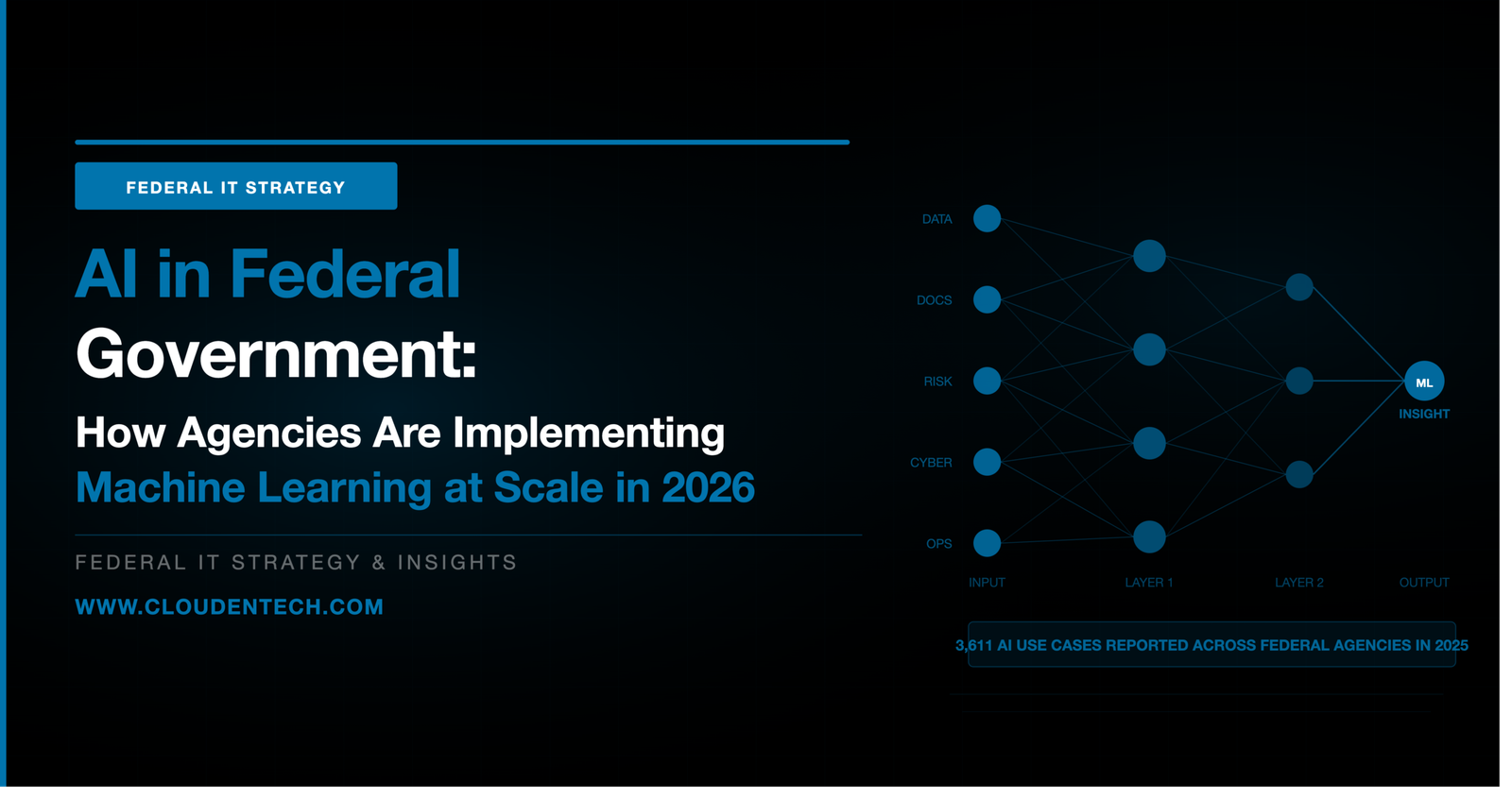
OMB’s consolidated version of all federal agencies’ AI inventories shows a dramatic increase of nearly 70 percent in reported AI use cases, totaling 3,611 reported use cases in 2025, compared to only 2,133 during 2024. This dramatic increase likely underrepresents the actual extent of AI use within federal agencies. Elevate
AI use case inventories, federal jobs data, OMB memoranda, and interviews with federal technologists reveal that the pace and scope of AI adoption has accelerated in recent years, though use remains concentrated among a handful of large agencies. Expanding support for AI literacy across agencies and fostering public trust through stronger transparency practices can help bolster responsible AI adoption across the federal government. Greypike
The policy framework has also solidified. On April 3, 2025, OMB issued two revised policies on federal agencies’ use and procurement of AI — M-25-21 on Accelerating Federal Use of AI through Innovation, Governance, and Public Trust, and M-25-22 on Driving Efficient Acquisition of Artificial Intelligence in Government. These memos are designed to support the implementation of Executive Order 14179 on Removing Barriers to American Leadership in Artificial Intelligence, and largely focus on facilitating rapid, responsible adoption across the federal government while improving public services. SecurityMetrics
This post covers what federal AI implementation actually looks like at scale in 2026, the policy and governance framework agencies must operate within, where machine learning is delivering the most significant mission value, and what the agencies getting this right are doing differently from those who remain stuck at pilot stage.
The Federal AI Policy Framework in 2026
Understanding where AI adoption stands requires understanding the policy environment that governs it. Federal agencies operate within a layered set of requirements that shape what AI they can use, how they must govern it, and what they must report publicly.
OMB M-25-21 mandates that agencies inventory and publicly publish their AI use cases at least annually, publicly report risk determinations and waivers from minimum practices for high-impact AI alongside a justification, and name a Chief AI Officer within 60 days of the memo’s issuance. As of July 2024, at least 57 federal agencies had appointed CAIOs as directed. The Trump-era OMB guidance continued governance structures established under the Biden administration, including the Chief AI Officer Council chaired by OMB, agency-level AI governance boards, and expanded AI use-case inventories. SecurityMetricsDTC Today
OMB M-25-21 folds the former Biden-era rights-impacting and safety-impacting sensitive-use categories of AI into a single high-impact AI category, describing any AI application that could have significant impacts when deployed, particularly when outputs serve as the basis for consequential decisions affecting individuals’ rights, opportunities, access to services, or safety. Agencies had until April 15, 2026, to bring every high-impact system into compliance or shut it down. DTC Today
OMB M-25-22 complements M-25-21 by instructing federal agencies how to acquire AI responsibly, focusing on three overarching themes: fostering a competitive American marketplace for AI to ensure high-quality, cost-effective solutions, safeguarding taxpayer dollars by tracking AI performance and managing risks, and promoting effective AI acquisition through cross-functional engagement. SecurityMetrics
The Department of Justice’s 2025 AI use case inventory illustrates how rapidly agencies are moving within this framework. The DOJ’s 2025 inventory includes 315 entries, a 30.7 percent increase from 2024. The inventory includes AI use cases in all stages of development including pre-deployment, pilot, deployed, and retired. The inventory facilitates collaboration and unifies efforts by providing DOJ components with a common understanding of how AI is being used, expediting use and decreasing overall costs. SSE Inc
Where Federal Agencies Are Implementing Machine Learning at Scale
The growth in AI use case numbers tells part of the story. Understanding where the most significant implementations are occurring tells the rest. Federal machine learning adoption in 2026 is concentrated in five mission areas where the data advantage of AI is most clearly aligned to agency outcomes.
Fraud Detection and Financial Integrity
AI positively impacts federal departments by enhancing productivity, operational efficiency, and mission-enabling processes like financial management and human resources. It also supports knowledge management and back-office functions essential for improved service delivery to the public. Fraud detection is one of the clearest cases where machine learning at scale produces outcomes that manual review processes fundamentally cannot match. ConsensusDocs
Federal programs disbursing hundreds of billions of dollars annually — Medicare, Medicaid, Social Security, federal procurement — face fraud patterns that evolve faster than human review teams can adapt. Machine learning models trained on historical transaction data identify anomalous patterns in real time, flag suspicious claims before payment rather than after, and continuously update their models as fraudsters adapt. The GAO has specifically recommended AI tools for managing improper payments, with the prerequisite that data quality and trained human oversight are in place before deployment.
The Veterans Health Administration has deployed machine learning models that predict which claims require closer human review, concentrating experienced examiner capacity where it adds the most value rather than distributing it uniformly across claim volume that no team can fully review manually. The outcome is not workforce reduction. It is workforce precision — human judgment focused where it is needed most.
Cybersecurity Threat Detection
AI is being used for decision-support systems including fraud detection and resource allocation by 34 percent of federal agencies, and cyber threat identification represents one of the fastest-growing applications across defense and civilian agencies alike. MAD Security
The cybersecurity use case for machine learning in federal agencies is particularly compelling because the threat environment operates at machine speed. Advanced persistent threat actors conduct reconnaissance, execute lateral movement, and exfiltrate data through sequences of individually low-signal activities that human analysts reviewing logs sequentially cannot reliably detect. Machine learning models that establish behavioral baselines across network traffic, user activity, and system events can identify the patterns that constitute a multi-stage attack even when each individual event falls within normal thresholds.
AI agents powered by large language models, reinforcement learning systems, and real-time data pipelines can autonomously analyze inputs, generate recommendations, and coordinate actions across mission systems. Across these use cases, two themes are emerging as central to federal AI adoption: interoperability and resource optimization. Agencies are prioritizing systems that can seamlessly share data both within and across organizations, enabling more unified decision-making and reducing duplication of effort. White & Case LLP
Document Processing and Natural Language Understanding
Federal agencies process volumes of unstructured text that dwarf what any human organization can review comprehensively. FOIA requests, legal case documents, scientific literature, regulatory comments, intelligence reports, medical records, and procurement documentation all represent natural language processing opportunities where machine learning has demonstrated significant efficiency gains.
Natural language processing is being used for analyzing unstructured data including processing text from docket comments and case reports across multiple agencies. The Department of Health and Human Services leads with multiple NLP efforts across the CDC, FDA, and NIH for healthcare and biomedical applications, including detecting health conditions from medical images, analyzing social media data for disease surveillance, adverse event analysis and review of drug applications, and predictive models for disease progression through mining scientific literature. O’Melveny
The FOIA processing use case is a concrete illustration of both the opportunity and the implementation discipline required. As discussed in the blog 4 of the May content series, AI tools have dramatically increased efficiency in processing FOIA requests through automated classification, redaction assistance, and routing. But the same tools have contributed to a tripling of request volume at some agencies, because requesters can draft and submit FOIA requests more easily with AI assistance. Agencies that deployed processing AI without also implementing intake governance found that their efficiency gains were absorbed by volume increases. Those that addressed both sides of the equation captured real time and cost savings.
Predictive Analytics for Mission Planning
Predictive analytics powered by AI helps agencies simulate outcomes, assess risks, and plan effectively. This application uses historical data, behavioral models, and scenario analysis to provide insights that would otherwise be missed using traditional analysis. The integration happens via dashboards or decision-support systems accessible to policymakers, enabling real-time visualization and simulation. Morgan Lewis
The Department of Defense’s adoption of AI for campaign planning, logistics coordination, and intelligence fusion represents the highest-stakes end of this spectrum. At the core of the DoD’s AI approach is the integration of multi-agent architectures that support tasks such as campaign planning, logistics coordination, intelligence fusion and dynamic targeting, with interconnected AI agents that can autonomously analyze inputs and coordinate actions across mission systems. White & Case LLP
For civilian agencies, predictive analytics applications are more modest in profile but equally important in mission impact. The Social Security Administration uses machine learning to predict application processing bottlenecks and allocate examiner capacity accordingly. FEMA uses predictive models for disaster resource pre-positioning. The IRS uses machine learning to prioritize audit selection. In each case, the machine learning model is not making the decision. It is providing the decision-maker with better information faster than any manual analysis process could produce.
Workforce and Operational Optimization
The Department of Veterans Affairs is applying AI for analyzing medical records and data for risk prediction including suicide risk and disease progression, and for computer-aided detection and diagnosis from medical images and sensor data. Both applications represent a form of workforce optimization — not eliminating the clinician’s role, but giving the clinician earlier, more accurate information that makes their judgment more effective. O’Melveny
AI also supports workforce productivity through automating repetitive tasks and analyzing massive datasets to identify trends, while maintaining human oversight at every critical decision point. Manual tasks like document classification, data entry, and compliance reporting that consume valuable staff time can be automated through AI tools, freeing skilled federal employees to focus on the judgment-intensive work that machines cannot do. ConsensusDocs
This is the distinction that separates successful federal AI implementations from disruptive ones. The agencies getting machine learning right are treating it as a tool that makes skilled employees more effective, not a mechanism for reducing headcount. The workforce planning and change management implications of that framing are entirely different from those of a pure automation-first approach.
The Gap Between AI Inventory and AI Impact
The 3,611 use cases reported across federal agencies in 2025 represent a significant increase in AI adoption. But use case volume and mission impact are not the same metric. AI adoption remains concentrated among a handful of large agencies. Expanding AI literacy across agencies and fostering public trust through stronger transparency practices are prerequisites for responsible adoption at broader scale. Greypike
The pattern that emerges from agency AI inventories is one of many pilots and few production systems delivering sustained mission value at scale. The barriers between pilot and production are not primarily technical. They are organizational, infrastructural, and governance-related.
Data quality is the first barrier. Machine learning models are only as good as the data they train on. Federal agencies often maintain data in legacy formats, across siloed systems, with inconsistent classification and variable quality. An agency that wants to train a fraud detection model needs clean, labeled, consistently formatted transaction data. Building that data foundation is often the longest phase of an AI implementation program — and the one most frequently underestimated.
Infrastructure is the second barrier. Running machine learning models at production scale requires compute resources, data platform architecture, and MLOps tooling that many agencies have not yet built. Cloud migration and modern data platform investment are prerequisites, not concurrent activities, for most AI production deployments.
Governance is the third barrier. Federal agencies face competing, mixed messages about how to effectively use AI tools and lack the needed expertise to oversee responsible implementation. High-impact AI systems require documented risk assessments, minimum practice compliance verification, and ongoing monitoring of model outputs for bias, accuracy, and drift. Agencies without mature AI governance programs cannot certify that their high-impact AI systems meet the requirements of OMB M-25-21, which means those systems must either remain in pilot status or be shut down. Elevate
Workforce capability is the fourth barrier. Manual tasks like document classification, data entry, and compliance reporting consume valuable staff time. Upskilling the workforce to work alongside AI tools — to review outputs, refine prompts, and validate decisions — requires training investment that is separate from the technology investment. An AI system that produces outputs that agency staff do not understand how to evaluate is not an AI system that will be trusted, regardless of its technical performance. gsa
What Successful Federal AI Implementation Looks Like
The agencies and programs producing measurable outcomes from AI in 2026 share a set of implementation characteristics that distinguish them from those producing impressive pilot demonstrations that never reach production.
They start with a specific mission problem, not with an AI technology looking for a use case. The question driving successful implementations is what mission outcome we need to improve and what data we have that could help, not what can we do with this AI tool we just procured.
They invest in data infrastructure before model development. The data engineering work — cleaning, labeling, standardizing, governing, and making accessible the data the model needs — typically represents 60 to 80 percent of the total implementation effort. Agencies that skip this step or compress it to accelerate model development find that their models perform poorly in production and require significant rework.
They define human oversight protocols before deployment. For high-impact AI applications — any system whose outputs influence consequential decisions affecting individuals’ rights, opportunities, access to services, or safety — the human review workflow must be defined, tested, and documented before the system goes live. The AI system operates in service of human judgment, not as a replacement for it.
They measure outcomes against mission baselines. A successful AI implementation reduces fraud losses by a measurable percentage. It reduces claim processing time by a measurable amount. It increases the detection rate of cybersecurity threats above the pre-implementation baseline. Agencies that cannot articulate the mission baseline they are improving against cannot demonstrate whether their AI investment is producing value or merely producing activity.
They build for continuous improvement. A machine learning model deployed into a static operational environment will degrade over time as the patterns it was trained on drift from current reality. Production AI systems require ongoing monitoring, periodic retraining on updated data, and governance processes that detect and respond to model performance changes before mission impact occurs.
The Security Architecture That Federal AI Requires
Responsible AI implementation in federal agencies is not just a governance question. It is a security architecture question. The infrastructure that runs production AI workloads must meet the same FedRAMP, FISMA, and zero trust requirements as any other federal IT system — and AI systems introduce specific security considerations that standard IT security frameworks do not fully address.
Training data security is one. The data used to train federal AI models often contains sensitive information, including personally identifiable information, CUI, and law enforcement-sensitive data. That training data must be handled under the same data classification and access control requirements as any other sensitive federal data — requirements that many agencies have not yet fully mapped to their AI pipeline architectures.
Model integrity is another. An AI model is itself an artifact that can be tampered with. Adversarial inputs can cause models to produce incorrect outputs. Model poisoning attacks can corrupt a model’s decision-making at the training stage. Supply chain attacks can introduce compromised model components through third-party AI services. Federal agencies deploying AI in high-impact applications must include model integrity verification in their security architecture alongside the standard access control and monitoring controls.
API security is the third. AI capabilities are most commonly consumed through APIs — whether from commercial AI providers or from internally hosted model-serving infrastructure. Those APIs must be governed under the same zero trust access control framework as any other application interface handling federal data, with authenticated, authorized, and monitored access to every AI capability.
How ClouDen Technologies Supports Federal AI Implementation
At ClouDen Technologies, we approach AI in federal government the way we approach every other technology modernization challenge — starting with mission requirements, building on a secure and compliant infrastructure foundation, and delivering outcomes that can be measured and sustained.
Our cloud solutions practice provides the FedRAMP-authorized cloud infrastructure and data platform architecture that production AI workloads require. We do not deploy machine learning models on top of unvetted infrastructure. We build the cloud-native, zero trust-aligned environments that give agencies both the compute scale and the security assurance that federal AI deployments demand.
Our application development practice builds AI-enabled applications that integrate machine learning capabilities into agency workflows in ways that support, rather than bypass, the human oversight requirements that high-impact AI governance demands. Our DevSecOps services embed security into the AI development and deployment pipeline, including training data governance, model integrity verification, and the continuous monitoring that production AI systems require to maintain their authorization to operate.
Our enterprise architecture practice addresses the data governance, system integration, and cross-agency interoperability challenges that are the most common structural barriers to moving federal AI from pilot to production scale. And our management services provide the program management and change management support that large-scale AI implementations require to navigate the organizational complexity of deploying new decision-support capabilities across federal workforces.
As an SBA-certified 8(a) small business operating under ISO 27001:2022, ISO 9001:2015, and ISO/IEC 20000-1:2018, we bring both the technical capability and the governance discipline that federal AI implementation demands. We have supported mission-critical IT programs for the U.S. Department of the Interior, the Federal Reserve Board, and the Defense Finance Agency — organizations that require exactly the security rigor, compliance discipline, and operational accountability that responsible AI deployment requires.
If your agency is planning an AI or machine learning implementation, building the data infrastructure for AI at scale, or developing the governance framework for high-impact AI systems, contact ClouDen Technologies today.
Key Takeaways
AI in federal government reached 3,611 reported use cases in 2025, a 70 percent increase from 2024. The actual extent of AI use across agencies is likely higher, as reporting requirements do not capture classified applications or all informal AI tool use.
OMB M-25-21 and M-25-22, issued April 2025, establish the current governance framework. All agencies must name a Chief AI Officer, maintain annual AI use case inventories, and bring high-impact AI systems into compliance with minimum practice requirements or shut them down. The April 15, 2026 compliance deadline has passed.
Federal AI adoption is concentrated in five mission areas delivering the most measurable value: fraud detection and financial integrity, cybersecurity threat detection, document processing and natural language understanding, predictive analytics for mission planning, and workforce and operational optimization.
The barriers between AI pilot and AI production are primarily organizational and infrastructural, not technical. Data quality, compute infrastructure, governance maturity, and workforce capability are the four factors that determine whether a pilot becomes a production system delivering sustained mission value.
Successful federal AI implementations share four characteristics: they start with a specific mission problem not a technology, they invest in data infrastructure before model development, they define human oversight protocols before deployment, and they measure outcomes against mission baselines.
Federal AI security architecture must address training data security, model integrity verification, and API access control under the same FedRAMP, FISMA, and zero trust requirements that govern all federal IT systems.
About ClouDen Technologies
ClouDen Technologies is an SBA-certified 8(a) small business delivering cloud, cybersecurity, DevSecOps, enterprise architecture, application development, and management services to U.S. federal agencies, educational institutions, and commercial organizations. ClouDen operates under ISO 9001:2015, ISO/IEC 20000-1:2018, and ISO/IEC 27001:2022.