Cloud security architecture for federal agencies has entered its most demanding phase yet. In 2026, agencies are not choosing between security and cloud adoption. They are being required to achieve both simultaneously, under a framework that has become significantly more structured, more automated, and more rigorously enforced than at any point in FedRAMP’s history.
FedRAMP controls form the security backbone of every cloud service operating within the federal government. With CR26 — FedRAMP’s Consolidated Rules for 2026 — the program is undergoing its most significant structural overhaul since it was codified into law in December 2022. New certification terminology, updated baseline classes, machine-readable package requirements, and formalized continuous monitoring obligations are all taking effect on a published schedule with enforcement beginning January 2027. Broadcom
At the same time, the convergence of FedRAMP requirements, NIST SP 800-53 Revision 5 controls, zero trust architecture mandates, and zero trust cloud security posture management expectations means that agency CIOs and their IT partners are designing cloud environments to satisfy multiple overlapping compliance frameworks simultaneously. CSPs today operate in what can best be described as a federal cloud security hybrid compliance state: technically aligned to Rev 5, procedurally aligned to current FedRAMP authorization requirements, interpretively influenced by legacy impact level expectations, and strategically pressured by Zero Trust Architecture mandates. Virtru
This blog post is a practical architecture guide for federal IT leaders navigating that environment. It covers the five foundational principles that every federal cloud security architecture must be built on in 2026, and how each principle connects to the specific compliance requirements that agencies and their contractor partners must satisfy.
The Federal Cloud Security Framework in 2026
Before examining the five principles, it is important to understand how the frameworks that govern federal cloud security relate to each other. Many agencies treat FedRAMP, FISMA, NIST, and zero trust as separate compliance programs. In a well-designed cloud security architecture, they are not separate programs. They are layers of the same framework.
NIST cloud security is not one standard. CSF 2.0 gives the outcome model, SP 800-53 gives the control catalog, FedRAMP gives the cloud interpretation, and the architecture decides where proof has to come from. CSF 2.0 can organize the program, but it cannot implement the control. Govern, Identify, Protect, Detect, Respond, and Recover need to be mapped to services, owners, and testable evidence before they mean anything operationally. CMS Information Security and Privacy Program
FedRAMP takes SP 800-53 controls and turns them into cloud-ready baselines. It does this through baseline selection — controls grouped into Low, Moderate, and High impact systems — and through control interpretation, clarifying requirements for cloud environments including inheritance from cloud providers. FedRAMP also introduces the Customer Responsibility Matrix, which defines which controls are inherited, shared, or customer-owned. CMS Information Security and Privacy Program
FedRAMP’s relationship to NIST SP 800-53 is additive. FedRAMP adopts the NIST control catalog and adds cloud-specific parameters, implementation requirements, and monitoring obligations. This means NIST 800-53 compliance is necessary but not sufficient for FedRAMP certification. The cloud-specific additions are where the meaningful compliance work lives. Broadcom
Under the new CR26 structure, FedRAMP is replacing Low, Moderate, and High impact level labels with four Certification Classes — A, B, C, and D. Class A replaces the Pilot and Ready designations. Class B replaces Li-SaaS and Low. Class C replaces Moderate. Class D replaces High. The change eliminates confusion with DoD Impact Level terminology and clarifies that certification classes describe assessment scope, not a universal security quality judgment. Broadcom
Understanding these relationships is the prerequisite for designing cloud security architecture that passes authorization review rather than requiring significant redesign mid-authorization. The five principles below address the most consequential architectural decisions within this framework.
Principle 1: Design the Authorization Boundary Before Any Other Architecture Decision
The authorization boundary is the single most important architectural decision in any federal cloud deployment. Everything else — control selection, inheritance mapping, continuous monitoring scope, incident response procedures — flows from where the boundary is drawn.
An authorization boundary provides a diagrammatic illustration of a cloud service provider’s internal services, components, and other devices along with connections to external services and systems. An authorization boundary encompasses all technologies, external and internal services, and leveraged systems, and accounts for all federal information, data, and metadata that the cloud service provider is responsible for. The authorization boundary is a critical component associated with NIST Special Publication 800-37, Guide for Applying the Risk Management Framework, and OMB Circular A-130. Federal News Network
In practice, agencies frequently make the authorization boundary decision too late — after infrastructure has been provisioned, applications have been deployed, and integrations with external services have been built. At that point, the boundary that the architecture implies often does not match the boundary that the security team wants to defend, and realigning them requires expensive rework.
The authorization boundary must be defined first, precisely, and in coordination with the agency’s Authorizing Official. It must account for every service that processes, stores, or transmits federal information — including third-party SaaS integrations, API connections, logging services, and identity providers. Services that fall within the boundary inherit the security obligations of the authorized system. Services that fall outside it must either be FedRAMP-authorized themselves or be excluded from contact with federal data entirely.
CSPs use the FIPS 199 Categorization Template, along with the guidance of NIST Special Publication 800-60, to correctly categorize their system based on the types of information processed, stored, and transmitted. Ultimately, the security impact level of a system is determined by the federal agency customer, as each Authorizing Official will have different risk tolerance levels and each federal agency’s mission is different, which may impact how they classify their data. cloudentech
Agencies and their cloud solution partners must resolve this categorization question before making infrastructure decisions. The Certification Class that applies to a workload determines the control baseline, which determines the infrastructure requirements, which determines the cost and timeline of the authorization. Discovering that a workload requires Class C controls after building it on a Class B architecture is one of the most common causes of authorization delays and budget overruns in federal cloud programs.
Principle 2: Build Identity as the Security Control Plane, Not a Supporting Function
In traditional IT security architecture, identity management was a supporting function — important, but secondary to network perimeter defenses. In cloud security architecture, identity is the primary security control plane. Every access decision for every user, service account, API call, and automated process is made through the identity layer.
For cloud teams, the highest-friction control families are the ones tied to identity, logging, configuration, incident response, risk, and runtime integrity. They create the most audit work because they change constantly. Identity controls in cloud environments are also the most commonly misconfigured, because the abstraction of cloud identity management — IAM roles, service principals, managed identities, federated authentication — introduces complexity that on-premise Active Directory environments did not present. CMS Information Security and Privacy Program
For federal cloud security architecture, identity implementation must address several specific requirements. Phishing-resistant multi-factor authentication — specifically PIV credentials or FIDO2/WebAuthn protocols — is required by OMB M-22-09 for all federal agency users accessing cloud systems. Standard MFA including SMS codes, push notifications, and authenticator app one-time passwords does not satisfy the phishing-resistant requirement regardless of how it is labeled in system documentation.
Privileged access management requires a separate, more stringent treatment than standard user access. Privileged accounts — administrative roles, service accounts with elevated permissions, emergency access accounts — must be governed under explicit controls that include time-limited access grants, just-in-time provisioning, comprehensive activity logging, and regular access reviews. The NSA’s Zero Trust Implementation Guidelines for Phase One specifically identify privileged access management as one of the five foundational technology capabilities required for Target Level zero trust maturity.
Non-person entity identity — service accounts, APIs, automation tools, CI/CD pipeline identities, and machine-to-machine authentication — is where the most significant identity security gaps exist in federal cloud environments. These identities are often provisioned with excessive permissions, rarely reviewed, and poorly monitored. A non-person entity with over-privileged access to sensitive data or critical systems represents exactly the lateral movement opportunity that sophisticated adversaries exploit after gaining initial access through any other attack vector.
Attribute-based access control, which grants access based on a combination of user identity, device health, location context, and data sensitivity rather than static role assignments, is the access control model that zero trust architecture requires. Federal cloud environments built on role-based access control alone cannot satisfy the granular, context-aware access enforcement that current mandates demand.
Principle 3: Treat Every Layer of the Network Stack as Untrusted
The foundational premise of zero trust cloud security architecture is that no network path, no network segment, and no cloud service is trusted by default. Every connection between every component of the cloud environment must be explicitly authorized, encrypted, and monitored. The concept of a trusted internal cloud network does not exist in a zero trust model.
For federal cloud security architecture, this principle translates into several specific implementation requirements. CISA, in consultation with OMB and FedRAMP, developed the Cloud Security Technical Reference Architecture to illustrate recommended approaches to cloud migration and data protection that leverage Cloud Security Posture Management. This architecture informs agencies of the advantages and inherent risks of adopting cloud-based services as agencies move closer to zero trust architecture. Zscaler
All traffic within the cloud environment — not just traffic crossing the boundary from external sources — must be encrypted in transit. For HTTP, all agencies are required to use HTTPS for all accessible web services and APIs. HTTPS is now required for all traffic, externally facing and internally, without exception. Agencies that have implemented perimeter encryption but allowed unencrypted internal traffic have satisfied the compliance letter of earlier requirements while maintaining a significant security gap that adversaries with any form of internal network access can exploit. CMS Information Security and Privacy Program
Micro-segmentation divides the cloud environment into isolated segments where traffic between segments requires explicit authorization based on identity and context. A workload in one segment of the cloud environment cannot communicate freely with workloads in adjacent segments. This containment architecture limits the blast radius of any successful intrusion, forcing adversaries to authenticate and authorize each lateral movement attempt rather than moving freely once they have gained a foothold anywhere in the environment.
DNS security is a specific network layer requirement that federal agencies frequently underestimate. Encrypted DNS, enforced at the endpoint level, prevents DNS-based reconnaissance and data exfiltration techniques that remain actively used in campaigns against federal networks. Cloud security architectures that implement perimeter controls without addressing DNS-layer security leave a significant visibility and control gap that many threat actors specifically target.
Control inheritance is how cloud environments stay auditable at scale. Instead of implementing every control from scratch, you inherit a portion of them from the provider through programs like FedRAMP. FedRAMP-authorized cloud platforms inherit significant network security controls from their authorization packages. Agencies must understand precisely which controls are inherited, which are shared responsibility, and which must be implemented entirely at the agency layer — and ensure that the agency-layer controls are implemented and producing evidence before authorization review begins. CMS Information Security and Privacy Program
Principle 4: Classify and Protect Data at the Object Level, Not the Network Level
Data security in federal cloud environments cannot be achieved by protecting the network perimeter around data storage. It must be achieved at the object level — meaning that individual data assets are classified, labeled, and protected based on their sensitivity, and that access controls are applied to individual objects rather than to the containers that hold them.
CISA’s Cloud Security Technical Reference Architecture specifically addresses how CSPM capabilities can facilitate the implementation of zero trust architectures, contextualizing these capabilities in terms of configuring cloud services and mitigating cloud risks while leveraging Cloud Security Posture Management. Federal News Network
Federal data classification must align to FISMA categorization at minimum, distinguishing between unclassified data, Controlled Unclassified Information, and classified data. For cloud environments, this classification must be implemented programmatically — through data labeling, tagging, and classification tools that apply sensitivity labels to data objects at creation and maintain those labels throughout the data lifecycle.
Data loss prevention controls must monitor and restrict how sensitive data moves within and outside the cloud environment. A DLP program that monitors only data leaving the perimeter misses the internal data movement patterns that are often the precursors to external exfiltration. Federal cloud security architecture must implement DLP at both the perimeter layer and within the environment, with policies calibrated to the specific data types that the agency handles.
Encryption of data at rest is required for all federal data stored in cloud environments, with key management practices that maintain agency control over encryption keys even when the underlying infrastructure is managed by a cloud service provider. Customer-managed key architectures ensure that the cloud provider’s access to agency data is limited by the agency’s key management decisions, providing a meaningful additional layer of protection for sensitive workloads.
Audit failures usually start with scope, ownership, and evidence lifecycle. If assets, exceptions, identities, and findings are not tied to live cloud state, the team ends up reconstructing reality during the audit. Cloud compliance is a many-to-many mapping problem. Data governance documentation — the records that demonstrate what data is classified at what level, where it resides, who can access it, and how that access is controlled — must be maintained as a continuously accurate reflection of the production environment, not as a periodic snapshot compiled for authorization reviews. CMS Information Security and Privacy Program
Principle 5: Build Continuous Monitoring Into the Architecture, Not the Operations Plan
Continuous monitoring is not a security operations function that runs on top of a cloud architecture. It is an architectural requirement that must be designed into the cloud environment from the beginning, producing the evidence streams that both FedRAMP obligations and operational security require.
Receiving a FedRAMP Certification is the beginning of a continuous obligation, not its conclusion. The ongoing requirements have become more demanding and more explicitly enforced since the JAB was rescinded, and CR26 formalizes several obligations that were previously ambiguous. Broadcom
Cloud Security Posture Management is the technical capability that operationalizes continuous monitoring at cloud scale. A CSPM platform continuously evaluates the cloud environment against the security policy baseline — FedRAMP controls, NIST SP 800-53 families, agency-specific configuration standards — and produces real-time findings for any configuration that deviates from the authorized baseline. This continuous evaluation replaces the periodic manual assessment that characterized legacy authorization processes and produces the automated evidence that FedRAMP 20x and CR26 increasingly expect.
NIST cloud security fails when teams try to operationalize it without a control mapping layer underneath. CSF tells you that you must be able to identify assets, protect them, detect issues, and respond with evidence. One CSF category usually maps to multiple SP 800-53 families. One technical control often partially satisfies multiple requirements simultaneously. A provider or CSPM mapping may connect one setting to one control, but that does not prove the control requirement is met or even applicable to that workload. CMS Information Security and Privacy Program
This is the most technically precise and most commonly misunderstood aspect of federal cloud continuous monitoring. A CSPM finding that a configuration deviates from a policy does not automatically map to a specific NIST SP 800-53 control finding. The mapping between CSPM policies, NIST controls, FedRAMP requirements, and agency SSP documentation must be explicitly constructed, maintained, and validated. Automated tooling that produces configuration findings without that mapping layer cannot produce the evidence that authorizing officials and continuous monitoring programs require.
To support automation, FedRAMP is collaborating with OMB, NIST, and CISA to adopt interoperable standards, such as the Open Security Controls Assessment Language (OSCAL), for submitting security assessments and continuous monitoring data. FedRAMP will also identify processes that can be automated to improve efficiency and make artifacts more accessible to federal agencies. OSCAL-formatted evidence submission is becoming the expected standard for FedRAMP continuous monitoring packages. Cloud security architectures that generate evidence in OSCAL-compatible formats will be significantly better positioned for the CR26 enforcement environment beginning January 2027. GovCIO Media
Logging strategy is the operational foundation of continuous monitoring. Every component of the cloud architecture must produce logs that capture security-relevant events at the granularity required by FedRAMP continuous monitoring obligations — not at the granularity that is convenient to implement. Log retention periods, centralized log aggregation, tamper-evident storage, and the alerting rules that translate log events into actionable security findings must all be designed as part of the cloud security architecture, not added after the environment is deployed.
The CR26 Changes Every Federal CIO Must Prepare For
CR26 is FedRAMP’s Consolidated Rules for 2026, representing the most significant structural overhaul since the program was codified into law. New certification terminology, updated baseline classes, machine-readable package requirements, and formalized continuous monitoring obligations are all taking effect with enforcement beginning January 2027. Broadcom
The key architectural implication of CR26 is that machine-readable authorization packages — documentation submitted in OSCAL format rather than as traditional Word and Excel documents — will become the expected standard. Cloud security architectures that produce compliance evidence in machine-readable formats automatically will be significantly more efficient under CR26 than those requiring manual documentation compilation.
RFC-0027 through RFC-0030 are currently updating the Rev5 security controls baseline as part of CR26. Updates driven by NIST changes follow the NIST public comment process separately from FedRAMP’s RFC process. Organizations should track both channels to stay current on controls that may change before CR26 enforcement begins. Agencies and their cloud security partners should assign explicit ownership for tracking CR26 RFC updates and evaluating their impact on existing authorization baselines and SSP documentation. Broadcom
How ClouDen Technologies Builds Federal Cloud Security Architecture
At ClouDen Technologies, our cloud solutions practice designs and implements cloud security architectures that satisfy FedRAMP, NIST SP 800-53, FISMA, and zero trust requirements simultaneously — not as separate compliance programs but as an integrated architecture built on the five principles described above.
We begin every cloud engagement with authorization boundary definition and workload classification, ensuring that the architecture is designed for the correct Certification Class from day one. We design identity architectures that satisfy phishing-resistant MFA requirements, implement privileged access management, and address non-person entity identity — the control areas where most federal cloud authorization reviews find deficiencies. We implement network segmentation and encryption at every layer of the cloud stack, including internal traffic, with the CSPM tooling and control mapping that produces continuous monitoring evidence in formats that FedRAMP authorization reviews and CR26 requirements expect.
Our cybersecurity services provide the security architecture, risk management, and compliance expertise that cloud security architecture decisions require, ensuring that the technical choices made during cloud design satisfy the control requirements that authorizing officials will evaluate. Our DevSecOps practice embeds security into the cloud-native development pipeline, so that applications deployed into FedRAMP-authorized environments maintain the security posture that their authorization requires through every development cycle.
Our enterprise architecture services address the cross-system integration and data governance decisions that cloud security architecture must account for, ensuring that authorization boundaries, data classification, and identity governance are consistent across the full agency IT environment rather than designed independently for each cloud deployment.
As an SBA-certified 8(a) small business operating under ISO 27001:2022, ISO 9001:2015, and ISO/IEC 20000-1:2018, we bring the governance discipline and compliance documentation expertise that federal cloud security architecture programs require. We have delivered cloud security and IT modernization work for the U.S. Department of the Interior, the Federal Reserve Board, and the Defense Finance Agency — environments where cloud security architecture failures are not acceptable and where authorization quality determines mission continuity.
If your agency is designing a new cloud environment, preparing for a FedRAMP authorization or reauthorization, or building the continuous monitoring infrastructure that CR26 and zero trust mandates require, contact ClouDen Technologies today.
Key Takeaways
Cloud security architecture for federal agencies must simultaneously satisfy FedRAMP CR26 certification class requirements, NIST SP 800-53 Rev 5 control families, OMB zero trust mandates, and FISMA authorization obligations. Treating these as separate programs produces redundant work and compliance gaps at the integration points.
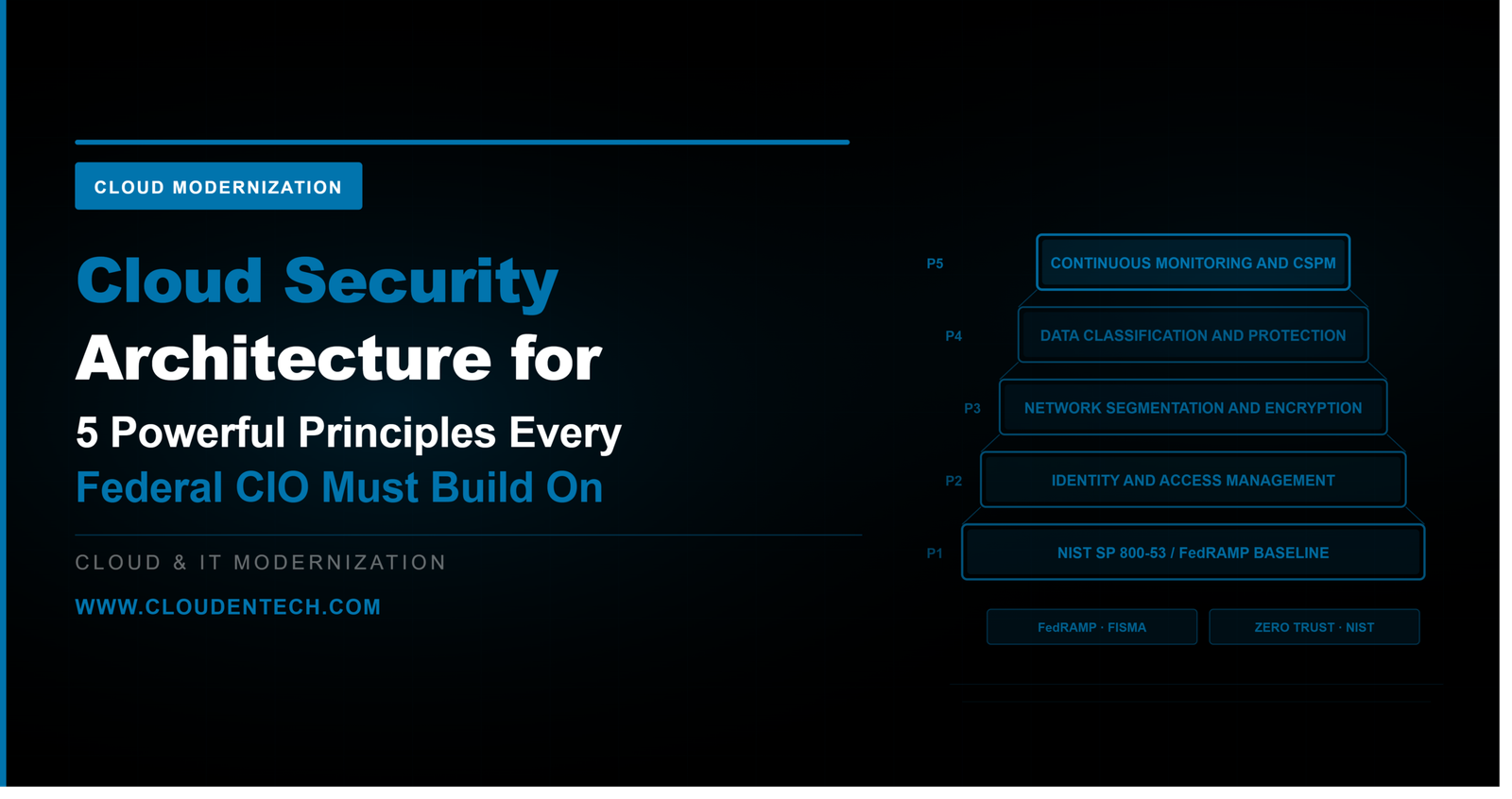
The five foundational principles are: define the authorization boundary before any other architectural decision; build identity as the primary security control plane; treat every network layer as untrusted; classify and protect data at the object level; and design continuous monitoring into the architecture from the start.
FedRAMP CR26 is the most significant overhaul of the program since it was codified into law. New Certification Classes A through D replace the Low, Moderate, and High impact level designations, and machine-readable OSCAL-format package requirements will become the expected standard with enforcement beginning January 2027.
Phishing-resistant MFA — specifically PIV credentials or FIDO2/WebAuthn protocols — is required by OMB M-22-09. SMS codes, push notifications, and authenticator app one-time passwords do not satisfy the phishing-resistant requirement regardless of how they are labeled in system documentation.
Continuous monitoring is an architectural requirement, not an operations plan. CSPM tooling, control-to-finding mapping layers, OSCAL-compatible evidence generation, and centralized logging infrastructure must all be designed into the cloud environment before authorization, not added afterward.
Authorization boundary definition must happen before infrastructure decisions. The Certification Class that applies to a workload determines the control baseline, the infrastructure requirements, and the cost and timeline of the authorization. Discovering an incorrect classification after building the environment is one of the most expensive and time-consuming mistakes in federal cloud programs.
About ClouDen Technologies
ClouDen Technologies is an SBA-certified 8(a) small business delivering cloud, cybersecurity, DevSecOps, enterprise architecture, application development, and management services to U.S. federal agencies, educational institutions, and commercial organizations. ClouDen operates under ISO 9001:2015, ISO/IEC 20000-1:2018, and ISO/IEC 27001:2022.