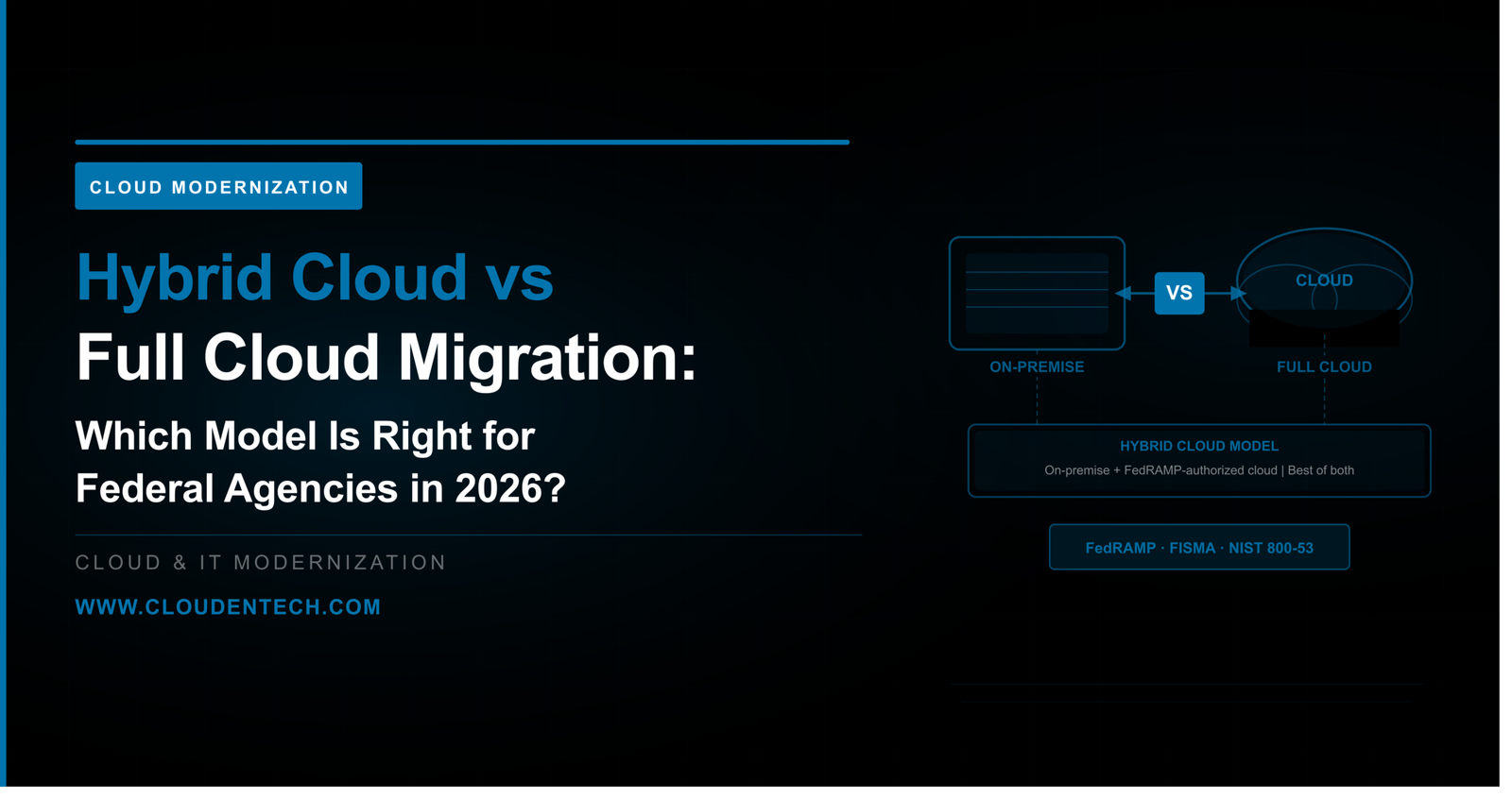
Hybrid cloud migration for federal agencies is the dominant cloud architecture in government IT in 2026 — and for good reason. Most federal agencies are not choosing between hybrid cloud and full cloud as a matter of preference. They are navigating a set of regulatory, operational, and mission-specific constraints that make the answer genuinely different for different agencies, different workloads, and different program offices within the same agency.
Hybrid and multi-cloud models now account for 53 percent of total government cloud deployments. Government agencies report an average 30 percent cost reduction after migrating legacy workloads to the cloud, and operational efficiency improved by 45 percent for departments implementing cloud automation tools. These are real, documented outcomes. But they are averages across a diverse population of agencies and workloads — and the headline number conceals the fact that the wrong migration model for a specific agency can produce the opposite results. PiTech
Federal cloud migrations are exponentially more complex than commercial cloud migrations. Government agencies must navigate FedRAMP authorization requirements, FISMA compliance, data classification and handling rules, legacy system interdependencies, and procurement regulations — all while maintaining continuity of mission-critical services. Agencies that rush to the cloud without a coherent strategy often end up with sprawling, ungoverned cloud environments paying 30 to 40 percent more than necessary while introducing new security vulnerabilities. Ignyte
This post is a practical decision framework for federal IT leaders evaluating cloud migration strategy in 2026. It covers what hybrid cloud and full cloud actually mean in a federal context, the six factors that should drive your model selection, where each approach delivers and where it fails, and what the migration execution process looks like for agencies that get it right.
What Hybrid Cloud and Full Cloud Actually Mean in a Federal Context
Before evaluating which model is right for a given agency or workload, the terms need to be defined precisely. The commercial definitions of hybrid and full cloud do not map perfectly onto the federal environment.
A hybrid cloud combines on-premise infrastructure with cloud services, allowing agencies to migrate gradually while maintaining control over sensitive workloads. For many federal organizations, especially those with legacy systems or classified environments, hybrid cloud offers a practical path to modernization without full reliance on external providers. Executive Gov
In a federal context, hybrid cloud specifically means maintaining some workloads in on-premise or agency-controlled data center environments while migrating other workloads to FedRAMP-authorized cloud platforms such as AWS GovCloud, Microsoft Azure Government, or Google Cloud for Government. The two environments operate under a unified security and governance framework, with data flows between them managed according to data classification requirements.
Full cloud migration means moving all eligible workloads off on-premise infrastructure and onto FedRAMP-authorized cloud platforms. The key word is eligible. No federal agency operates zero on-premise systems. Classified workloads, certain high-availability mission systems, and applications with specific latency or data residency requirements will remain on-premise or in government-controlled facilities regardless of the agency’s broader cloud strategy. Full cloud migration is really full cloud migration for unclassified, non-mission-critical workloads — not a complete elimination of physical infrastructure.
FedRAMP applies only to cloud components within a hybrid architecture. The hardware, devices, and operating systems of on-premises systems remain outside FedRAMP scope but still require authorization packages that cover physical devices. Agencies must balance on-premises systems with FedRAMP cloud capabilities, which creates unique challenges for security teams. Lazarusalliance
Understanding this boundary is critical. An agency that treats its hybrid environment as two separate compliance programs — one for cloud, one for on-premise — will create security gaps at the integration points between them. A well-designed hybrid architecture applies consistent security governance across both environments, with the cloud components meeting FedRAMP requirements and the on-premise components meeting the equivalent federal security standards.
The Federal Cloud Landscape in 2026
The policy environment governing federal cloud strategy is clear and has been stable for several years. The Cloud Smart policy, which succeeded the earlier Cloud First mandate, directs agencies to evaluate cloud options based on security, procurement, and workforce considerations rather than defaulting to cloud adoption without analysis. That framework remains in effect.
FedRAMP authorization, NIST 800-53 control families, and the federal move toward Zero Trust architecture all assume a level of automation, telemetry, and control granularity that is difficult to achieve on legacy infrastructure. Modern cloud platforms provide these capabilities natively and are audited against the same frameworks. This is the strongest argument for cloud migration in any form. The security architecture that federal mandates require is more achievable, more cost-effective, and more continuously maintainable on modern cloud platforms than on aging on-premise infrastructure. FedRAMP
Cloud migration is the number two IT priority for CIOs in 2026, behind only cybersecurity. By 2028, 75 percent of enterprise workloads will be in cloud or edge environments, up from 52 percent in 2024. For federal agencies, this trajectory is further accelerated by zero trust mandates, FedRAMP 20x modernization, CMMC compliance requirements, and the AI and analytics workloads that require the compute elasticity and data platform capabilities that cloud provides far more efficiently than on-premise infrastructure. Carahsoft
The CDC has embraced the notion that it will have legacy workflows that must reside on-premise, meaning it will perpetually live in some level of hybrid cloud. In that space, the agency works to solve long-standing legacy technical debt problems while modernizing workloads and applications that were historically built in silos into more enterprise-level platforms that enable data sharing, visualization, and faster decision-making. The CDC’s experience is representative. For most large federal agencies, hybrid cloud is not a temporary transitional state on the way to full cloud. It is the target architecture — a permanent design that allocates workloads to the environment best suited to their requirements. FedRAMP
6 Powerful Factors That Determine Your Agency’s Right Cloud Model
Factor 1: Data Classification and Sensitivity
The single most deterministic factor in federal cloud migration decisions is how data is classified. This is not a preference or a policy choice. It is a legal and regulatory constraint that governs where specific categories of data can reside.
Unclassified data that does not involve Controlled Unclassified Information, personally identifiable information, or protected health information has the widest range of cloud placement options, including commercial cloud platforms with FedRAMP Moderate authorization. CUI requires FedRAMP Moderate at minimum, with specific handling, access control, and audit logging requirements that must be satisfied at the cloud platform level. Classified data at any level requires government-controlled infrastructure and is not eligible for commercial public cloud deployment regardless of authorization status.
Workloads subject to strict data residency regulations, systems with rigid on-premises licensing structures, and legacy applications that would require significant refactoring to run in the cloud are typically good candidates for remaining on-premises. The decision should be based on a structured workload assessment, not default assumptions. FedRAMP
For agencies with a mixed data portfolio — which describes virtually every federal agency — a hybrid model is almost always the appropriate architecture. The question is how the boundary between on-premise and cloud environments is designed, governed, and secured.
Factor 2: Mission-Critical System Availability Requirements
Some federal systems have availability requirements that are difficult or impossible to guarantee over a commercial cloud connection. Real-time operational systems, systems that must function in disconnected or denied network environments, and systems supporting time-sensitive physical operations may require on-premise deployment regardless of other factors.
Agencies that manage sensitive information are still required to maintain on-premises systems, resulting in complex hybrid IT infrastructures that span both on-premises and cloud environments. The ideal hybrid IT infrastructure for the federal government should seamlessly integrate on-premises systems with secure, scalable cloud services. FedRAMP
This does not mean these systems cannot benefit from cloud services. Hybrid architectures frequently pair on-premise operational systems with cloud-based analytics, reporting, backup, and collaboration platforms. The mission-critical operational core stays on-premise where availability can be guaranteed under all network conditions. The supporting functions that benefit from cloud scale, elasticity, and modern tooling move to FedRAMP-authorized cloud environments.
Factor 3: Legacy System Interdependencies
Legacy system complexity is the most common source of migration budget overruns and timeline failures in federal cloud programs. Legacy applications carry invisible dependencies: database calls, shared file systems, network paths that surface only at cutover. 47 percent of migration delays trace directly to undiscovered legacy dependencies. FedRAMP
For agencies with deeply interconnected legacy environments, attempting to migrate everything to full cloud simultaneously creates an extremely high-risk program with complex cutover scenarios and significant probability of mission disruption. A phased hybrid approach — identifying which applications can be migrated cleanly, migrating those first, and systematically addressing legacy dependencies before migrating dependent applications — dramatically reduces risk and produces early wins that build organizational confidence and momentum.
Data from the Public Sector Cloud Adoption 2025 report shows agencies actually become more optimistic the further along they are in their hybrid cloud journey. The single biggest determining factor of how optimistic respondents feel about moving to the cloud is how far along they are in their cloud journey — the farther along they go, the more optimistic they seem to feel, and the easier things seem to get. Secureframe
Factor 4: FedRAMP Compliance Architecture
Cloud-only deployments can reduce costs by 20 percent and simplify compliance through unified security management, streamlined documentation, and inheritance of controls from FedRAMP-authorized providers. This is a genuine advantage of full cloud migration for eligible workloads. FedRAMP-authorized cloud platforms carry inherited controls that agencies can leverage directly in their authorization packages, significantly reducing the documentation and assessment burden compared to managing an equivalent on-premise system. Lazarusalliance
However, the compliance advantage of full cloud only materializes when the workloads being migrated are fully compatible with FedRAMP-authorized platforms. When hybrid environments are unavoidable, agencies must design a unified compliance framework that addresses both the FedRAMP cloud components and the on-premise systems under a coherent authorization boundary. Splitting compliance management across two separate programs without integrating them creates the gaps that auditors and Authorizing Officials find.
Any cloud service provider used by a federal agency to process, store, or transmit federal data must be FedRAMP authorized. The FedRAMP Marketplace lists all authorized services, and agencies should select cloud service providers from this marketplace whenever possible. The Marketplace also allows agencies to leverage existing authorizations through FedRAMP’s use-once, authorize-once model, reducing the time to authorization for cloud services that other agencies have already authorized. Ignyte
Factor 5: Workforce Capability and Change Management
Cloud migration strategy must account for the workforce that will operate the resulting environment. A technically optimal cloud architecture that the agency’s IT staff cannot effectively manage and secure creates operational risk that outweighs the architectural benefits.
Not every workload belongs in the cloud. Agencies that rush to the cloud without a coherent strategy often end up with sprawling, ungoverned cloud environments. The primary cause of ungoverned cloud sprawl is not architectural failure. It is workforce capability gaps — IT teams that were not equipped with the skills, tools, and processes to manage cloud environments at the governance level that federal security requirements demand. Ignyte
A hybrid migration approach allows agencies to build cloud operations capabilities incrementally, starting with workloads where the risk of misconfiguration is lowest, developing the monitoring, access control, and continuous compliance practices that cloud operations require, and expanding cloud scope as internal capability matures. Full cloud migration that outpaces the agency’s workforce development creates exactly the security and governance gaps it was intended to close.
Factor 6: Total Cost of Ownership Over the Mission Lifecycle
Cloud migration is frequently justified on cost reduction grounds, and the projected savings are often real. Organizations that conduct a formal readiness assessment before migrating have 2.4 times higher success rates, and 65 percent of cloud migrations are completed on time and within budget — up from 54 percent in 2022 as tools and methodologies mature. The organizations that miss their budget and timeline targets are those that did not do the readiness work first. Carahsoft
38 percent of cloud migration projects exceed budget, with an average overrun of 23 percent. For federal agencies operating under fixed appropriations, a 23 percent budget overrun on a cloud migration program is not recoverable within the fiscal year. It typically requires reprogramming, delays to other IT investments, and in some cases mission disruption. The right cloud model is not the one that looks cheapest in the initial business case. It is the one that can be executed within the agency’s actual budget, workforce, and timeline constraints. FedRAMP
The total cost of ownership analysis must include not just the cloud platform costs but the migration labor, application refactoring, training, governance tooling, and ongoing operational costs of managing the cloud environment over the full mission lifecycle.
When Hybrid Cloud Is the Right Answer
Hybrid cloud is the right model for federal agencies when classified or highly sensitive workloads must remain on-premise by law or policy, when mission-critical systems require guaranteed availability independent of network connectivity, when legacy system complexity makes phased migration significantly safer than full migration, when the agency’s workforce capability requires incremental cloud operations development, and when workload-specific requirements — latency, data residency, licensing, or operational technology — make cloud placement inappropriate for specific systems.
This describes the majority of large federal agencies in 2026. The CDC, the Department of Defense, the Department of Homeland Security, and most CFO Act agencies operate in permanent hybrid architectures by design, not by default or indecision. Their hybrid environments are managed, governed, and continuously improved — not a temporary state awaiting full cloud migration.
When Full Cloud Migration Makes More Sense
Full cloud migration — meaning migration of all eligible unclassified workloads to FedRAMP-authorized cloud platforms — is the right answer when the agency’s workload portfolio consists primarily of unclassified, non-mission-critical applications without deep legacy interdependencies, when the agency has the workforce and governance capability to manage a cloud-native environment from day one, when unified FedRAMP compliance management provides a significant documentation and assessment burden reduction, and when cost and operational efficiency targets require the elimination of on-premise infrastructure maintenance overhead.
Smaller federal agencies, program offices within larger agencies, and government entities whose core functions involve information management and service delivery rather than classified or operational technology environments are the best candidates for full cloud migration of eligible workloads.
The Migration Execution Framework That Determines Success
Regardless of which model an agency chooses, the execution methodology is where most federal cloud migrations succeed or fail.
A workload assessment is the non-negotiable starting point. Every application and dataset must be evaluated against a consistent framework that classifies it by data sensitivity, availability requirements, legacy dependencies, refactoring complexity, and compliance requirements. This assessment produces the migration sequence — which workloads move first, which move in later waves, and which remain on-premise — and it must be completed before any migration work begins.
Architecture design comes next. The target state architecture — whether hybrid or full cloud — must be fully specified before workloads begin moving. This includes the network architecture connecting on-premise and cloud environments, the identity and access management framework that governs both, the monitoring and logging infrastructure that provides security visibility across the full environment, and the FedRAMP authorization boundary that defines what is in scope for each authorization package.
Phased migration execution follows the architecture. Moving workloads in prioritized waves — starting with low-complexity, low-sensitivity applications and progressing to more complex workloads as migration capability matures — reduces risk, creates early value, and builds the organizational confidence that sustains a multi-year modernization program.
Continuous monitoring and governance closes the loop. A migrated environment that is not actively monitored, continuously assessed against its FedRAMP authorization baseline, and regularly reviewed for misconfiguration drift is not a compliant environment. It is a compliant environment on paper that is accumulating risk in production.
How ClouDen Technologies Supports Federal Cloud Migration
At ClouDen Technologies, our cloud solutions practice delivers cloud architecture, cloud advisory, cloud migration, and cloud security services designed specifically for the federal compliance environment. We support agencies evaluating hybrid versus full cloud migration through structured workload assessments, FedRAMP-aligned architecture design, and phased migration execution that maintains mission continuity throughout the transition.
Our cloud advisory services help agencies make the model selection decision with full transparency into the technical, compliance, and operational implications of each path. We do not recommend cloud models based on vendor preference or platform partnerships. We recommend them based on a rigorous analysis of the agency’s workload portfolio, workforce capability, compliance requirements, and mission priorities.
Our enterprise architecture practice designs the IT infrastructure frameworks that make hybrid environments work as unified, governed architectures rather than two separate IT programs operating in parallel. Our cybersecurity services ensure that the security architecture of the migrated environment satisfies both FedRAMP authorization requirements and the zero trust mandates that apply to federal agencies in 2026. Our DevSecOps practice supports application refactoring and cloud-native development for workloads that require modernization as part of the migration process.
As an SBA-certified 8(a) small business with over 20 years of federal IT experience and ISO 27001:2022, ISO 9001:2015, and ISO/IEC 20000-1:2018 certifications, we bring the governance discipline and federal compliance expertise that cloud migration programs require. We have delivered cloud modernization work for agencies including the U.S. Department of the Interior and the Federal Reserve Board — environments where mission continuity, security, and compliance are non-negotiable throughout every phase of the transition.
If your agency is evaluating cloud migration strategy, choosing between hybrid and full cloud models, or building the architecture for a FedRAMP-authorized cloud environment, contact ClouDen Technologies today.
Key Takeaways
Hybrid cloud migration for federal agencies is the dominant architecture in government IT in 2026, accounting for 53 percent of total government cloud deployments. It is the right model for most large federal agencies operating classified workloads, mission-critical systems, or complex legacy environments.
Full cloud migration of eligible unclassified workloads is appropriate for agencies with simpler, non-mission-critical portfolios and the workforce capability to manage cloud-native environments from day one.
The six factors that determine the right model are data classification requirements, mission-critical system availability requirements, legacy system interdependency complexity, FedRAMP compliance architecture implications, workforce capability and change management capacity, and total cost of ownership over the mission lifecycle.
Agencies that conduct a formal workload readiness assessment before migrating have 2.4 times higher migration success rates. 47 percent of migration delays trace directly to undiscovered legacy dependencies found only at cutover.
FedRAMP applies only to the cloud components of a hybrid architecture. On-premise systems within a hybrid environment require their own authorization packages and must be governed under a unified security framework alongside the cloud components to avoid compliance gaps at the integration boundary.
Cloud migration is the number two IT priority for federal CIOs in 2026. Agencies that build a coherent migration strategy aligned to their workload portfolio, compliance requirements, and workforce capabilities will achieve the efficiency and security improvements the data shows are achievable. Those that rush without a strategy will spend more than planned and introduce the vulnerabilities they were trying to close.
About ClouDen Technologies
ClouDen Technologies is an SBA-certified 8(a) small business delivering cloud, cybersecurity, DevSecOps, enterprise architecture, application development, and management services to U.S. federal agencies, educational institutions, and commercial organizations. ClouDen operates under ISO 9001:2015, ISO/IEC 20000-1:2018, and ISO/IEC 27001:2022.