Zero trust security for federal agencies is no longer a planning conversation. It is an active, funded, and measured government-wide mandate — and in 2026, agencies are being held accountable for how far along their implementation actually is, not just whether they submitted a plan.
OMB Memorandum M-22-09, Moving the U.S. Government Toward Zero Trust Cybersecurity Principles, set a federal zero trust architecture strategy requiring agencies to meet specific cybersecurity standards and objectives by the end of FY 2024, with the goal of reinforcing government defenses against increasingly sophisticated and persistent threat campaigns targeting federal technology infrastructure. That deadline has passed. Now the question is maturity, not intent. CAL IT Group
OMB M-22-09 itself remains in effect. The follow-up FY 2025 guidance, issued as OMB M-25-04 in January 2025, explicitly directs agencies to continue maturing their zero trust architectures and increasing the deployment of critical security tools. OMB Memorandum M-24-14, released in July 2024, set zero trust maturation as one of the FY 2026 budget cybersecurity priorities for federal agencies. SBA
This is not a policy that winds down. It is a baseline that raises. Agencies that treated FY 2024 as a finish line are already behind. And for the agency IT leaders, security architects, and contractor partners responsible for delivering real security outcomes in this environment, understanding what zero trust actually requires across all five pillars — and where the hardest implementation gaps remain — is the most important operational knowledge they can have right now.
This post covers what zero trust architecture means in the federal context, where agencies stand in 2026, what each of the five pillars requires in practice, the implementation gaps that remain the most difficult to close, and how to build the security architecture that survives both audit scrutiny and real-world adversaries.
What Zero Trust Architecture Actually Means
The phrase zero trust gets used loosely enough that it has become nearly meaningless in some vendor conversations. In the federal context, it has a precise definition rooted in a specific set of directives, frameworks, and measurable outcomes.
Zero trust has emerged as not merely a compliance requirement but a fundamental paradigm shift. For public sector cybersecurity leaders, adopting a zero trust model means embedding cyber risk management into an agency’s DNA, transcending traditional approaches that rely heavily on perimeter defenses. U.S. Small Business Administration
The traditional model assumed that anything inside the network perimeter could be trusted. Firewalls kept threats out, and users and systems inside were assumed to be legitimate. That model has not been viable for years. Remote work, cloud adoption, mobile devices, and sophisticated adversaries who routinely operate inside network perimeters have made perimeter-based security a dangerously incomplete strategy.
Zero trust is premised on the idea that no user or asset is to be implicitly trusted. Access decisions are made continuously, dynamically, and based on verified identity, device health, network context, and data sensitivity — not on network location. Built In
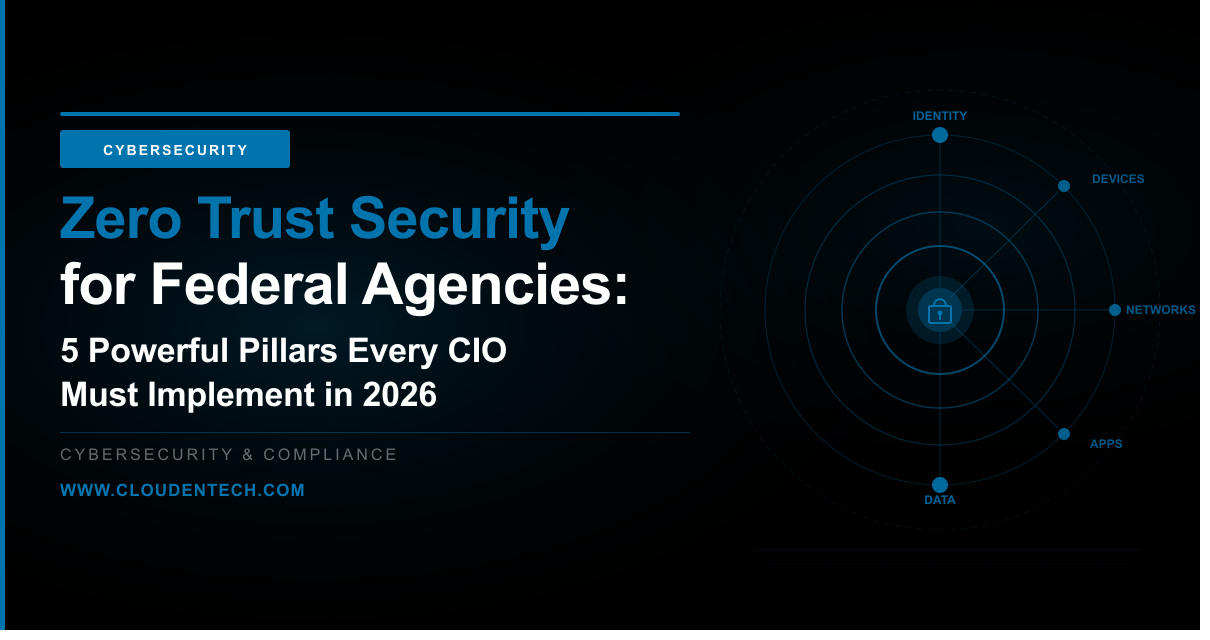
For federal agencies, this translates into a specific architectural model built around five pillars defined by CISA’s Zero Trust Maturity Model and required by OMB M-22-09. The strategic goals set forth in M-22-09 align with CISA’s five pillars: Identity, Devices, Networks, Applications and Workloads, and Data. Each pillar has specific technical requirements and measurable outcomes that agencies are expected to achieve and continuously mature. GovCon Wire
Where Federal Agencies Stand in 2026
Before examining each pillar, it is worth being honest about where implementation actually stands across the federal civilian enterprise as of May 2026.
The September 30, 2024 deadline came and went. Federal CIO Clare Martorana told a Billington Cybersecurity Summit audience that the 24 CFO Act agencies were in the high 90 percent range on completing essential ZTA elements. That is a meaningful achievement across a large and complex enterprise. However, percentage completion of initial requirements is not the same as operational zero trust maturity. U.S. GAO
CISA published a formal Zero Trust Architecture Implementation report on January 29, 2025, walking through agency progress pillar by pillar. The headline takeaway was that meaningful progress had been made, especially on identity and devices, while networks and data remained the harder pillars to operationalize at scale. SBA
The overall risk reduction goals of zero trust architecture could not be achieved without an increased focus on developing and executing an effective data strategy. Those efforts will take some time to bear fruit due to the scope and complexity of the issues involved. Cloudvara
Because federal agencies have finite resources to dedicate to cybersecurity, they must focus those resources on activities such as continuing to mature zero trust architectures that are critical to mitigating cybersecurity risks. Agencies are expected to incorporate performance measurement strategies into resource requests in order to build visibility into requested activities and allow effective measurement of investments. Crunchbase
The picture in 2026 is one of real progress unevenly distributed across pillars and unevenly distributed across agencies. Identity and device controls are the most advanced. Network segmentation, application-level access controls, and data-centric security are where the most significant implementation gaps remain. These gaps are also where sophisticated adversaries are most active. The pillars agencies find hardest to implement are the pillars most worth attacking.
The 5 Pillars of Zero Trust: What Each One Requires in Practice
Pillar 1: Identity
Identity is the foundation of every zero trust architecture. In a zero trust model, identity is the new perimeter. Every user, every service account, every non-person entity that accesses a federal system must be continuously verified before access is granted, not just at login.
The federal government must improve its identity systems and access controls. As agencies adopt new infrastructure and applications, they should ensure that information is accessed by the right users, at the right time, and for the right purposes. This requires phishing-resistant multi-factor authentication that protects personnel from sophisticated online attacks. GovCon Wire
M-22-09 requires agencies to employ centralized identity management systems that can be integrated with applications and common platforms. Multi-factor authentication must be enforced at the application layer, not the network layer. The Personal Identity Verification standard and FIDO2/WebAuthn protocols are the specifically named phishing-resistant approaches the memo requires. CACI
Note the distinction that trips up many agencies. Standard MFA — SMS codes, push notifications, one-time passwords from authenticator apps — does not satisfy M-22-09’s phishing-resistant requirement. Phishing-resistant MFA refers to authentication methods that cannot be intercepted or relayed by typical phishing attacks. The memo points specifically to FIDO2/WebAuthn protocols and Personal Identity Verification credentials. SMS codes, push notifications, and one-time passwords from authenticator apps are not considered phishing-resistant under M-22-09. SBA
For agencies that have deployed standard MFA and checked the identity pillar as complete, this is a material finding that needs to be corrected. For agencies building new identity infrastructure, PIV and FIDO2 should be the only approaches considered for systems handling sensitive data.
Identity also extends beyond human users. Service accounts, APIs, automation tools, and cloud workloads all have identities that require management, least-privilege access controls, and continuous validation. Non-person entity identity management is one of the less mature areas across the federal enterprise and one of the most actively exploited attack vectors.
Pillar 2: Devices
Every device that accesses federal systems must be known, inventoried, monitored, and health-validated before it is permitted access. The federal government should have a complete inventory of every device it operates and authorizes for government use and be able to prevent, detect, and respond to incidents on those devices. Federal News Network
In practice, device pillar implementation requires an enterprise-wide asset inventory that is accurate and continuously updated, device health validation integrated into access decisions so that a compromised or out-of-compliance device is denied access regardless of valid user credentials, endpoint detection and response capabilities across all managed devices, and a defined policy for government-furnished equipment versus personal devices accessing agency systems.
Zero trust implementation guidelines published in January 2026 specifically address device health tool gap analysis, non-person entity and PKI device under management requirements, and the implementation of Comply-to-Connect frameworks as core device pillar activities. Virginia Business
The device pillar also intersects directly with supply chain security. Devices themselves — hardware and firmware — represent an attack surface that sophisticated adversaries have exploited in documented campaigns against federal networks. Zero trust device management must extend to validating not just device health at runtime but device provenance and firmware integrity.
Pillar 3: Networks
The network pillar is where zero trust diverges most sharply from traditional security architecture, and where implementation is most technically complex. The goal is to eliminate the concept of a trusted internal network entirely. No network segment, not even a classified internal network, should be trusted by default.
Technical silos between zero trust pillars create real and present danger by increasing opportunities for attackers to exploit vulnerabilities, move laterally between systems, escalate privileges, or exfiltrate data under the guise of legitimate access. Silos increase incident response time by adding complexity for security teams who must manage multiple disparate systems and tools, each with their own policies and interfaces. Federal News Network
Network segmentation under zero trust means implementing micro-segmentation that limits the blast radius of any successful intrusion, encrypting all traffic including internal traffic, implementing DNS-layer security and encrypted DNS protocols, and deploying network detection and response capabilities that identify anomalous traffic patterns in real time.
For DNS, agencies should configure endpoints to use agency-designated encrypted DNS servers. For HTTP, all agencies are required to use HTTPS for all accessible web services and APIs. HTTPS is now required for all traffic, externally facing and internally, without exception. Federal News Network
Networks and data remained the harder pillars to operationalize at scale across the federal enterprise as of the most recent CISA assessment. The technical complexity of re-architecting large, legacy federal networks around zero trust principles — while keeping mission-critical systems operational throughout the transition — is one of the most significant implementation challenges in the federal IT landscape. Legacy systems that cannot support modern encryption or segmentation protocols create persistent gaps that require architecture-level decisions, not just configuration changes. SBA
Pillar 4: Applications and Workloads
The applications and workloads pillar addresses how software systems expose functionality to users and other systems, and how access to that functionality is controlled at the application layer rather than the network layer.
In a zero trust model, applications do not trust the network they run on. Every request to an application is authenticated and authorized individually, with access decisions made based on user identity, device health, and the sensitivity of the specific resource being accessed — not on whether the request originated from inside a trusted network segment.
Agencies should implement zero trust principles first on FISMA Low systems before attempting to meet requirements for FISMA Moderate systems, building confidence in controls and processes progressively as architecture matures. This is sound practical guidance that acknowledges the reality of incremental implementation across a complex enterprise. GovCon Wire
Application-level zero trust also requires that agencies have a comprehensive understanding of their internet-accessible assets. In practice, it can be very challenging for a large, decentralized organization to track every asset reliably. For agencies to maintain a complete understanding of what internet-accessible attack surface they present, continuous discovery and inventory of internet-accessible assets is required. GovCon Wire
This pillar connects directly to DevSecOps practices. Applications built with security embedded throughout the development lifecycle — with automated scanning, continuous monitoring, and secure-by-design architecture — are significantly easier to integrate into a zero trust model than applications built under traditional development approaches. Agencies that have invested in DevSecOps programs will find the applications and workloads pillar considerably more tractable than those still running legacy, perimeter-dependent applications.
Pillar 5: Data
The data pillar is the most strategically important and the least operationally mature across the federal enterprise. Identity, devices, networks, and applications all exist to protect data. A zero trust architecture that controls access at every other layer but lacks a coherent data strategy has not achieved its fundamental objective.
Fewer resources were available to address the capabilities of the data pillar across the federal civilian enterprise. The overall risk reduction goals of zero trust architecture could not be achieved without an increased focus on developing and executing an effective data strategy. Cloudvara
Data pillar implementation requires agencies to classify and categorize their data assets so that access policies can be applied based on data sensitivity, not just user role. It requires data loss prevention controls that monitor and restrict how sensitive data moves within and outside agency environments. It requires encryption of data at rest and in transit across all systems, with key management practices that meet federal standards. And it requires the visibility and analytics capabilities that allow security teams to detect anomalous data access patterns before they result in exfiltration.
Agencies can plan for opportunities to coordinate capabilities across the pillars to enable granular, least-privilege access controls and mitigate additional risks. Data classification drives the granularity of access decisions across every other pillar. An agency that has not built a coherent data classification and governance program cannot implement truly risk-appropriate access controls, regardless of how mature its identity or device capabilities are. Built In
For agencies operating under FISMA, FedRAMP, and federal data governance requirements, the data pillar also intersects with a large body of existing policy that must be unified into a coherent zero trust data strategy rather than treated as separate compliance streams.
The Three Cross-Cutting Capabilities That Make All Five Pillars Work
Cutting across all five pillars are three capabilities that every pillar depends on: visibility and analytics, automation and orchestration, and governance. You cannot defend what you cannot see, you cannot scale zero trust without automation, and none of it sticks without governance to enforce it. SBA
Visibility and analytics means having the logging, monitoring, and analysis capabilities to see what is happening across all five pillar domains in real time. Security information and event management systems, endpoint detection and response platforms, network detection and response tools, and cloud security posture management solutions all contribute to the visibility fabric that zero trust requires. Without comprehensive visibility, access decisions cannot be made in real time, anomalous behavior cannot be detected, and incidents cannot be investigated effectively.
Automation and orchestration addresses the operational reality that zero trust generates more security events, more access decisions, and more policy enforcement activity than traditional perimeter-based architectures. Machine learning models can assist with data sensitivity categorization and security automation, though any automated actions should first be implemented in report-only mode before enforcement to validate accuracy and reduce false positives. The volume of access decisions a mature zero trust architecture generates cannot be managed manually. Automation is not optional at scale. GovCon Wire
Governance means having the policy framework, accountability structures, and ongoing measurement capabilities that keep zero trust implementation aligned with agency mission requirements. Technical silos created when individual project teams design zero trust architecture for a given pillar without cross-pillar coordination lead to controls that do not communicate or interact across pillars — creating security gaps that adversaries can exploit to move laterally between systems. Governance prevents those silos from forming in the first place and corrects them when they do. Federal News Network
The Hardest Implementation Challenges in 2026
Understanding where agencies most commonly struggle helps IT leaders prioritize their investments and avoid the mistakes that slow progress or create false confidence in incomplete implementations.
Legacy system integration is the single most cited barrier to zero trust maturity. Many federal agencies run mission-critical applications on infrastructure that predates modern authentication protocols, cannot support encrypted communications, and was never designed for the continuous verification model zero trust requires. Some agencies will continue to face problems with advancing on zero trust as long as they are running legacy IT architecture, especially on critical systems. There needs to be resources put into helping migrate and rearchitect these legacy systems. Zero trust does not fix legacy infrastructure. It surfaces the risk that legacy infrastructure creates, and forces the architectural decisions that modernization requires. GovCon Digest
Cross-pillar integration is the second major challenge. A user might be authenticated at login through the identity pillar, but during their active session, the user’s laptop or mobile device might become compromised through the devices pillar. Because there has not been a unifying set of controls between identity and devices, the system may not revoke or adjust the user’s access permissions dynamically. True zero trust maturity requires that decisions made in one pillar influence access enforcement in all others in real time. Building that integration across disparate vendor tools, legacy systems, and distributed agency environments is architecturally complex and organizationally difficult. Federal News Network
Data classification at scale remains an unsolved problem for many agencies. You cannot apply data-sensitive access controls without knowing what data you have, where it lives, and how sensitive it is. For large agencies with decades of accumulated data across hundreds of systems, building that inventory and classification is a multi-year program, not a project.
How ClouDen Technologies Supports Zero Trust Implementation
At ClouDen Technologies, our cybersecurity services are designed around the NIST, FedRAMP, and FISMA frameworks that underpin federal zero trust requirements. We support agencies and government contractors across the full zero trust implementation lifecycle — from architecture assessment and security design through cloud security implementation, access control engineering, continuous monitoring, and risk management.
Our cloud solutions practice directly supports the network and applications pillars of zero trust by designing secure, FedRAMP-aligned cloud environments built around zero trust principles from the architecture stage. We do not retrofit security onto cloud systems after the fact. We build it in from the start, producing environments that satisfy both zero trust requirements and authorization-to-operate standards simultaneously.
Our enterprise architecture services address the cross-pillar integration challenge that is the most common source of zero trust implementation gaps. We design IT infrastructure frameworks where identity, device, network, application, and data controls are engineered to work together, eliminating the technical silos that create exploitable gaps between pillar implementations.
Our DevSecOps practice ensures that the applications agencies build and operate are designed for the applications and workloads pillar from day one, with continuous security scanning, secure-by-design architecture, and the automated compliance evidence generation that zero trust governance requires.
As an SBA-certified 8(a) small business operating under ISO 27001:2022 information security certification, ISO 9001:2015 quality management certification, and ISO/IEC 20000-1:2018 IT service management certification, we bring the governance discipline that federal zero trust programs require — not just the technical capability.
We have delivered mission-critical security and IT modernization work for the U.S. Department of the Interior, the Federal Reserve Board, and the Defense Finance Agency. These are environments where security failures have real consequences, and where the discipline of zero trust is not a compliance aspiration but an operational necessity.
If your agency is assessing its zero trust maturity, addressing implementation gaps in specific pillars, or building the security architecture for a new cloud environment or application modernization program, contact ClouDen Technologies today.
Key Takeaways
Zero trust security for federal agencies is an active, funded, and measured mandate under OMB M-22-09, OMB M-25-04, and OMB M-24-14. The FY 2024 deadline established a baseline. Agencies are now expected to continuously mature their implementations across all five pillars.
Meaningful progress has been made on the identity and devices pillars across the federal civilian enterprise. Networks and data remain the hardest pillars to operationalize at scale and represent the most significant remaining implementation gaps.
Phishing-resistant MFA under M-22-09 specifically requires PIV credentials or FIDO2/WebAuthn protocols. SMS codes, push notifications, and standard authenticator app one-time passwords do not satisfy the requirement, regardless of how they are labeled in agency documentation.
Cross-pillar integration is the most technically complex challenge in zero trust implementation. Controls that do not communicate across pillars create lateral movement opportunities that sophisticated adversaries actively exploit.
The three cross-cutting capabilities — visibility and analytics, automation and orchestration, and governance — are not optional additions to a zero trust program. They are the operational infrastructure that makes all five pillars function as a unified security architecture rather than five separate compliance tracks.
Legacy system integration and data classification at scale are the two implementation challenges most likely to create timeline risk for agencies pursuing zero trust maturity in 2026 and beyond.
About ClouDen Technologies
ClouDen Technologies is an SBA-certified 8(a) small business delivering cloud, cybersecurity, DevSecOps, enterprise architecture, application development, and management services to U.S. federal agencies, educational institutions, and commercial organizations. ClouDen operates under ISO 9001:2015, ISO/IEC 20000-1:2018, and ISO/IEC 27001:2022.